pomelo pith
ingredient / ingredient-pomelo-pith
ザボンの白皮 / Citrus grandis (L.) Osbeck
Pomelo albedo (the white mesocarp). Quantification of naringin and limonin, debittering, and sensory evaluation were addressed in the same study.
Photographs (captions in Japanese)
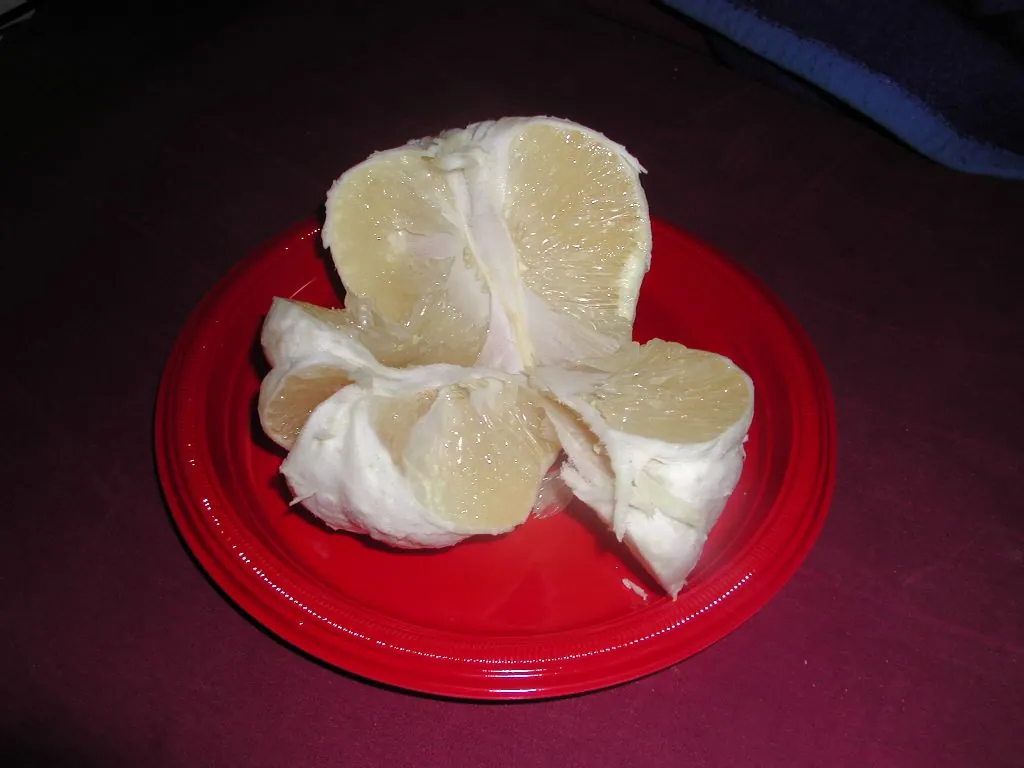
Fruit of the pomelo (zabon). The flesh in segments is surrounded by a thick white rind (mesocarp). The source page does not give a scientific species name and lists it only under the common name pomelo.
Shown: Citrus maxima (the source says pomelo; no scientific name is given in the source)Part / state: The fruit split open and the flesh taken out. The thick white mesocarp (albedo, the so-called white pith) surrounding the flesh segments is visible
Photo: Allen Timothy Chang (Allentchang, English Wikipedia) / CC BY-SA 3.0 / original image / ledger's original image
Scope and provenance of the photo
Identification: Identified as labelled in the source. The source page describes the subject only as "pomelo" and gives no scientific species name. Re-identification by a specialist has not been done.
Image shown: The full-size version from Wikimedia Commons. No cropping or color changes by NIGAMI LAB. For display, a WebP capped at 1200 px wide is served; the ledger's original image can be checked from the link above.
On this page (8 sections)
Reading the bitterness
Pomelo white peel (albedo, the white part of the mesocarp) is an ingredient for which the contents of naringin and limonin, known bitter constituents, processing to reduce them, and sensory evaluation were addressed in the same paper. A 2025 study tested conditions combining β-cyclodextrin, a cyclic sugar compound, with ultrasound treatment on the albedo of the Kao Nampung variety of pomelo. Untreated albedo contained 18.90 naringin and 0.2907 limonin (both mg/g dry weight), but after treatment combining 0.7% β-cyclodextrin and ultrasound, these were measured at 5.1395 and 0.0776, respectively.
The same study also reports bitterness ratings (the number and training of the assessors are not stated in the methods; the 15 people were participants in a separate post-meal test) and concludes that processing reduced bitterness, stating that the lowest rating for treated samples was 1.31. However, although the sensory-methods section is supposed to use a scale from 0 (no bitterness) to 5 (very strong), the value shown in the table for the untreated sample is 7.20, above the scale maximum. The paper itself cannot establish which is correct, the methods description or the table value; although the direction of reduced bitterness can be read, the absolute value of how much it fell must remain on hold. The chemical quantification values for naringin and limonin can be read separately from this internal inconsistency in the sensory evaluation.
Sources for this overview
Postprandial Glucose Reduction by Pomelo Albedo Treated with β-Cyclodextrin and Ultrasound
Checked for this overview: The range in which the naringin and limonin concentrations before and after treatment were confirmed. / The range in which the report of the minimum post-treatment bitterness rating of 1.31 by a 15-person panel was confirmed. / The range in which the internal inconsistency between the 0-5 scale and the untreated value of 7.20 was confirmed.
Follow the connections
pomelo pith →is reduced by→ pomelo albedo β-cyclodextrin ultrasound treatment →reduces→ bitterness
Measured values (4)
| Kind | Compound | Target | Value | Conditions | Source |
|---|---|---|---|---|---|
| concentration | naringin | pomelo pith | 18.90 mg/g DW | Untreated Kao Nampung pomelo albedo (Table 3。) | Jaroennon Pattamaporn, 2025 |
| concentration | naringin | pomelo pith | 5.1395 mg/g DW | 0.7% β-CD plus ultrasonic treatment (Table 3。) | Jaroennon Pattamaporn, 2025 |
| concentration | limonin | pomelo pith | 0.2907 mg/g DW | Untreated Kao Nampung pomelo albedo (Table 3。) | Jaroennon Pattamaporn, 2025 |
| concentration | limonin | pomelo pith | 0.0776 mg/g DW | 0.7% β-CD plus ultrasonic treatment (Table 3。) | Jaroennon Pattamaporn, 2025 |
Values are the reported values of each source (with units and conditions). Thresholds and EC50 depend on the panel and method; they are not single true values.
Hypotheses and recipe candidates for this entry are on the Japanese page.
Structured claims — open a section to read each claim's confidence, evidence and limits
Sensory (2)
Scope: A comparison of bitterness scores of pomelo albedo powder by treatment condition. The number and training of the assessors are not stated in the methods (the 15 people were participants in a separate post-meal test)
Note: The methods describe a 0-5 scale, but the untreated value in Table 3 is 7.20. The direction is reported, but there is an internal inconsistency in the numeric scale. External audit N3 (2026-10-20): the "15-member trained panel" confused the sensory panel with the number of participants in the blood glucose test, so it was corrected.
Show data
ingredient-pomelo-pith —has_perceived_bitterness_suppressed_by→ process-pomelo-cyclodextrin-ultrasoundScope: An internal cross-check between the text and tables of Jaroennon et al. 2025
Note: The inconsistency itself is recorded here. No correction has been confirmed.
Show data
ingredient-pomelo-pith —has_methodological_limitation→ (the claim sentence above)How processing and cooking change it (1)
Scope: Kao Nampung pomelo albedo, 0.7% β-CD combined with ultrasound processing
Note: The chemical quantification of naringin and limonin is consistent with the methods and tables. Health-effect claims are not adopted.
Show data
ingredient-pomelo-pith —is_reduced_by→ process-pomelo-cyclodextrin-ultrasound