grapefruit juice
ingredient / ingredient-grapefruit-juice
グレープフルーツジュース / Citrus paradisi
Grapefruit juice is a citrus juice in which slight bitterness accompanies sweetness and acidity. Studies of removing naringin and limonin show that reducing bitterness can also change aroma and liking.
Photographs (captions in Japanese)
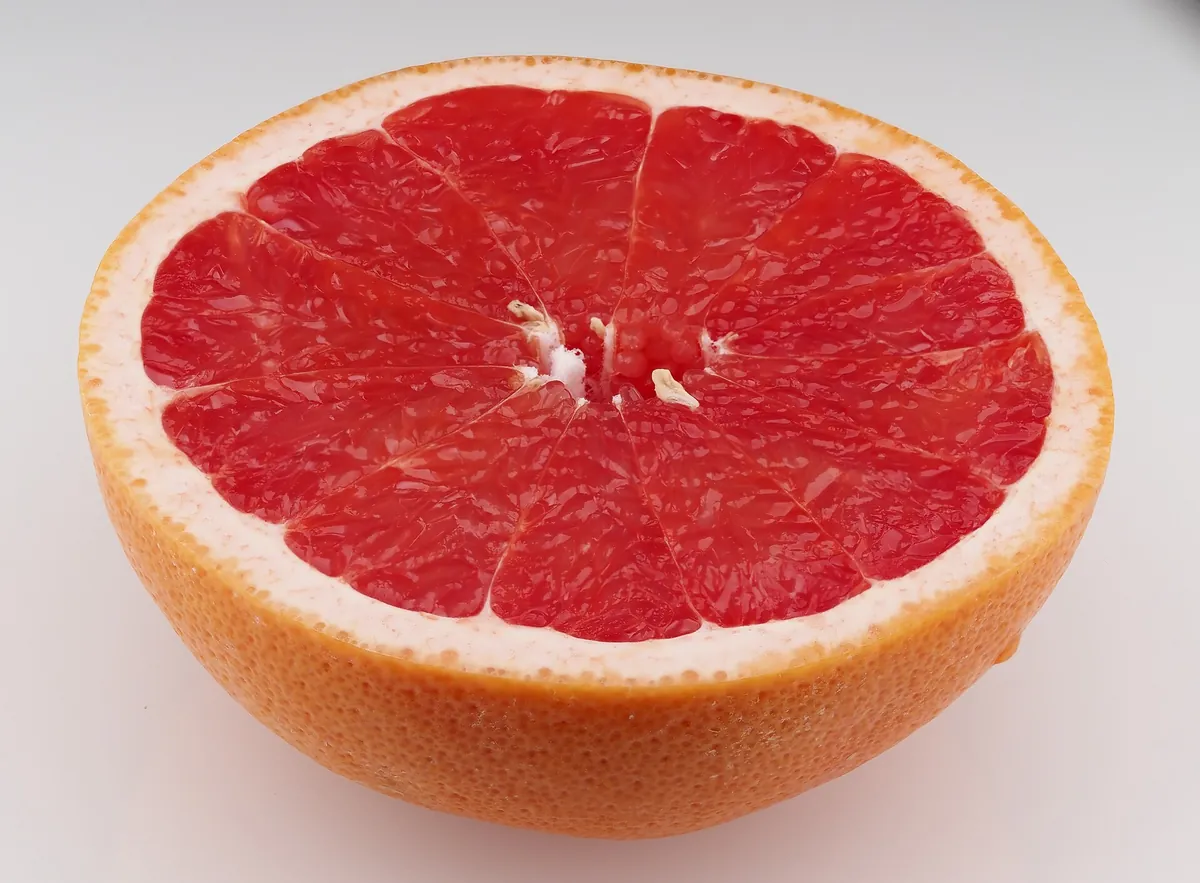
A cross-section of the fruit used as the raw material for grapefruit juice. The white albedo and segment membranes surrounding the flesh can also be seen. The cultivar and how the juice is made cannot be determined from this photograph.
Raw materialShown: grapefruit (species and cultivar not stated in the source)Part / state: Fruit cut in half crosswise
Photo: Jedesto / CC BY-SA 4.0 / original image / ledger's original image
Scope and provenance of the photo
Identification: Identified as labelled in the source. Its relation to the encyclopedia entry is as raw material, not the juice itself.
Image shown: The 1920 px version from Wikimedia Commons. The original image is a composite of 6 focus-stacked frames. No additional processing by NIGAMI LAB. For display, a WebP capped at 1200 px wide is served; the ledger's original image can be checked from the link above.
On this page (7 sections)
Reading the bitterness
The photo shows a cross-section of the fruit, but this entry concerns the juice pressed from it. Besides the pulp's sweetness and acidity, components abundant in the membranes enclosing the segments and the white albedo inside the peel can enter the juice during pressing and shape its slight bitterness. Debittering studies have mainly targeted naringin, a flavonoid glycoside, and limonin, a limonoid. These two components do not belong to the same chemical pathway and must be tracked separately during processing.
Reducing bitterness does not remove just one element of flavor. A study combining immobilized enzymes with an adsorbent reduced naringin and limonin, but conducted no sensory panel. In a separate resin study, aroma compounds were also adsorbed, and in a consumer test, partially debittered juice was preferred most over completely debittered juice. The amount of bitterness removed and how good the drink tastes are not the same measure.
Even for the same juice, liking varies among drinkers. A study of 246 adults associated perception of quinine bitterness and recalled liking for unsweetened grapefruit juice with genetic variants near TAS2R31. The participants rated a remembered preference, however, rather than juice tasted at the time, and nearby variants may be linked. The result does not show that preference is determined by one particular gene alone.
Sources for this overview
Checked for this overview: Clarified naringin's transfer from membranes and albedo into juice and its immediate bitterness. / A debittering study that targeted both naringin and limonin. / Component reduction using immobilized enzymes and an adsorbent, with the limitation that no sensory evaluation was conducted.
Sorption of citrus flavour compounds on XAD-7HP resin during the debittering of grapefruit juice
Checked for this overview: A study in which resin co-adsorbed naringin and some volatile aroma compounds.
Checked for this overview: A consumer test that preferred partial debittering most over complete debittering.
Quinine Bitterness and Grapefruit Liking Associate with Allelic Variants in TAS2R31
Checked for this overview: A study of the association among quinine bitterness, recalled juice liking, and genetic variation.
Follow the connections
grapefruit juice →has liking associated with→ TAS2R31
grapefruit juice →— perceived bitterness is s…→ naringin →is associated with→ bitterness
Structured claims — open a section to read each claim's confidence, evidence and limits
Sensory (4)
Scope: 246 adults (mostly of European ancestry). Recalled liking of unsweetened grapefruit juice was rated on a bipolar hedonic scale
Note: A parallel association was seen with quinine bitterness (21.5 versus 30.8 gLMS). The authors discuss the possibility that the earlier TAS2R19 association reflects linkage disequilibrium with TAS2R31. The verified agonist of TAS2R31 is quinine, not naringin or limonin.
Show data
ingredient-grapefruit-juice —has_liking_associated_with→ receptor-tas2r31Scope: Layer: Solution. Not actual grapefruit juice, but a model beverage composed with color, aroma, naringin concentration, and sucrose concentration as factors. Descriptive analysis by a trained panel of 16 raters and acceptance evaluation by a consumer panel of 90 raters (female, aged 18-24).
Note: This supports a household method of 「甘みで苦味を和らげる」 (in translation: alleviating bitterness with sweetness) beyond resin adsorption and naringinase, but the results are from a model system and reproducibility in actual beverages requires separate confirmation.
Show data
ingredient-grapefruit-juice —has_perceived_bitterness_suppressed_by→ compound-naringinScope: Layer: solution. The same grapefruit-like model beverage as in Gous et al. (2019). An experimental design combining 2 levels of aroma — low (2.5 mg/kg) and high (10 mg/kg) — with multiple levels of naringin concentration (bitterness). Descriptive analysis on a 10-point intensity scale by a trained panel of 16.
Show data
ingredient-grapefruit-juice —has_perceived_bitterness_suppressed_by→ (the claim sentence above)Scope: Commercial grapefruit juice (1 lot, warmed to 60°C, left to cool and frozen; diluted 2-fold) and its agar gel. Ranking tests with 10 to 16 students and staff members. Held for 30 minutes. Sensory evaluation of the holding temperature of juice, not marmalade or heat-cooked dishes
Note: The direction of the ranking is not stated in the text; from the conclusion that "60°C is significantly more bitter", it was read that a smaller rank sum means stronger. The authors themselves state that results on the relationship between the perception of bitterness and temperature are not consistent across reports. This is the effect of sample temperature and is separate from any effect of heating increasing bitter substances (the study froze the juice for sensory use in a uniform way to remove differences in components). This study alone cannot say whether a cooled dish makes bitterness taste weaker.
Show data
ingredient-grapefruit-juice —has_perceived_bitterness_affected_by→ (the claim sentence above)How processing and cooking change it (3)
Scope: Grapefruit juice treated at pH 4.0 and 30°C. The biocatalyst was reused across 5 batches of 24 hours each
Note: Whether the final concentration reached the cited detection threshold was carrier-dependent: limonin fell below threshold on both carriers, but naringin only on the octyl carrier.
Show data
ingredient-grapefruit-juice —can_be_debittered_by→ (the claim sentence above)Scope: HLB-affected Florida grapefruit juice in a fixed-bed column. A consumer sensory comparison of untreated, half-debittered, and fully debittered juice
Note: Consumers rated the debittered and half-debittered juices higher than the untreated juice, but the half-debittered juice was preferred most; complete removal of bitterness was not the consumer optimum.
Show data
ingredient-grapefruit-juice —can_be_debittered_by→ (the claim sentence above)Scope: The product description for "Sunkist 100% Luxury Juice, Rich Grapefruit" (Morinaga Milk Industry; from concentrate, sweetened; a mass-market product)
Note: An example of an official press release for a mass-market, from-concentrate product presenting bitterness as a distinguishing feature rather than a flaw. Recorded as a counterexample to the oversimplified picture that "mass-market products remove bitterness."
Show data
ingredient-grapefruit-juice —is_presented_as→ (the claim sentence above)