chinpi (Japanese Pharmacopoeia chenpi)
ingredient / ingredient-chenpi-jp-pharmacopoeia
チンピ
Chinpi (Japanese Pharmacopoeia chenpi) is a pharmacopoeial crude drug from mature unshu mikan or mandarin peel. Covered by the chenpi monograph of the Eighteenth Revision of the Japanese Pharmacopoeia.
Photographs (captions in Japanese)
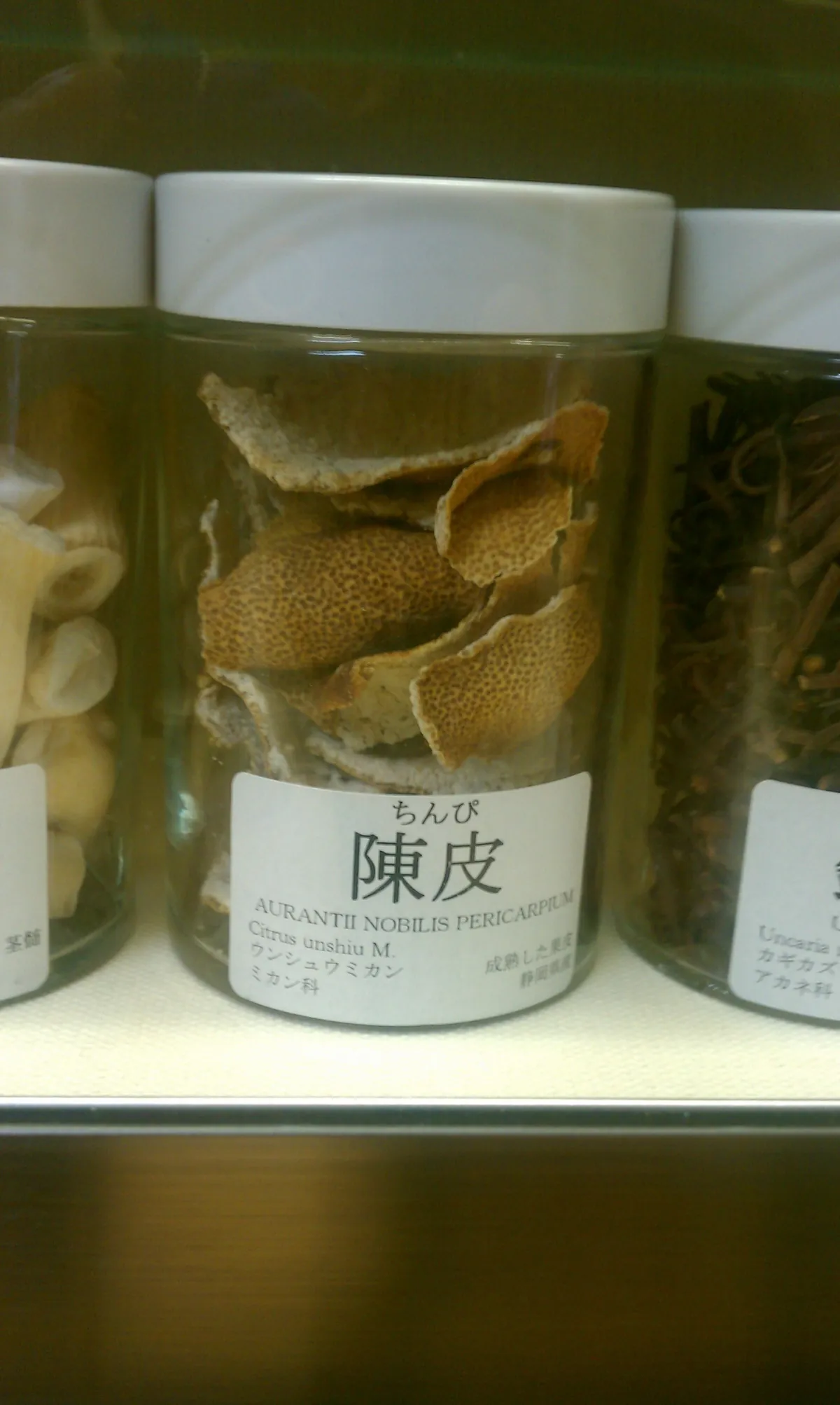
A specimen of chimpi (chenpi) as defined by the Japanese Pharmacopoeia. The raw material is the ripe peel of Citrus unshiu, kept in a specimen jar with a label bearing the Latin name Aurantii Nobilis Pericarpium. Several dried, shrunken pieces of peel can be seen overlapping.
Shown: Citrus unshiuPart / state: Pieces of dried Satsuma mandarin peel (chenpi) in a crude-drug specimen jar
Photo: Hanabishi / CC BY-SA 3.0 / original image / ledger's original image
Scope and provenance of the photo
Identification: Identified as labelled in the source. The source is a photograph of a crude-drug specimen display, and the scientific name written on the label was adopted as it is. The origin and aging years of the item cannot be judged from the photograph.
Image shown: The 1920 px version from Wikimedia Commons. No cropping or color changes by NIGAMI LAB. For display, a WebP capped at 1200 px wide is served; the ledger's original image can be checked from the link above.
On this page (9 sections)
Reading the bitterness
「陳皮」 (in translation: "chenpi"; Japanese reading: chinpi) is a crude-drug name defined by the Japanese Pharmacopoeia for mature peel from unshu mikan or Citrus reticulata Blanco. The chenpi monograph in the Eighteenth Revision describes its properties as 「味は苦くて、僅かに刺激性」 (in translation: "the taste is bitter, with slight pungency"), making bitterness part of the standard. This describes a pharmacopoeial standard; it does not survey all dried mikan peels made at home for food.
The Japanese Pharmacopoeia quantifies chenpi quality by its content of hesperidin, a flavonoid, requiring at least 4.0% relative to the calculated dried material. This is a minimum required by the standard, not an average measured in commercial or homemade chenpi. It is a pharmacopoeial quality-control criterion; this source does not establish how much hesperidin contributes to bitterness as food.
Sources for this overview
Checked for this overview: Checked the definition using mature peel of unshu mikan and related sources. / Checked the description 「味は苦くて僅かに刺激性」 (in translation: "the taste is bitter, with slight pungency"). / Checked the pharmacopoeial minimum of 4.0% hesperidin. / Checked that hesperidin is the quantified quality indicator.
Other names: 陳皮 (ja)
Follow the connections
chinpi (Japanese Pharmacopoeia chenpi) →is the mature peel of→ Citrus unshiu Marcowicz
hesperidin →is quality marker for→ chinpi (Japanese Pharmacopoeia chenpi)
chinpi (Japanese Pharmacopoeia chenpi) →— sensory attribute→ bitterness →can be measured separately …→ astringency
Measured values (1)
| Kind | Compound | Target | Value | Conditions | Source |
|---|---|---|---|---|---|
| concentration | hesperidin | chinpi (Japanese Pharmacopoeia chenpi) | 4.0 % | Calculated dried material. (A minimum under the Japanese Pharmacopoeia standard (at least), not a measured average.) | 厚生労働省, 2021 |
Values are the reported values of each source (with units and conditions). Thresholds and EC50 depend on the panel and method; they are not single true values.
Structured claims — open a section to read each claim's confidence, evidence and limits
Composition and content (4)
Scope: The chenpi entries of the Japanese Pharmacopoeia
Note: This is a record of the crude drug's botanical origin under the Pharmacopoeia, not a classification covering dried mandarin peel used as food in general.
Show data
ingredient-chenpi-jp-pharmacopoeia —is_mature_peel_of→ organism-citrus-unshiuScope: The chenpi entries of the Japanese Pharmacopoeia
Note: Those entries record the mature peel of this species as one of the botanical origins of chenpi.
Show data
organism-citrus-unshiu —provides_material_for→ ingredient-chenpi-jp-pharmacopoeiaScope: The chenpi specification in the Japanese Pharmacopoeia
Note: This is the lower limit of the specification, not the average content or the content distribution of commercial or home-made products.
Show data
ingredient-chenpi-jp-pharmacopoeia —contains→ (the claim sentence above)Scope: The chenpi entries of the Japanese Pharmacopoeia
Note: Recorded as a quantity assessed for quality. This source does not establish its contribution to bitterness as food.
Show data
compound-hesperidin —is_quality_marker_for→ ingredient-chenpi-jp-pharmacopoeiaSensory (1)
Scope: The crude-drug description in the Japanese Pharmacopoeia
Note: The original text states 「味は苦くて,僅かに刺激性」 (in translation: "the taste is bitter, with slight pungency"). This is not an intensity measurement by a food sensory panel.
Show data
ingredient-chenpi-jp-pharmacopoeia —has_sensory_attribute→ sensation-bitter