Chenpi
ingredient / ingredient-chenpi-cn-aged
陳皮
"chenpi", a Chinese medicinal-and-food material made by drying and long-term aging the peel of ripe citrus fruits.
Photographs (captions in Japanese)
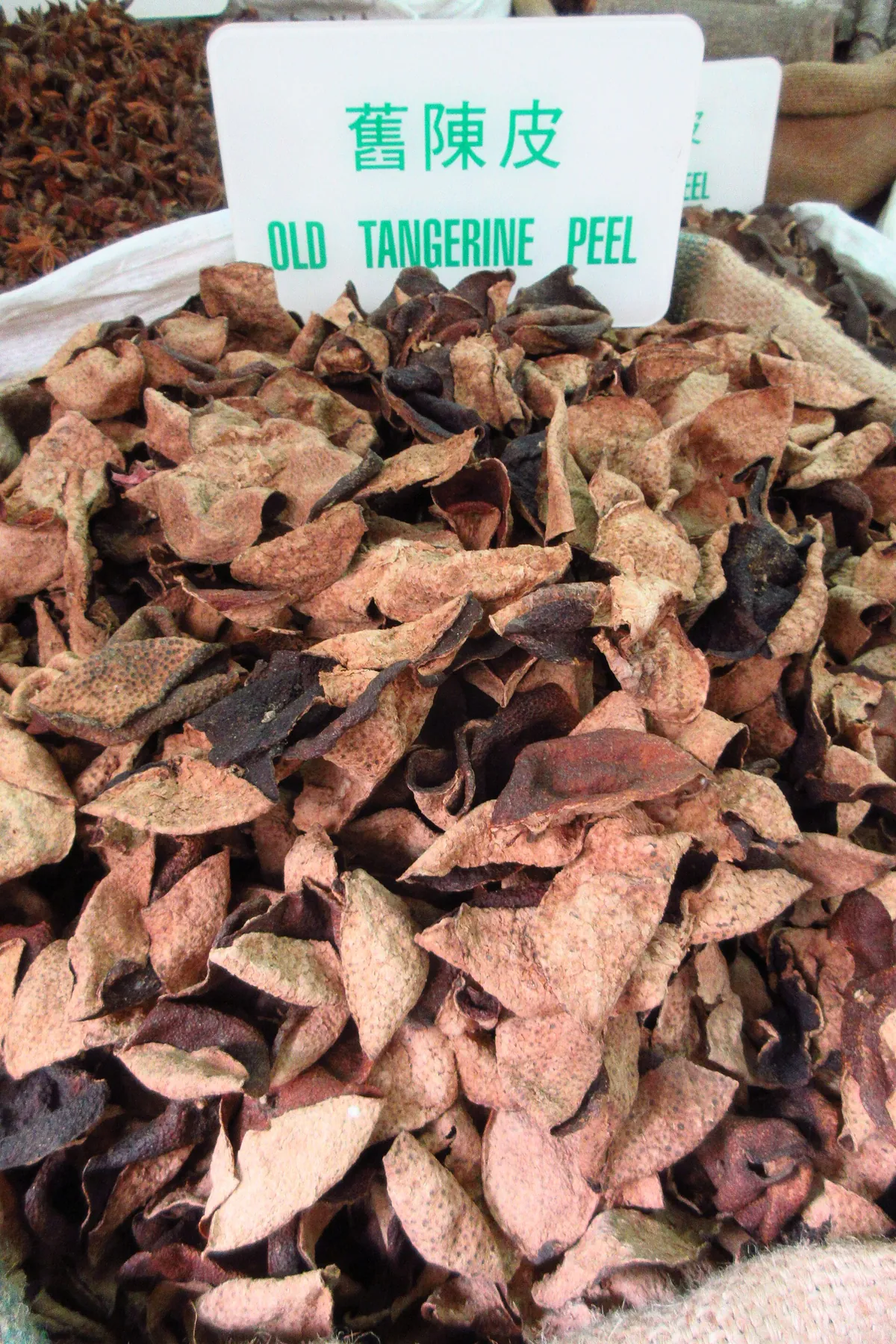
Aged chenpi (dried mandarin-type peel), the long-aged "old chenpi (laochenpi)". It is sold by weight at a spice shop in Hong Kong with an "OLD TANGERINE PEEL" label, and the surface is darkened with the edges curled back.
Shown: Citrus reticulata (the source labels it 舊陳皮 = old chenpi)Part / state: Pieces of darkened, old chenpi (dried mandarin peel) heaped with a "舊陳皮 OLD TANGERINE PEEL" tag at a dried goods and spice shop in Hong Kong
Photo: Borshingwoods / CC BY-SA 4.0 / original image / ledger's original image
Scope and provenance of the photo
Identification: Identified as labelled in the source. The source caption is a shop display photograph, with no scientific name or origin for the citrus. It is not the standard form of "chenpi" in general but one example of a product sold by one shop in Hong Kong as "old chenpi (laochenpi)".
Image shown: The 1920 px version from Wikimedia Commons. No cropping or color changes by NIGAMI LAB. For display, a WebP capped at 1200 px wide is served; the ledger's original image can be checked from the link above.
On this page (9 sections)
Reading the bitterness
Chenpi is a Chinese medicinal-and-food material made by drying and aging the peel of ripe citrus fruits over a long period. In traditional Chinese medicine's classification of properties and flavors, it is described as warm in nature, as combining pungency and bitterness, and as acting on the spleen and lung meridians. This is recorded as a position within a traditional-medicine classification system, not as bitterness measured in a sensory test.
This long aging characterizes chenpi. A 2026 review describes aging as a complex process of biotransformation that requires at least 3 years. The evaluation 「古いほど良い」 (in translation: "the older, the better") is linked to the gradual accumulation of phenolic acids with aging, and polymethoxyflavones are also described as continuing to increase through aging. The review also refers to studies of products aged for 5-30 years.
Reported total flavonoid content ranges from 36.24 to 88.64 mg/g, of which hesperidin accounts for 71-92%. Hesperidin is chenpi's principal flavonoid, but is not itself a bitter glycoside. The review does not claim that hesperidin content itself is the main cause of bitterness and does not determine which components cause bitterness.
Sources for this overview
Checked for this overview: The section checked for the traditional Chinese medicine classification of warm nature, pungent-bitter flavor, and action on the spleen and lung meridians. / The section checked for at least 3 years of aging, phenolic-acid accumulation, and references to products aged 5-30 years. / The section checked for the figures for total flavonoids and the proportion of hesperidin.
Other names: 陈皮 (zh), Citri Reticulatae Pericarpium (la)
Follow the connections
Chenpi →is produced through→ chenpi aging
Structured claims — open a section to read each claim's confidence, evidence and limits
Composition and content (1)
Scope: Chenpi
Note: Hesperidin itself is not a bitter glycoside (the bitter compounds are of the naringin type). This claim does not assert an attribution of bitterness.
Show data
ingredient-chenpi-cn-aged —contains→ (the claim sentence above)How processing and cooking change it (1)
Scope: Chenpi (Citri Reticulatae Pericarpium)
Show data
ingredient-chenpi-cn-aged —is_produced_through→ process-chenpi-agingCulture (1)
Scope: Traditional classification in Chinese medicine
Note: This is a traditional classification, not a sensory measurement. It is retained in the bitterness database as a cultural positioning.
Show data
ingredient-chenpi-cn-aged —is_classified_by→ (the claim sentence above)