Citrus tamurana Hort. ex Tanaka
ingredient / ingredient-hyuganatsu
日向夏
Citrus tamurana Hort. ex Tanaka is a citrus fruit originating in Miyazaki, eaten together with its white inner peel (albedo). Its outer peel is reported to contain relatively few bitter constituents. A separate related cultivar is grown in Kochi under the name Konatsu.
Photographs (captions in Japanese)
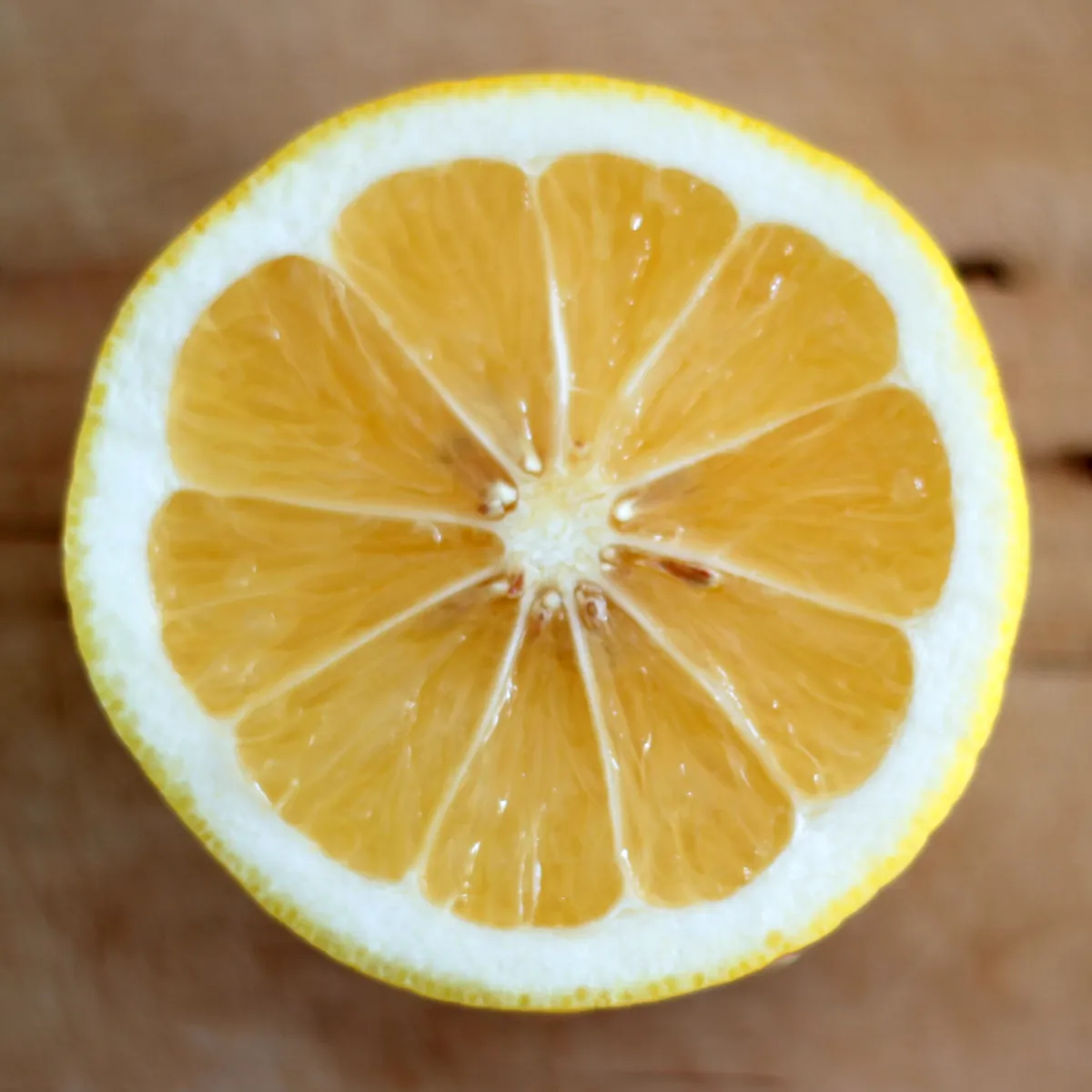
A cross-section of a hyuganatsu cut in half. The thick white inner rind (albedo) remains around the yellow flesh.
Shown: Citrus tamuranaPart / state: Cross-section of the fruit (including the outer rind, the inner rind = albedo, and the flesh)
Photo: Marubatsu / CC BY-SA 3.0 / original image / ledger's original image
Scope and provenance of the photo
Identification: Identified as labelled in the source. The description is "Hyuganatsu cut in half". The characteristic of eating it together with the albedo can be confirmed visually from the cross-section. I opened the image and confirmed that a thick white layer (albedo) remains on the outside of the flesh, fused with the flesh.
Image shown: The original from Wikimedia Commons, reduced to 2400 px on the long side. No cropping or color changes. For display, a WebP capped at 1200 px wide is served; the ledger's original image can be checked from the link above.
On this page (8 sections)
Reading the bitterness
Hyuganatsu is distinctive because the outer peel is pared thinly, like an apple, and the white albedo is eaten with the flesh; this way of eating it is also mentioned in the background section of a peer-reviewed paper. A 2015 review of citrus processing compares Hyuganatsu with pomelo-type citrus such as grapefruit and pummelo, whose outer peel is thick and strongly bitter, and says Hyuganatsu has a softer outer peel with fewer bitter constituents. The review does not give quantitative values for bitter constituents in Hyuganatsu itself.
Heating is generally described as generating bitterness in citrus marmalade production. A study of Hyuganatsu reports that using high-pressure processing instead of heating produced marmalade with less bitterness and good flavor. Here too, numerical values from sensory assessment of bitterness are not stated in the text; this remains the authors’ interpretation.
Sources for this overview
Checked for this overview: Background description of the custom of eating the albedo with the flesh. / Used the qualitative bitterness comparison with pomelo-type citrus as evidence for this paragraph. / Used the reported reduction of bitterness under high-pressure processing as evidence for this paragraph.
Other names: 日向夏蜜柑 (ja), ニューサマーオレンジ (ja, identification medium), 小夏 (ja, identification low)
Structured claims — open a section to read each claim's confidence, evidence and limits
Sensory (1)
Scope: A 2015 paper reviewing the authors’ earlier studies on high-pressure marmalade made from yuzu, Hyuganatsu, and lemon.
Note: This review gives no specific quantitative value for Hyuganatsu bitter constituents; the comparison is qualitative. Pairwise sensory comparisons including a bitterness item are shown for yuzu and lemon, but direct sensory values for Hyuganatsu could not be confirmed.
Show data
ingredient-hyuganatsu —has_sensory_attribute→ (the claim sentence above)How processing and cooking change it (1)
Scope: Background descriptions in a peer-reviewed 2015 review and a peer-reviewed 2025 review.
Note: Both sources chiefly concern processing properties and functional assessment of bone metabolism, respectively, but agree in their background descriptions of how the fruit is eaten.
Show data
ingredient-hyuganatsu —has_food_part→ (the claim sentence above)Culture (1)
Scope: A description in official materials of Sukumo City, Kochi Prefecture.
Note: Tamura Toshichika was from Kochi Prefecture and is described as having sent scions and seedlings to his family home, initiating cultivation there under the name 『小夏』 (in translation: "Konatsu").
Show data
ingredient-hyuganatsu —has_discovery_history→ (the claim sentence above)