Radicchio Variegato di Castelfranco
ingredient / ingredient-radicchio-castelfranco
カステルフランコ斑入りラディッキオ / Cichorium intybus L. var. silvestre
Radicchio Variegato di Castelfranco is an Italian variegated chicory with reddish-purple mottling on cream-colored leaves.
Photographs (captions in Japanese)
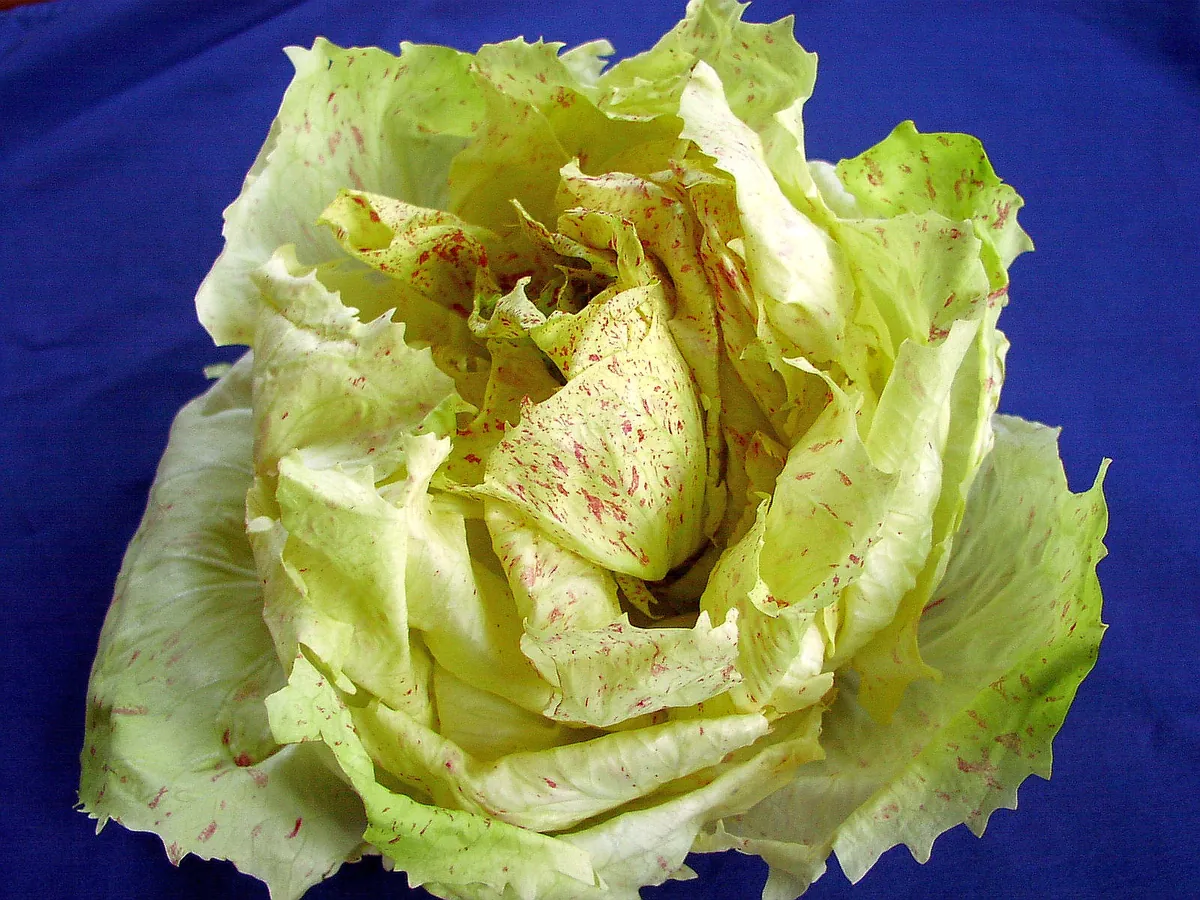
1 head of Radicchio Variegato di Castelfranco is shown. The pattern characteristic of this cultivar, with red-purple spots scattered over cream to pale yellow-green leaves, can be seen clearly. The source page says only "Radicchio type Castelfranco" and gives no scientific species name.
Shown: Cichorium intybus (Variegato di Castelfranco)Part / state: The whole harvested headed plant. Cream to pale yellow-green leaves with red-purple spots are visible
Photo: Goldlocki / CC BY-SA 3.0 / original image / ledger's original image
Scope and provenance of the photo
Identification: Identified as labelled in the source. The source page describes the subject only as "Radicchio type Castelfranco" and gives no scientific name (the scientific placement of the cultivar name). Re-identification by a specialist has not been done.
Image shown: The full-size version from Wikimedia Commons. No cropping or color changes by NIGAMI LAB. For display, a WebP capped at 1200 px wide is served; the ledger's original image can be checked from the link above.
On this page (8 sections)
Reading the bitterness
Castelfranco variegated radicchio is an Italian variegated chicory with reddish-purple spots scattered over cream-colored leaves. The EU geographical-indication specification defines it as a variegated form belonging to the silvestre variety (var. silvestre) of the genus Cichorium (Cichorium intybus). The reddish-purple pattern on a white ground is itself an appearance condition set by the legal specification.
This appearance does not arise from natural growth alone. The same specification positions the process of forming new leaves in a shaded environment (forcing and blanching) as an essential and irreplaceable production stage. The mottled pattern is created not only by the cultivar but also by people adding this process.
In terms of taste, the same specification describes the leaves as 「甘味から心地よい苦味へ続く繊細な味」 (in translation: "a delicate taste continuing from sweetness to pleasant bitterness"). Bitterness is not excluded as a defect but treated as one characteristic of this vegetable. However, this is a legal quality description for the geographical indication, not bitterness intensity measured numerically by trained assessors, and it does not guarantee the range of taste in individual plants.
Sources for this overview
Summary of requirements: Radicchio Variegato di Castelfranco PGI
Checked for this overview: The classification rule defining it as a variegated form of Cichorium intybus var. silvestre. / The description of forcing and blanching under shade. / The sensory description of a taste continuing from sweetness to pleasant bitterness.
Follow the connections
Radicchio Variegato di Castelfranco →is a type of→ chicory
Radicchio Variegato di Castelfranco →is processed by→ radicchio forcing and blanching
Structured claims — open a section to read each claim's confidence, evidence and limits
Composition and content (1)
Scope: Classification under the EU PGI specification
Note: A variegated form of Cichorium intybus var. silvestre.
Show data
ingredient-radicchio-castelfranco —is_a_type_of→ ingredient-chicorySensory (1)
Scope: The sensory description at shipment under the EU specification
Note: Described not as bitterness alone, but as a continuum with sweetness.
Show data
ingredient-radicchio-castelfranco —has_sensory_attribute→ (the claim sentence above)How processing and cooking change it (1)
Scope: Traditional process in the EU specification
Note: Forcing and blanching to form new leaves under shade.
Show data
ingredient-radicchio-castelfranco —is_processed_by→ process-radicchio-forcing-blanching