stamnagathi
ingredient / ingredient-stamnagathi
スタムナガシ / Cichorium spinosum
Stamnagathi is a leafy vegetable of spiny chicory called stamnagathi in Crete and elsewhere. Its bitter flavor and use boiled or in salads are recorded in the literature.
Photographs (captions in Japanese)
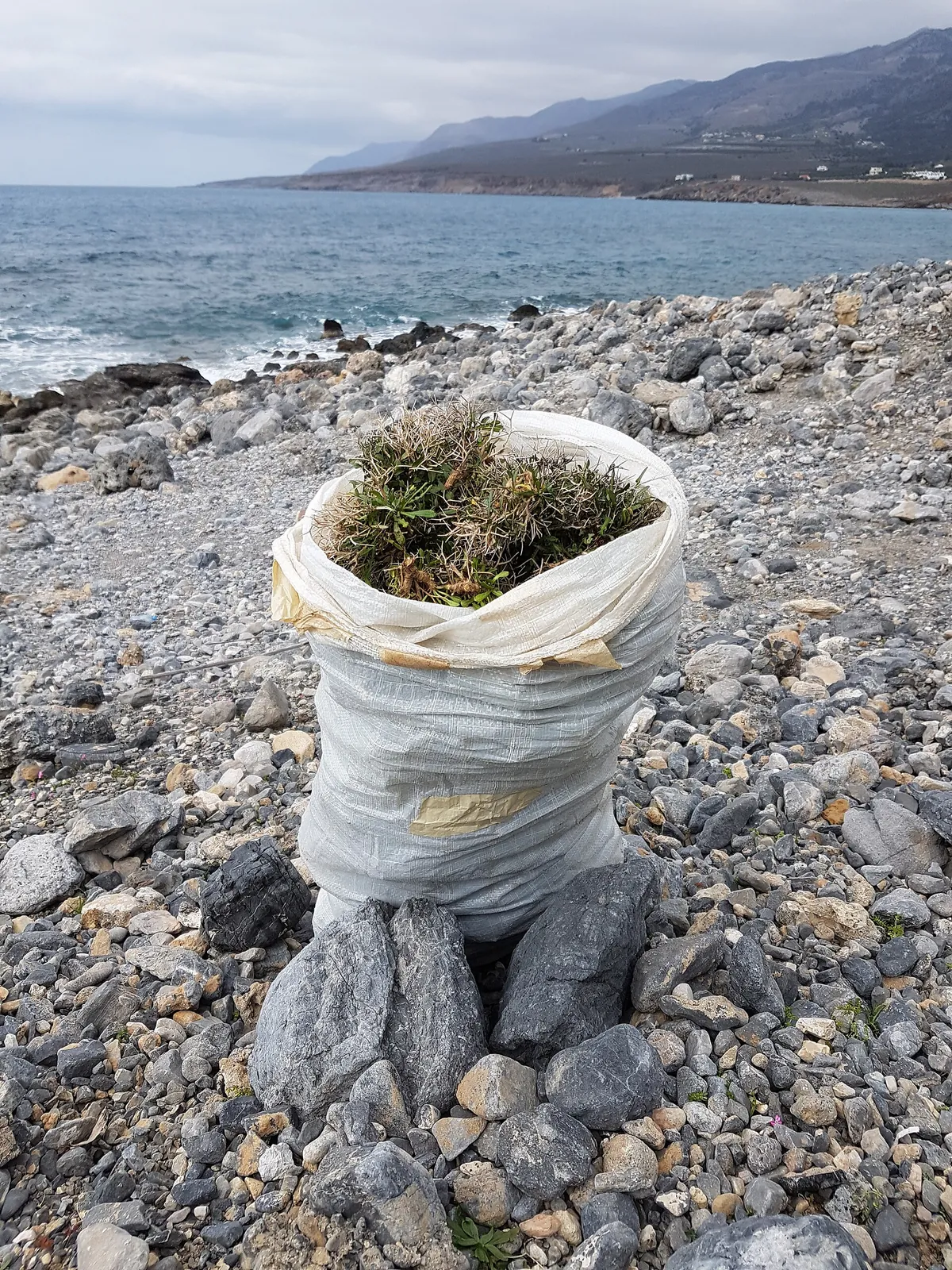
Stamnagathi (Cichorium spinosum) collected with its roots and packed in a white bag. Photographed along the coast in the Sfakia region of Crete, with thin, spiny leaves and withering stems showing from the mouth of the bag. The source page says "Collecting Cichorium spinosum in Sfakia (Kreta)".
Shown: Cichorium spinosumPart / state: Just after being pulled up and collected with the roots. Thin, spiny leaves and roots packed in a white burlap bag
Photo: Aguara / CC BY-SA 4.0 / original image / ledger's original image
Scope and provenance of the photo
Identification: Identified as labelled in the source. The source page states the scientific species name Cichorium spinosum and the collection location (Sfakia, Crete). Re-identification by a specialist has not been done. It is shown just after collection, before cooking or washing, and differs from how it appears in shops.
Image shown: The 1920 px version from Wikimedia Commons. No cropping or color changes by NIGAMI LAB. For display, a WebP capped at 1200 px wide is served; the ledger's original image can be checked from the link above.
On this page (9 sections)
Reading the bitterness
Stamnagathi is the leafy vegetable of spiny chicory (Cichorium spinosum), called by this name in Crete and elsewhere. A 2024 cultivation study used Cichorium spinosum L. as experimental material in hydroponic cultivation and identified it as stamnagathi. However, the spelling and scope of the regional name vary among sources, so this paper alone does not guarantee that the product name and usage across all regions are completely identical.
The same study’s background states that these leaves have a bitter flavor, are harvested at various growth stages, and are eaten boiled or raw as a salad. This is a description organized as background for a cultivation study; it is neither a sensory test that actually measured bitterness intensity nor a record of the specific ingredients or seasoning of a salad.
The Gramvousa cooperative introduces this leaf vegetable as having 「上品な苦味」 (in translation: "elegant bitter taste"). This is an evaluative phrase used by a producer cooperative when describing its product, not a sensory test that measured bitterness intensity. Whether this evaluation is shared across the whole region cannot be determined from this source alone.
In an omelette posted by the same cooperative, stamnagathi leaves are first sautéed in olive oil, then eggs mixed with milk, salt, and pepper are poured in to finish the dish, with grated cheese added on top as desired. Beyond eating it raw in salads or simply boiled, this confirms a specific dish in which the leaves are sautéed in oil and combined with eggs. It is one example posted by the cooperative.
Another dish posted by the cooperative boils the leaves for about 7 minutes, adds the boiling liquid to cuttlefish cooked in olive oil and red wine, and finishes by returning the boiled leaves to simmer together. This is a process that uses both the leaves themselves and the boiling liquid in one dish. Because the source does not measure bitterness before and after cooking, this is not treated as a method for reducing bitterness through boiling.
Sources for this overview
Checked for this overview: The range in which the identification as Cichorium spinosum L. and its use as hydroponic-cultivation material were confirmed. / The range in which the background description of a bitter flavor and consumption boiled or in salads was confirmed. / The range in which the description of harvesting at any growth stage and eating it raw in salads was confirmed.
Stamnagathi | Agricultural Coop. of Gramvoussa
Checked for this overview: Used for the cooperative's evaluative phrase "elegant bitter taste" and the limitation that it is not a sensory measurement. / Used for the process of sautéing the leaves in oil and combining them with the egg mixture, and the limitation that it is one example posted by the cooperative. / Used for the about-7-minute boiling, reuse of the boiling liquid, the process of returning the leaves to the cuttlefish, and the limitation that bitterness was not measured.
Follow the connections
stamnagathi salad →includes→ stamnagathi
Hypotheses and recipe candidates for this entry are on the Japanese page.
Structured claims — open a section to read each claim's confidence, evidence and limits
Composition and content (1)
Scope: Plant identification from cultivation research and prior literature
Note: The spelling and scope of the local name vary across sources.
Show data
ingredient-stamnagathi —is_a→ (the claim sentence above)Sensory (1)
Scope: Background description in cultivation research on Cichorium spinosum
Note: Not a sensory-panel measurement from that study.
Show data
ingredient-stamnagathi —has_sensory_attribute→ (the claim sentence above)How processing and cooking change it (1)
Scope: The basic dish composition based on the background description in the Cichorium spinosum cultivation study (Voutsinos-Frantzis et al. 2024). Regional ingredient differences and specific ingredients or seasoning have not been confirmed.
Note: The background description mentions eating it raw in a salad and provides the connection. It does not indicate quantities, ingredient proportions, or cooking conditions.
Show data
dish-stamnagathi-salata —includes→ ingredient-stamnagathiCulture (3)
Scope: The Gramvousa cooperative's English-language product introduction
Note: The original text reads "elegant bitter taste." It is an evaluative phrase from a producer cooperative, not a measurement by a sensory panel.
Show data
ingredient-stamnagathi —is_presented_as→ (the claim sentence above)Scope: One omelette recipe posted by the Gramvousa cooperative
Note: One recipe posted by the cooperative. It is not treated as a method common across all of Crete.
Show data
ingredient-stamnagathi —is_prepared_by→ (the claim sentence above)Scope: One cuttlefish dish posted by the Gramvousa cooperative
Note: One recipe posted by the cooperative. There is no measurement showing that the boiling process or reuse of the boiling liquid reduces bitterness.
Show data
ingredient-stamnagathi —is_prepared_by→ (the claim sentence above)