namul
dish / dish-namul
ナムル
Namul is a collective term for Korean side dishes in which edible grasses, shoots, and similar ingredients are boiled, stir-fried, or otherwise prepared and dressed with yangnyeom (seasoning).
Photographs (captions in Japanese)
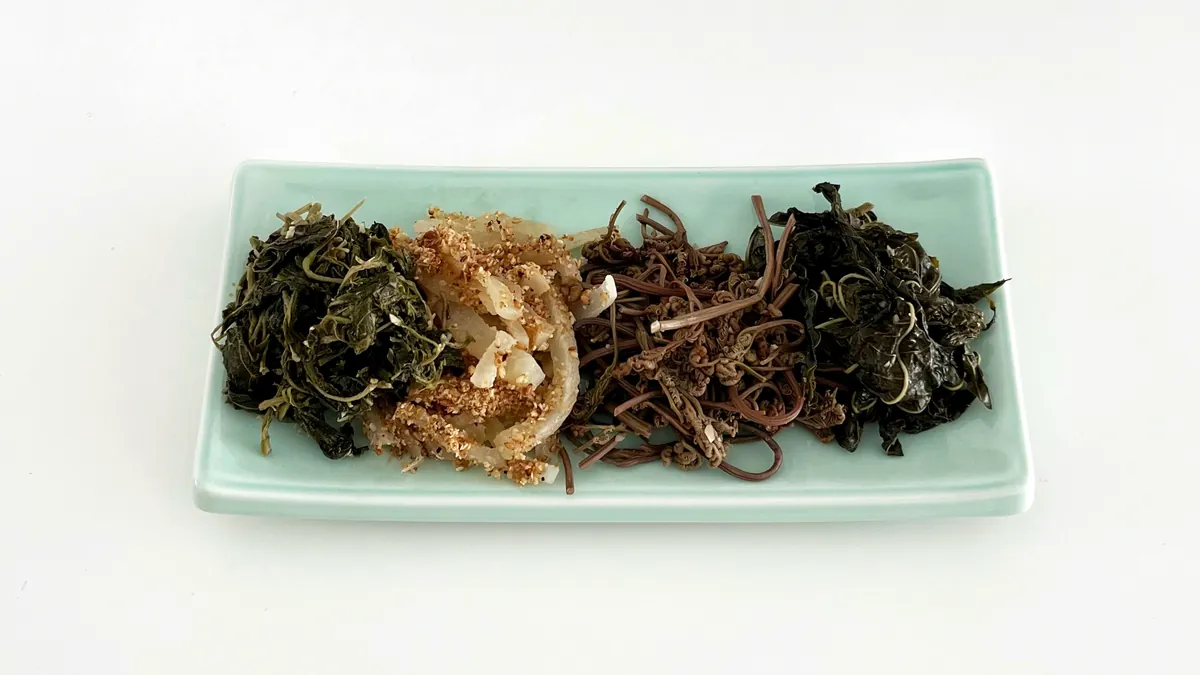
Assorted dried namul eaten at the New Year's Daeboreum (정월 대보름) event, served on a plate. Note that the subject is a composite, with several kinds of namul arranged together on one plate.
DishShown: Not applicable (dish)Part / state: Serving (assorted dried namul)
Photo: Garu Gim / CC BY-SA 2.0 / original image / ledger's original image
Scope and provenance of the photo
Identification: Identified as labelled in the source.
Image shown: No resizing, trimming, or color changes. The original image from Wikimedia Commons is used as it is. For display, a WebP capped at 1200 px wide is served; the ledger's original image can be checked from the link above.
On this page (8 sections)
Reading the bitterness
Namul (나물) is a collective term for Korean side dishes in which edible grasses, tree shoots, and similar ingredients are prepared by methods such as boiling, stir-frying, or serving raw, then dressed with a blended seasoning called yangnyeom. A literature review explains this collective term as broadly divided into saengchae (items dressed raw) and sukchae (items seasoned after being heated by boiling or stir-frying). In both lineages, the additional step of seasoning by dressing is essential to the finish.
The review states that many of the wild grasses and tree shoots used for namul have a strong aroma or bitterness and are difficult to chew as they are. It treats adding yangnyeom as the key that developed such ingredients into 「おいしい」 (in translation: "tasty") dishes in Korea. Rather than placing bitter plants on the table as they are, the idea of making them edible by combining preparation and seasoning is at the core of the namul group of dishes. However, it does not provide individual data on how bitter each plant is.
In a descriptive sensory analysis of 4 kinds of wild-vegetable namul (samnamul, miyeokchwi, daraesoon, and bangpung namul) prepared by 3 soaking treatments (soaked both before and after boiling / soaked only after boiling / not soaked), the abstract indicates that unsoaked miyeokchwi and bangpung namul samples had relatively high sensory-attribute scores for bitterness, together with astringency and roughness, and were least preferred in evaluations by 115 consumers. Attributes such as bitterness and astringency were analyzed as factors affecting this evaluation of 「好まれない」 (in translation: "disliked").
Sources for this overview
Namul, the driving force behind health and high vegetable consumption in Korea
Checked for this overview: The extent checked for the classification of saengchae and sukchae and the definitions of whether heating is used. / The extent checked for the review's description of the bitterness of wild plants and their transformation through seasoning.
Sensory Properties and Drivers of Liking Sanchae namul (seasoned dish with wild edible greens)
Checked for this overview: The finding that unsoaked samples had high bitterness sensory-attribute scores and were not preferred by consumers.
Other names: 나물 (ko)
Structured claims — open a section to read each claim's confidence, evidence and limits
Sensory (1)
Scope: Layer: food. Descriptive analysis by a trained panel of 10 people and 9-point-scale preference evaluation by 115 consumers.
Show data
dish-namul —has_perceived_bitterness_affected_by→ (the claim sentence above)How processing and cooking change it (1)
Scope: Korea
Show data
dish-namul —is_classified_by→ (the claim sentence above)Culture (1)
Scope: Namul of wild plants in Korea
Note: An example of cultural devices for accepting bitterness (seasoning and heating).
Show data
dish-namul —has_defining_sensory_theme→ (the claim sentence above)