Tacca chantrieri
organism / organism-tacca-chantrieri
タシロイモ(ブラックキャット)
Bat flower (family Taccaceae). An HRDI record gives ดีงูหล้า/ดีงูหว้า as northern Thai names, making it a candidate identity for the Lisu Tom Khom herb. Its flowers and young leaves are eaten in northern Thailand.
Photographs (captions in Japanese)
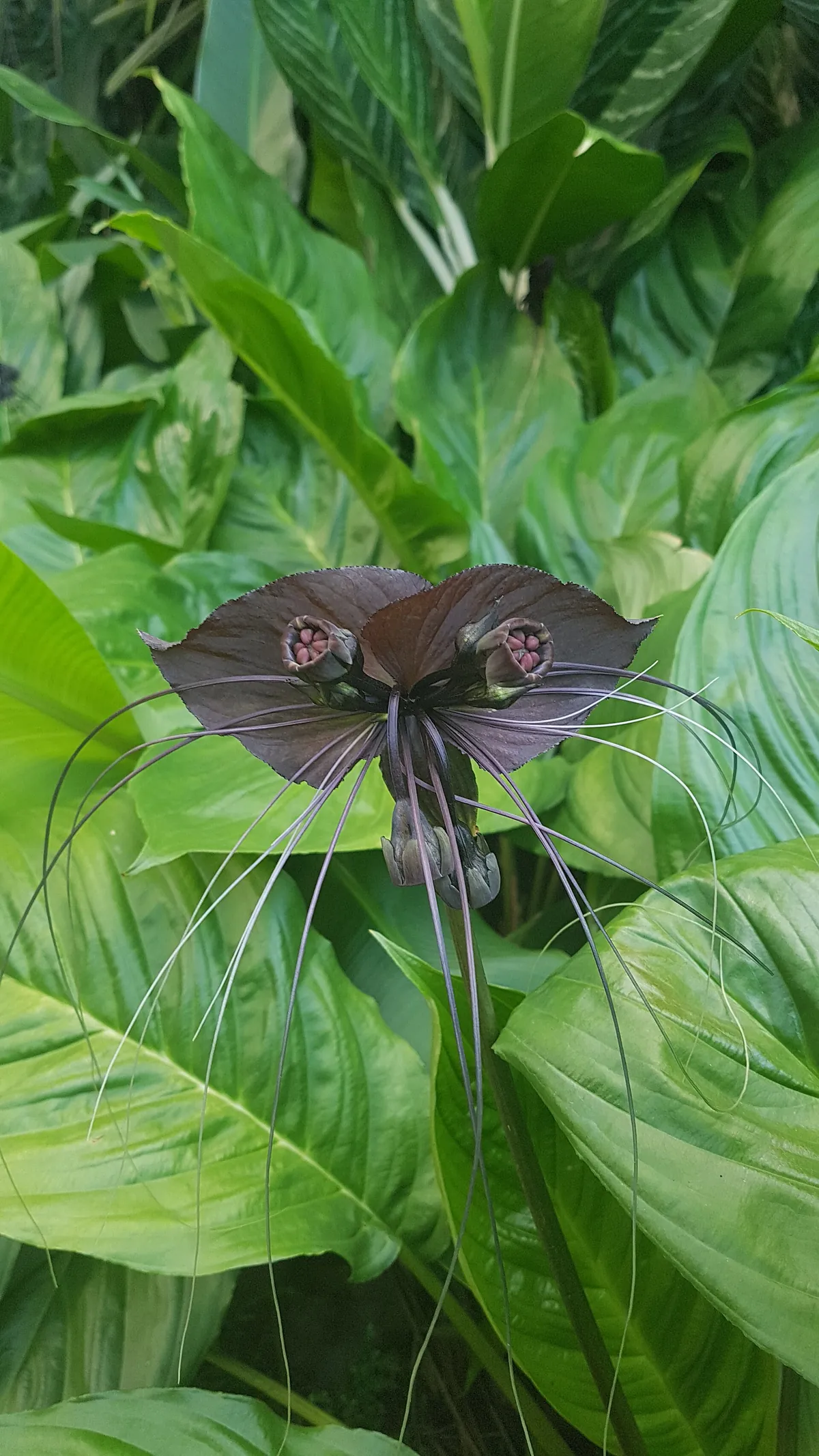
A flower of Tacca chantrieri (common names black cat / black bat flower). The blackish-brown, wing-like bracts and the long thread-like whiskers extending from them are shown.
Shown: Tacca chantrieriPart / state: The whole inflorescence in bloom (bracts, small flowers, and long whisker-like appendages)
Photo: Cameroncomix / CC BY-SA 4.0 / original image / ledger's original image
Scope and provenance of the photo
Identification: Identified as labelled in the source. The source gives no details of the growing site (it may be a cultivated plant). Re-identification by a specialist has not been done.
Image shown: The 1920 px version from Wikimedia Commons. No cropping or color changes by NIGAMI LAB. For display, a WebP capped at 1200 px wide is served; the ledger's original image can be checked from the link above.
On this page (8 sections)
Reading the bitterness
For Tacca chantrieri (also called tashiro-imo, or black cat), a government knowledge page compiling plant knowledge from the northern Thai highlands records that the flowers and young leaves are roasted over fire or blanched for eating, and the roots are decocted as a "tonic" (translation of the page's wording). The page describes no taste and is not an ethnographic survey, so when, by whom, and in what circumstances the plant is eaten remain unknown.
The same page lists ดีงูหล้า and ดีงูหว้า as northern Thai names for this plant, alongside other names from central and southern Thailand. However, this is only a name match: the page alone has not confirmed whether it is the plant called ดีงูหว้า among the herbs in Lisu Tom Khom. Because the same vernacular name may refer to different plants across regions or communities, the correspondence between name and species remains partly unconfirmed.
Sources for this overview
ดีงูหล้า (องค์ความรู้เพื่อการพัฒนาพื้นที่สูงอย่างยั่งยืน)
Checked for this overview: Checked the description of how the flowers and young leaves are eaten and how the roots are used. / Checked the listing of northern Thai names and the limits of certainty in the name-to-species correspondence.
Other names: เนระพูสีไทย (th), nera phu si thai (th-Latn), ค้างคาวดำ (th, identification medium), มังกรดำ (th, identification medium)
Follow the connections
dee ngu wa →The name is a candidate fo…→ Tacca chantrieri
Structured claims — open a section to read each claim's confidence, evidence and limits
Composition and content (3)
Scope: Name-level match only: the HRDI knowledge page lists ดีงูหว้า as a northern Thai variant name for ดีงูหล้า = Tacca chantrieri.
Note: Do not treat this as an identification. The HRDI page covers Thailand generally and gives no Lisu-language name, so the herb called ดีงูหว้า in a Lisu Tom Khom preparation could refer to a different plant. The identification rules and local-confirmation task are recorded in tomkhom-research-dossier.md.
Show data
organism-dee-ngu-wa —is_name_candidate_for→ organism-tacca-chantrieriScope: Central and southern Thailand.
Show data
organism-tacca-chantrieri —is_listed_as→ (the claim sentence above)Scope: Name-level match only, per TH-BIF (ONEP) species database record
Show data
organism-dee-ngu-wa —is_name_candidate_for→ organism-tacca-chantrieriHow processing and cooking change it (1)
Scope: Thailand; according to a knowledge page from the public agency HRDI that lists local names from northern, central, and southern Thailand.
Note: This is a government knowledge-base record rather than an ethnographic survey, and the page contains no description of taste. Information about Tacca bitterness (taccalonolides, Chen 1988) is bibliographic only and is intentionally not asserted here.
Show data
organism-tacca-chantrieri —is_eaten_as→ (the claim sentence above)