khilek leaves
ingredient / ingredient-khilek-leaves
キーレックの葉 / Senna siamea
Cooking parts including leaves, young shoots, and flowers of Khi Lek. A boiling-and-discarding-water step is recorded for gaeng.
Photographs (captions in Japanese)
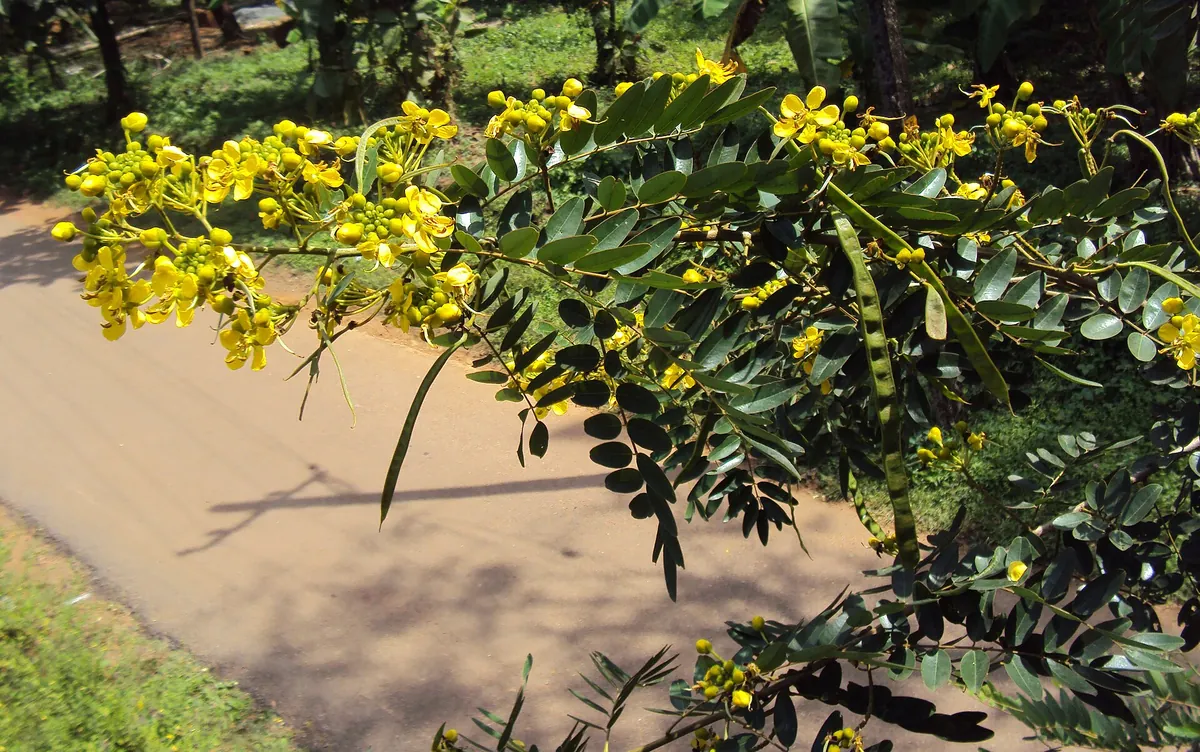
Branches and leaves of khilek (Senna siamea). The pairs of leaflets of the pinnate compound leaves, yellow 5-petaled flowers, and long slender pods are all mixed on the same branch. The young leaves, flowers, and pods are what is eaten, but this photograph shows the growing condition of the whole tree.
Shown: Senna siameaPart / state: A branch tip of khilek (Senna siamea). Pinnate compound leaves, yellow flowers, and long pods visible at the same time
Photo: Vinayaraj / CC BY-SA 3.0 / original image / ledger's original image
Scope and provenance of the photo
Identification: Identified as labelled in the source. The photograph shows the whole tree in the flowering and fruiting period and is not a photograph of only the young leaves harvested as food. The scientific name is based on Senna siamea in the source caption.
Image shown: The 1920 px version from Wikimedia Commons. No cropping or color changes by NIGAMI LAB. For display, a WebP capped at 1200 px wide is served; the ledger's original image can be checked from the link above.
On this page (7 sections)
Reading the bitterness
In Thai, the leaves, young shoots, and flowers of Senna siamea, known as Khi Lek, are collectively treated as the parts used in cooking. An ethnobotanical survey of 50 people in Pa Tio district, Yasothon province, northeastern Thailand, records this plant as a wild edible plant under the local name Khi Lek, and states that it is heated before eating to reduce bitterness. Rather than using the bitter leaves as they are, this becomes a food that reaches the table only after the added step of heating.
A university's cooking-preservation project lists leaves and flowers in gaeng Khi Lek with roast pork. It also records boiling and discarding the water. These are one example, and the record cannot show the required ingredients for all variants of gaeng using khilek, or the amount by which the debittering reduces bitterness.
Sources for this overview
Ethnobotanical study of wild edible plants in Pa Tio District, Yasothon Province, Thailand
Checked for this overview: Confirmed the record of Khi Lek as a wild edible plant and bitterness reduction by heating.
Checked for this overview: Confirmed that leaves and flowers appear in the ingredient list for gaeng Khi Lek.
Follow the connections
khilek leaves →is prepared from→ Senna siamea
gaeng khilek →includes→ khilek leaves
Hypotheses and recipe candidates for this entry are on the Japanese page.
Structured claims — open a section to read each claim's confidence, evidence and limits
Composition and content (1)
Scope: The leaves, young shoots, and flowers of Khi Lek used in Thai cuisine
Note: Connected the edible plant parts in the dish with the plant species.
Show data
ingredient-khilek-leaves —is_prepared_from→ organism-senna-siameaHow processing and cooking change it (2)
Scope: Gaeng khilek with roasted pork published by Mahidol University's Institute of Nutrition
Note: Not a required-ingredients list covering every variant of gaeng khilek.
Show data
dish-gaeng-khilek —includes→ ingredient-khilek-leavesScope: Faculty of Home Economics cooking column, Suan Dusit University
Show data
ingredient-khilek-leaves —is_prepared_with→ (the claim sentence above)