Crepidiastrum lanceolatum
organism / organism-hosobawadan
ホソバワダン / Crepidiastrum lanceolatum (Houtt.) Nakai
Hosobawadan, called njanabā or nigana in Okinawa; its leaves are eaten.
Photographs (captions in Japanese)
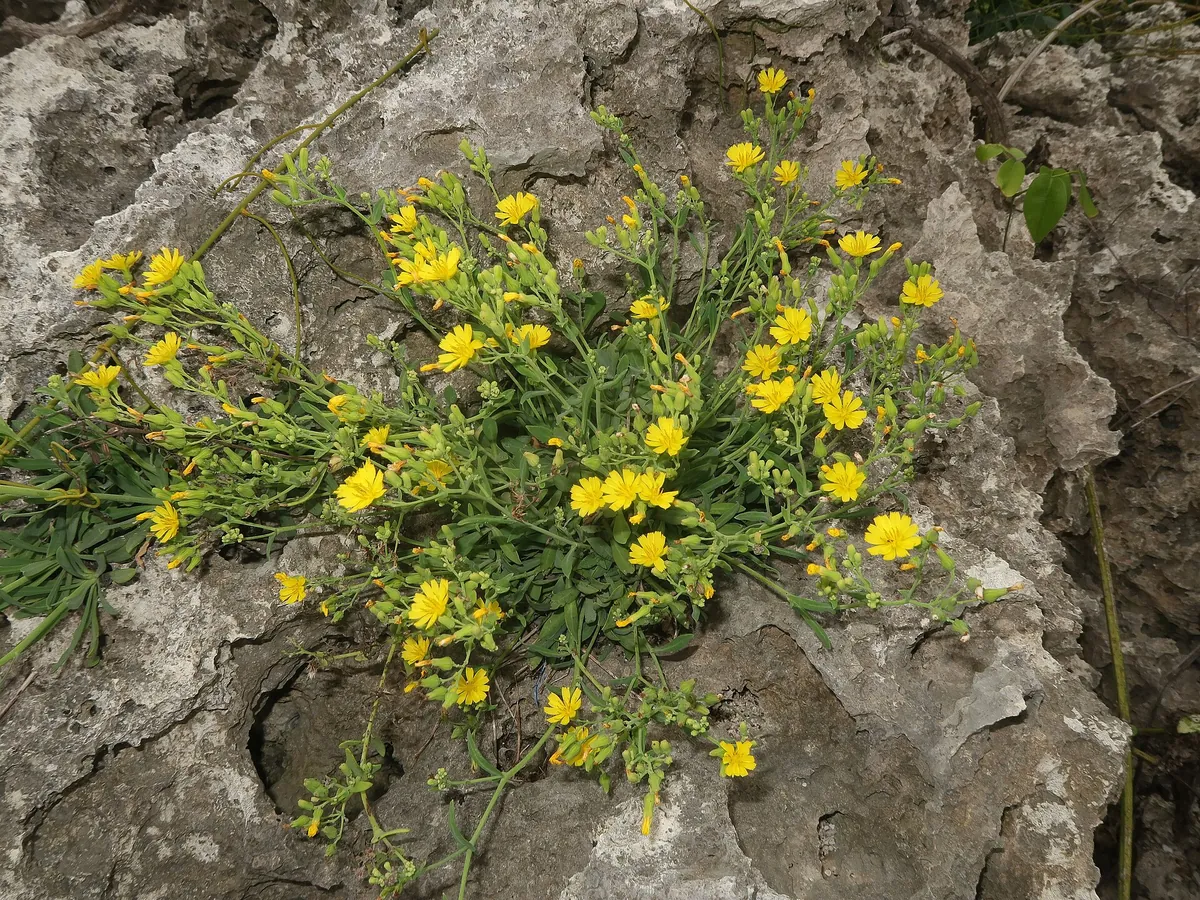
A growing plant of Crepidiastrum lanceolatum (hosoba-wadan). It grows wild on limestone on Miyako Island, with spatula-shaped leaves and yellow flower heads of the daisy family visible.
Shown: Crepidiastrum lanceolatum (Houtt.) NakaiPart / state: Spatula-shaped leaves and yellow daisy-family flower heads of a plant growing on limestone
Photo: Qwert1234 / CC BY-SA 4.0 / original image / ledger's original image
Scope and provenance of the photo
Identification: Identified as labelled in the source. The source page describes it as a plant in the wild on Miyako Island, Okinawa Prefecture. Re-identification by a specialist has not been done.
Image shown: The 1920 px version from Wikimedia Commons. No cropping or color changes by NIGAMI LAB. For display, a WebP capped at 1200 px wide is served; the ledger's original image can be checked from the link above.
On this page (8 sections)
Reading the bitterness
Hosobawadan (Crepidiastrum lanceolatum) is a member of the aster family called 「ンジャナバー」 (in translation: "njanabā") or 「ニガナ」 (in translation: "nigana") in Okinawa, where its leaves are eaten. Prefectural material on traditional food culture records the leaves as bitter and used in shira-ae and soups. This record concerns Okinawan hosobawadan specifically; it does not establish every way the plant is used in cooking.
Importantly, the plant usually called 「ニガナ」 (in translation: "nigana") in Okinawa differs from another plant commonly called 「ニガナ」 (in translation: "nigana") in other regions. The prefectural material notes the difference but does not give the scientific name of the other region’s nigana, so they should not simply be treated as the same species.
Sources for this overview
Checked for this overview: Confirmed the description identifying njanabā as hosobawadan and noting that it is usually called nigana. / Confirmed the caution that this is a different plant from 「ニガナ」 (in translation: "nigana") elsewhere.
Checked for this overview: Confirmed the description of bitterness in its leaves and use in shira-ae and soups.
Crepidiastrum lanceolatum (Houtt.) Nakai
Checked for this overview: Confirmed the record that Crepidiastrum lanceolatum is an accepted species.
Other names: ンジャナバー (ryu), Crepidiastrum lanceolatum (Houtt.) Nakai (la)
Follow the connections
nigana greens →is used as→ Crepidiastrum lanceolatum
Structured claims — open a section to read each claim's confidence, evidence and limits
Composition and content (2)
Scope: The Okinawan ingredient njana / nigana
Note: Connected to Crepidiastrum lanceolatum (hosoba-wadan) through a prefectural source and GBIF. Not automatically merged with a different plant that shares a similar name.
Show data
ingredient-nigana —is_derived_from→ organism-hosobawadanScope: a caution about the plant name usually called 『ニガナ』 (in translation: "nigana") in Okinawa
Note: The scientific name of the contrasting plant is not given in the source. Not linked to Ixeris dentata.
Show data
organism-hosobawadan —is_not_synonymous_with→ (the claim sentence above)Culture (1)
Scope: The leaves of Crepidiastrum lanceolatum (hosoba-wadan), eaten in Okinawa as njana / nigana
Note: An ingredient source originating from Okinawa Prefecture records the leaves' bitterness and their use in shira-ae (a tofu-dressed dish) and soups. Confidence calibration (2026-08-31 review): downgraded from supported to contextual, since the grounds are only public and press cultural records.
Show data
ingredient-nigana —is_used_as→ organism-hosobawadan