nigana greens
ingredient / ingredient-nigana
ニガナ(ンジャナ)
Nigana greens: a leafy ingredient called njana or nigana in Okinawa: the leaves of (hosoba-wadan; Crepidiastrum lanceolatum). Used in shiraae and soups.
Photographs (captions in Japanese)
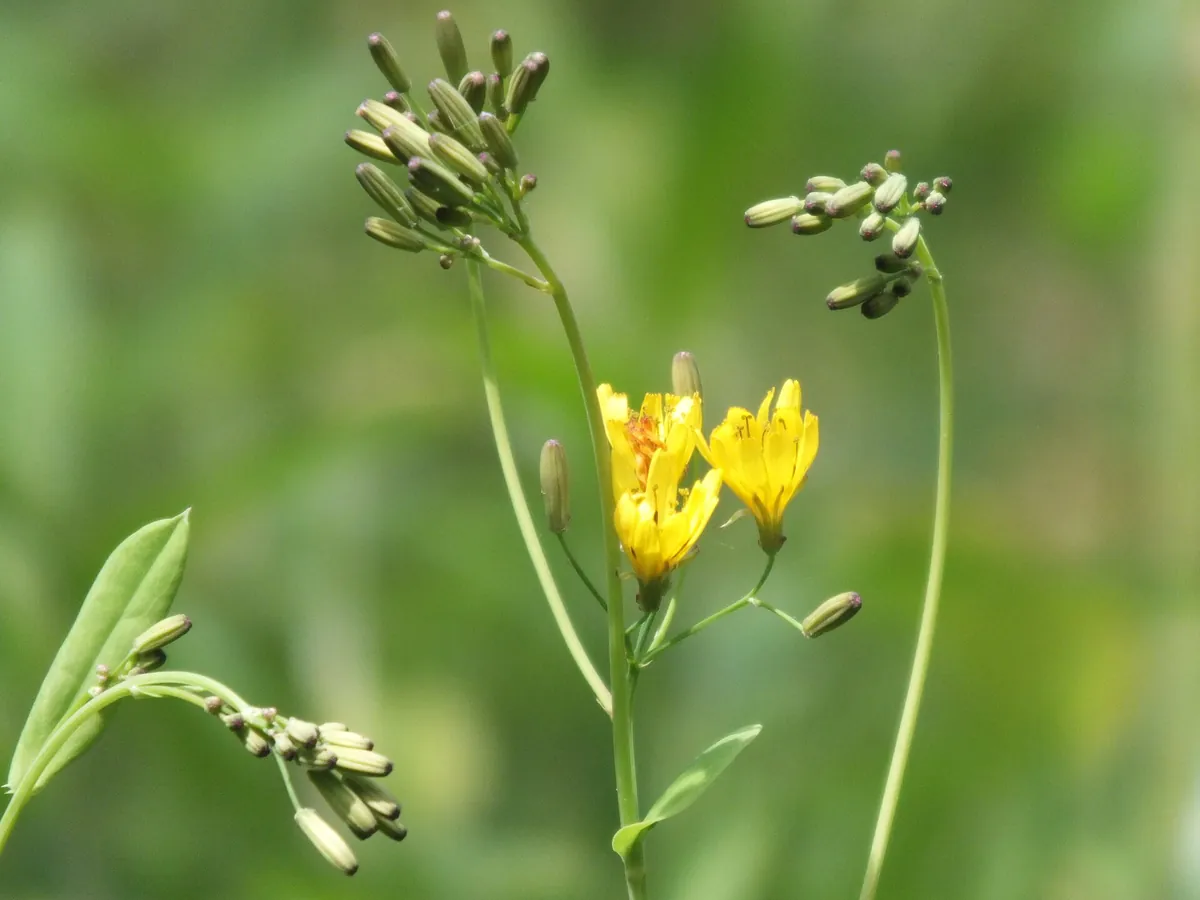
Ixeris dentata (nigana). Several yellow flower heads with few petals open at the ends of thin branching flower stalks, with unopened buds around them. The young leaves are mainly what is eaten, but this photograph shows the above-ground part in the flowering period.
Shown: Ixeris dentataPart / state: Yellow flower heads and buds of Ixeris dentata (nigana) blooming at the end of a thin flower stalk. Some of the leaves are also visible at the bottom of the frame
Photo: 松岡明芳 / CC BY-SA 3.0 / original image / ledger's original image
Scope and provenance of the photo
Identification: Identified as labelled in the source. The photograph shows the above-ground part in the flowering period and does not directly show the state of the young leaves used as food. The shooting location is "Yashiro-no-Mori Park" (from the source caption).
Image shown: The 1920 px version from Wikimedia Commons. No cropping or color changes by NIGAMI LAB. For display, a WebP capped at 1200 px wide is served; the ledger's original image can be checked from the link above.
On this page (8 sections)
Reading the bitterness
The leafy food called njana or nigana in Okinawa is the leaf of 「ホソバワダン」 (hosoba-wadan; Crepidiastrum lanceolatum). Okinawa Prefecture's traditional food-culture database explicitly identifies njana-baa with hosoba-wadan and says it is usually called nigana; the academic database GBIF also records Crepidiastrum lanceolatum as an accepted species. The name 「ニガナ」 (in translation: "nigana") alone does not identify a plant, however; it cannot automatically be equated with other plants called nigana elsewhere. The bitterness particular to these leaves has long been used in Okinawan home cooking.
Okinawan sources describe the leaf as bitter and used in shiraae and soups. One recipe calls for cutting the leaves into thin strips, soaking them in water to remove harshness, then draining them, but gives neither soaking duration nor number of repetitions. Another prefectural database mentions 「さっとゆでる」 (in translation: "boiling briefly"), suggesting variation in preparation among households and sources. A dressed dish combining njana and island tofu appears in several Okinawa Prefecture sources.
Sources for this overview
Checked for this overview: Checked the record identifying njana as hosoba-wadan. / Checked the record of a dressed dish with njana and island tofu.
Crepidiastrum lanceolatum (Houtt.) Nakai
Checked for this overview: Checked the scientific name in the academic database GBIF.
Checked for this overview: Checked the record of leaf bitterness and its use in shiraae and soups. / Checked the steps of thin slicing and water soaking to remove harshness.
Follow the connections
nigana greens →is used as→ Crepidiastrum lanceolatum
nigana shiraae →includes→ nigana greens
Structured claims — open a section to read each claim's confidence, evidence and limits
Composition and content (1)
Scope: The Okinawan ingredient njana / nigana
Note: Connected to Crepidiastrum lanceolatum (hosoba-wadan) through a prefectural source and GBIF. Not automatically merged with a different plant that shares a similar name.
Show data
ingredient-nigana —is_derived_from→ organism-hosobawadanHow processing and cooking change it (2)
Scope: Main ingredients shared by two Okinawa Prefecture food-culture sources.
Note: Uses njana from hosoba-wadan and island tofu.
Show data
dish-nigana-shiraae —includes→ ingredient-niganaScope: A recipe for njana-baa-suunee from Okinawa Prefecture.
Note: Another prefectural database also gives the method 『さっとゆでる』 (in translation: "boil briefly"); the difference among households and sources is retained. Confidence calibration (2026-08-31 review): because the basis consists only of public and news accounts of food culture, the status changed from supported to contextual.
Show data
ingredient-nigana —is_prepared_by→ (the claim sentence above)Culture (1)
Scope: The leaves of Crepidiastrum lanceolatum (hosoba-wadan), eaten in Okinawa as njana / nigana
Note: An ingredient source originating from Okinawa Prefecture records the leaves' bitterness and their use in shira-ae (a tofu-dressed dish) and soups. Confidence calibration (2026-08-31 review): downgraded from supported to contextual, since the grounds are only public and press cultural records.
Show data
ingredient-nigana —is_used_as→ organism-hosobawadan