日本語版

table olives

ingredient / ingredient-table-olives

テーブルオリーブ / Olea europaea

Olive drupes processed for direct eating.

Photographs (captions in Japanese)
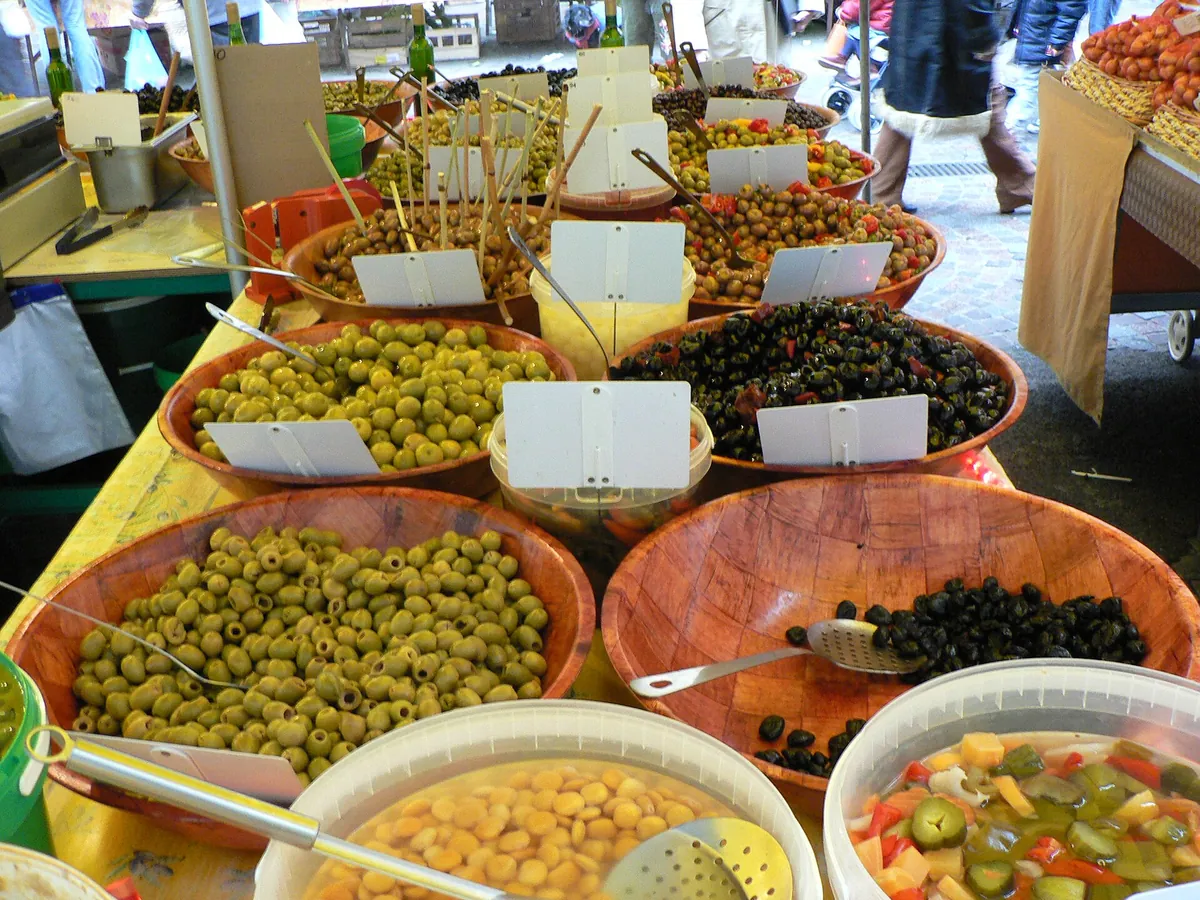
Several round wooden bowls on an outdoor market stall, each heaped with green, black, and brown olives. Green olives are in the bowl in front, black olives at the front right, and reddish olives with chili peppers at the back. Price tags and a scoop are included.

Table olives (fruit of Olea europaea processed by soaking in brine or seasoning liquid) sold at a morning market in Toulon, France, heaped by variety and preparation in wooden bowls. An example from a market, with several kinds including green olives, black olives, and ones with herbs or chili peppers.

Shown: Olea europaea (processed table olives)Part / state: Processed by soaking in seasoning liquid. Table olives of several varieties, green, black, and brown, heaped in wooden bowls and sold by weight at a market

Photo: David Monniaux / CC BY-SA 3.0 / original image / ledger's original image

Scope and provenance of the photo

Identification: Identified as labelled in the source. The source page says only "olives sold at the morning market in Toulon" and gives no scientific identification of cultivar or origin. This plate and stall display is not necessarily the standard form of table olives for the whole region. Re-identification by a specialist has not been done.

Image shown: The 1920 px version from Wikimedia Commons. No cropping or color changes by NIGAMI LAB. For display, a WebP capped at 1200 px wide is served; the ledger's original image can be checked from the link above.

On this page (8 sections)
  1. Overview
  2. Sources for this overview (2)
  3. Topic hubs
  4. Follow the connections
  5. Related entries (10)
  6. Composition and content (2)
  7. Sensory (3)
  8. How processing and cooking change it (1)
↑

Reading the bitterness

Table olives are olive drupes processed to be eaten as they are. Despite decreasing with fruit ripening, drupes are originally characterized by a strong bitter taste, which reviews summarize as being primarily attributable to oleuropein, a bitter compound. Raw fruit rarely reaches the table unmodified, and only after processing to partially or completely remove bitterness followed by fermentation do drupes become table olives as a pickled product.

The pathway for removing bitterness differs by commercial finishing method. In the Spanish style, prior to lactic fermentation in brine, drupes are immersed in a 1.5–4.5% (w/v) sodium hydroxide solution for chemical hydrolysis of oleuropein. In the Greek style, drupes are fermented directly in brine without using an immersion step. In the Alcaparras style, drupes split in half are immersed over approximately 1 week with water repeatedly changed, and oleuropein is removed by diffusion. Even with the same fruit, the removal pathway differs markedly depending on the finishing method.

Oleuropein that should have been removed sometimes remains measurable in some products. A dry-salted product was reported to have the highest oleuropein content, in contrast to the Spanish style, in which alkali treatment is described as capable of complete removal. In research tracking the processing of naturally green olives, hydrolysis of oleuropein via both enzymatic and chemical reactions has been confirmed during the process; however, these numerical values derive from individual studies compiled by reviews, and must be read with the premise that they vary by processing condition.

Sources for this overview

  1. Table Olives: An Overview on Effects of Processing on Nutritional and Sensory Quality

    Conte P; Fadda C; Del Caro A; Urgeghe PP; Piga A / 2020 / review / full text checked

    Checked for this overview: Confirmed in the text that drupes originally possess strong bitterness / Confirmed in the text that oleuropein is treated as the agent of bitterness / Confirmed in the text the debittering methods of Spanish, Greek, and Alcaparras styles / Confirmed in the text the persistence of oleuropein in dry-salted products

  2. Oleuropein hydrolysis in natural green olives: Importance of the endogenous enzymes

    Ramirez E; Brenes M; Garcia P; Medina E; Romero C / 2016 / journal article / full text checked

    Checked for this overview: Confirmed in the text the tracking of enzymatic hydrolysis in naturally green olives

Follow the connections

table olives →is produced through→ olive debittering and fermentation →reduces→ bitterness

table olives →contains, before and during…→ oleuropein →is a major cause of→ bitterness

table olives →can enhance→ bitterness →can be measured separately …→ astringency

Structured claims — open a section to read each claim's confidence, evidence and limits

Composition and content (2)

table olives contains, before and during processing, oleuropeinsupported

Scope: Natural green olives, in the cited processing studies

Note: The content changes through enzymatic and chemical hydrolysis.

During the processing of natural green olives, the enzymatic and chemical hydrolysis of oleuropein was tracked.
Limitations: Specific to the processing conditions.
Source: Oleuropein hydrolysis in natural green olives: Importance of the endogenous enzymes (Ramirez E; Brenes M; Garcia P; Medina E; Romero C, 2016) · full text checked
Fresh drupes are, verbatim, "characterized by a strong bitter taste that decreases with fruit ripening," and include "the bitter oleuropein that diminishes during maturation." Oleuropein remains measurable in some final products as well ("The highest oleuropein content was found on dry-salted Throuba Thassos olives").
Limitations: This extends the claim's scope beyond natural-green-olive research. Under Spanish-style alkali treatment, oleuropein can be completely removed, so its presence during processing is style-dependent.
Source: Table Olives: An Overview on Effects of Processing on Nutritional and Sensory Quality (Conte P; Fadda C; Del Caro A; Urgeghe PP; Piga A, 2020) · full text checked
In the control and aseptically treated groups, oleuropein disappeared completely within 1 month, while it remained stable for 6 months in fruit that was heat-treated and stored — showing that inactivating the endogenous enzyme halts the progress of debittering.
Limitations: A report on a single cultivar and a single condition. No sensory evaluation was carried out.
Source: Oleuropein hydrolysis in natural green olives: Importance of the endogenous enzymes (Ramirez E; Brenes M; Garcia P; Medina E; Romero C, 2016) · full text checked
Context: In the heat-treated group, formation of HyEDA was not observed at either temperature, while hydroxytyrosol and tyrosol were detected in all groups — indicating that beta-glucosidase and esterase differ in heat tolerance. The temperatures tested were 60 ºC and 90 ºC, with heating times of 10 and 30 min, respectively.
Limitations: This is an inference from the reaction products, not a direct measurement of enzyme activity.
Source: Oleuropein hydrolysis in natural green olives: Importance of the endogenous enzymes (Ramirez E; Brenes M; Garcia P; Medina E; Romero C, 2016) · full text checked
Show dataingredient-table-olives —contains_before_and_during_processing→ compound-oleuropein
claim: clm-table-olives-oleuropein / type: composition / updated: 2026-08-30
table olives does not significantly influence oleuropeinsupported

Scope: Layer: food. A comparison of salt and fermentation conditions in the same Gaeta PDO olives, with oleuropein quantified by chemical analysis.

Note: A counterexample showing that increasing salt does not chemically remove the principal bitter compound.

The residual oleuropein content at the point of commercial ripeness stayed within the range of 29-37 mg/kg, and the main effects of salt concentration and fermentation period were not statistically significant.
Limitations: A single-year, single-origin lot. Note that this is a chemical-analysis measure, separate from sensory bitterness intensity.
Source: Effect of Salt Addition and Fermentation Time on Phenolics, Microbial Dynamics, Volatile Organic Compounds, and Sensory Properties of the PDO Table Olives of Gaeta (Italy) (Sacchi R; Corrado G; Basile B; Mandarello D; Ambrosino ML; Paduano A; Savarese M; Caporaso N; Aponte M; Genovese A, 2022) · full text checked
Show dataingredient-table-olives —does_not_significantly_influence→ compound-oleuropein
claim: clm-w67a-olive-salt-oleuropein-unchanged / type: composition / updated: 2026-09-06

Sensory (3)

table olives can enhance bitternesssupported

Scope: Layer: food. Italian PDO "Oliva di Gaeta." Quantitative descriptive analysis on an unstructured 0-10 scale by a 10-member panel of students and researchers from the University of Naples Federico II.

The 30-day brine-fermentation lot had higher sensory bitterness and sourness scores than the 15-day lot. The same tendency held for both the 6% (MS) and 8% (HS) salt-concentration groups.
Limitations: A single-year, single-origin lot. The sensory panel consisted of students and researchers, not a representative consumer sample.
Source: Effect of Salt Addition and Fermentation Time on Phenolics, Microbial Dynamics, Volatile Organic Compounds, and Sensory Properties of the PDO Table Olives of Gaeta (Italy) (Sacchi R; Corrado G; Basile B; Mandarello D; Ambrosino ML; Paduano A; Savarese M; Caporaso N; Aponte M; Genovese A, 2022) · full text checked
Show dataingredient-table-olives —can_enhance→ sensation-bitter
claim: clm-w67a-olive-fermentation-time-bitterness / type: sensory / updated: 2026-09-06
table olives reduces bitternesssupported

Scope: Layer: food. Spanish-style Manzanilla green olives. Evaluation by a consumer panel of 100 with 3-10 years' experience regularly eating green olives. A 14-formulation experimental design.

In a sensory model with KCl concentration as the independent variable, increasing KCl concentration showed a coefficient that linearly lowered the bitterness score.
Limitations: A single cultivar, single processing style. The optimization desirability index stayed at 0.57, short of a complete optimum.
Source: Impact of Salts Mixtures on the Physicochemical and Sensory Characteristics of Spanish-Style Manzanilla Green Table Olives during Packaging (López-López A; Moreno-Baquero JM; Garrido-Fernández A, 2023) · full text checked
Show dataingredient-table-olives —reduces→ sensation-bitter
claim: clm-w67a-olive-kcl-reduces-bitterness / type: sensory / updated: 2026-09-06
table olives can enhance bitternesssupported

Scope: Layer: food. The same test, the same study, the same panel.

Note: An example showing that not every substitute for sodium salt weakens bitterness.

The bitterness model equation yielded positive coefficients of +0.426×CaCl2 + 0.380×MgCl2 − 0.023×CaCl2×MgCl2, and CaCl2 and MgCl2 were reported as major positive contributors to bitterness. The equation also includes a KCl term (+0.060×KCl).
Limitations: A single cultivar, single processing style. The interaction term is negative, so adding CaCl2 and MgCl2 together does not simply sum.
Source: Impact of Salts Mixtures on the Physicochemical and Sensory Characteristics of Spanish-Style Manzanilla Green Table Olives during Packaging (López-López A; Moreno-Baquero JM; Garrido-Fernández A, 2023) · full text checked
Show dataingredient-table-olives —can_enhance→ sensation-bitter
claim: clm-w67a-olive-cacl2-mgcl2-increase-bitterness / type: sensory / updated: 2026-09-06

How processing and cooking change it (1)

table olives is produced through: olive debittering and fermentationestablished

Scope: Principal processing method categories for table olives

Note: The degree and method of debittering vary.

Verbatim: 'Table olives are a pickled food product obtained by a partial/total debittering and subsequent fermentation of drupes.' Drupes are 'characterized by a strong bitter taste that decreases with fruit ripening'. The pathway of debittering differs by commercial preparation method: the Spanish style performs chemical hydrolysis of oleuropein by 'a lye treatment in a 1.5-4.5% (w/v) NaOH solution' prior to lactic fermentation in brine, the Greek style ferments drupes directly in brine, and the Alcaparras style removes oleuropein 'by diffusion' through repeated water rinsing over approximately 1 week from halved drupes.
Limitations: Review-level synthesis; quantitative results for phenolic compounds are attributable to cited primary studies (for example: complete removal of oleuropein under alkali treatment is according to reference [25]).
Source: Table Olives: An Overview on Effects of Processing on Nutritional and Sensory Quality (Conte P; Fadda C; Del Caro A; Urgeghe PP; Piga A, 2020) · full text checked
Show dataingredient-table-olives —is_produced_through→ process-olive-debittering
claim: clm-table-olive-process / type: processing / updated: 2026-08-30

↑ Top of page · ← Encyclopedia (English entries)