uruka (salted, fermented ayu entrails)
dish / dish-uruka
うるか
Uruka (salted, fermented ayu entrails) is an umbrella term for shiokara made by salting and fermenting or aging the flesh, viscera, eggs, or milt of ayu sweetfish. Varieties with regionally different names, including (mi-uruka), (ko-uruka), and (niga-uruka), are reported according to the part used and the production method.
Photographs (captions in Japanese)
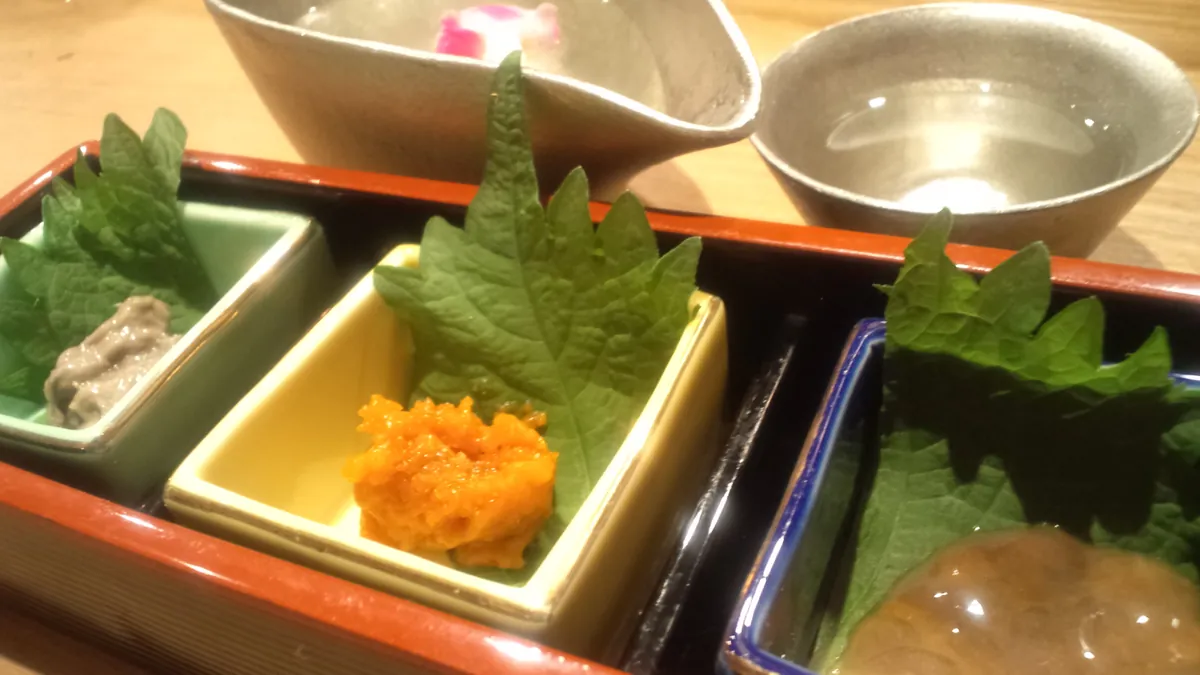
3 sake snacks: konoko (sea cucumber ovaries) from Yamaguchi, aged sea urchin from Sadamisaki, and ayu uruka (ko-uruka) from Shiga, photographed with junmai sake from Niigata. A composite photograph in which uruka is 1 of the 3 items and not shown by itself.
DishShown: Not applicable (dish)Part / state: Serving (part of the three-item sake snack plate)
Photo: Takamorry / CC BY-SA 2.0 / original image / ledger's original image
Scope and provenance of the photo
Identification: Identified as labelled in the source. Based on the ruling, a Commons file different from the shibu-uruka photograph used for dish-niga-uruka was adopted (to avoid duplication). Of this 3-item plate, the "ko-uruka" corresponds to the uruka line.
Image shown: No resizing, trimming, or color changes. The original image from Wikimedia Commons is used as it is. For display, a WebP capped at 1200 px wide is served; the ledger's original image can be checked from the link above.
On this page (10 sections)
Reading the bitterness
「うるか」 (uruka) is an umbrella term for shiokara made by salting and fermenting or aging the flesh, viscera, eggs, or milt of ayu sweetfish. A 1996 study compared the descriptions of 43 commercial products obtained across Japan with earlier literature and organized regionally different naming traditions according to the parts used and production methods, including 「身うるか」 (mi-uruka), 「子うるか」 (ko-uruka), 「白うるか」 (shiro-uruka), 「黒うるか」 (kuro-uruka), 「にがうるか」 (niga-uruka), and 「渋うるか」 (shibu-uruka). However, definitions of the same name vary by production area and cannot be fixed as a single classification.
In a product description from Minamiamabe District, Oita, 「にがうるか」 (niga-uruka) is defined as 『鮎の内臓のみをうるかにしたもの』 (in translation: "uruka made only from ayu viscera"). Official material introducing Oita regional cuisine also states that in Oita, the name uruka often refers to 「にがうるか」 (niga-uruka), and records that only ayu viscera are used. These accounts, however, come from one product and one prefectural record; they do not cover details of similarly named niga-uruka varieties elsewhere.
A 1996 study of 43 commercial ayu uruka products across Japan found salt concentrations ranging widely from 6.9% to 24.9% and reported a negative correlation between salt content and water activity (r=0.698). pH was generally around 6, slightly higher than the weakly acidic range commonly associated with fermented foods. A product description for mi-uruka from Masuda, Shimane, collected in the same study says 『鮎と身とはらわたを混ぜ合わせ、塩でもってねかせ、苦味と渋味を出させる』 (in translation: "mix the ayu flesh and innards and let them rest with salt to bring out bitterness and astringency"). Thus a single company's description presents bitterness and astringency developing during salt aging as part of the method.
A 2022 academic paper cites earlier cultural-history literature, 『ものと人間の文化史56 鮎』 (in translation: "History of Things and People 56: Ayu"), in presenting the distinctive aroma and flavor of the viscera of wild ayu, which feed on algae, and their traditional consumption in salt-grilled ayu and uruka. That literature records 86 ayu dishes and 21 processing methods, with forms ranging from chopping the flesh and opening the fish to using the whole fish with viscera. The same paper also quotes a chef running an ayu restaurant on the Nagara River as saying 『特に若い世代には内臓の苦味は好まれない』 (in translation: "the bitterness of the viscera is not liked, especially by younger people"). This remark chiefly concerns eating ayu with viscera, such as in salt-grilled fish; it does not necessarily describe preferences for uruka itself. It is one observation from one chef at one restaurant, not general evidence of differences in taste preferences between generations.
Sources for this overview
Checked for this overview: Checked the classification of names by part used and production method. / Checked the definition using only viscera in a product description from Minamiamabe District. / Checked salt concentrations of 6.9–24.9% and the negative correlation with water activity. / Checked the product description of salt aging to develop bitterness and astringency.
Checked for this overview: Checked the definition of niga-uruka in Oita regional-cuisine material.
長良川産アユの消化管内に混入する砂利の存在が食材としての品質に及ぼす影響について
Checked for this overview: Checked the record of 86 ayu dishes and 21 processing methods in the cultural account of ayu viscera consumption. / Checked the chef's statement that younger people dislike the bitterness of viscera.
Other names: 鮎うるか (ja), 身うるか (ja), 子うるか (ja), 白うるか (ja), 黒うるか (ja), 親うるか (ja), 切り込みうるか (ja, identification medium), 取り混ぜうるか (ja, identification medium)
Follow the connections
niga-uruka (bitter uruka, ayu entrails) →is a form of→ uruka (salted, fermented ayu entrails)
uruka (salted, fermented ayu entrails) →— bitterness is generated by→ shiokara-style salting and fermentation of viscera
3α,7α,12α-trihydroxy-5β-cholan-24-oic acid →is a bitter principle of→ uruka (salted, fermented ayu entrails)
Structured claims — open a section to read each claim's confidence, evidence and limits
Composition and content (3)
Scope: Ayu uruka products sold nationwide, and descriptions in prior literature
Note: A classification organized by a 1996 academic paper from a literature survey and a collection of product descriptions. The definitions vary by place of production, and there are examples — such as niga-uruka — where the same name is defined differently from one production area to another.
Show data
dish-uruka —has_variant→ (the claim sentence above)Scope: Uruka of Oita Prefecture (a local-dish source from Oita) and a nationwide product survey (a 1996 paper)
Show data
dish-niga-uruka —is_a_form_of→ dish-urukaScope: 1 ayu uruka product manufactured by the T Fisheries Cooperative in Shimane Prefecture (the sample used in the 1982 study)
Note: A study by the Department of Biochemistry, Tottori University School of Medicine (Sachiko Endo and Yoshikazu Ayaki). The sample was 1 product from a single fisheries cooperative and cannot be generalized to uruka in general.
Show data
dish-uruka —has_key_bitter_organoleptics→ (the claim sentence above)Sensory (4)
Scope: An interview with the head chef of "Ukou no Ie Sugiyama" on the Nagara River (a quotation within a 2022 academic paper; a remark from a single restaurant)
Note: A quotation from a single restaurant and a single individual; not treated as a general rule about generational differences in bitterness preference. Note that the remark mainly concerns eating the entrails in salt-grilled ayu, not uruka itself.
Show data
dish-uruka —has_perceived_bitterness_associated_with→ (the claim sentence above)Scope: A sensory test (6 assessors, using a method of rinsing the mouth with lukewarm water, then holding the sample in the mouth and expectorating it)
Note: It is also reported that bitterness intensified as purification progressed (Table 7), and the paper discusses the possibility that some other unknown component in uruka's total bile-acid fraction affects the discrimination threshold for bitterness and the expression of sweetness.
Show data
dish-uruka —has_bitter_recognition_threshold→ (the claim sentence above)Scope: The discussion section of the 1982 study
Note: Inferred, together with taurocholic acid, to be a principal bitter component.
Show data
compound-cholic-acid —is_a_bitter_principle_of→ dish-urukaScope: The discussion section of the 1982 study.
Note: Estimated as a major bitter component along with cholic acid.
Show data
compound-taurocholic-acid —is_a_bitter_principle_of→ dish-urukaHow processing and cooking change it (2)
Scope: 43 ayu uruka products sold across Japan as of 1996 (from various unspecified production areas and types of ayu and uruka).
Note: Measured data: general composition by standard methods, pH, water activity (Hydroskop-DT model), and salt concentration (silver nitrate titration). The paper explicitly states that extract components, including taste-active amino acids, were not measured.
Show data
dish-uruka —has_composition→ (the claim sentence above)Scope: The description on a mi-uruka product from Masuda City, Shimane Prefecture (one of the product materials collected by a 1996 paper)
Note: A quotation from a single company's product description; not generalized.
Show data
dish-uruka —has_bitterness_generated_by→ process-naizo-shiokaraCulture (1)
Scope: A literature review of ayu food culture in Japan (introduction to a 2022 academic paper).
Note: The paper's main focus is an investigation of gravel in the digestive tract; its introduction is treated as a literature review of food culture.
Show data
dish-uruka —is_documented_as_part_of→ (the claim sentence above)