coffee brew
ingredient / ingredient-coffee-brew
コーヒー(抽出液)
Coffee brew is a beverage made by grinding roasted beans and extracting the components in water or hot water. Bitterness arises not only from caffeine but is rearranged by roasting byproducts and extraction conditions.
Photographs (captions in Japanese)
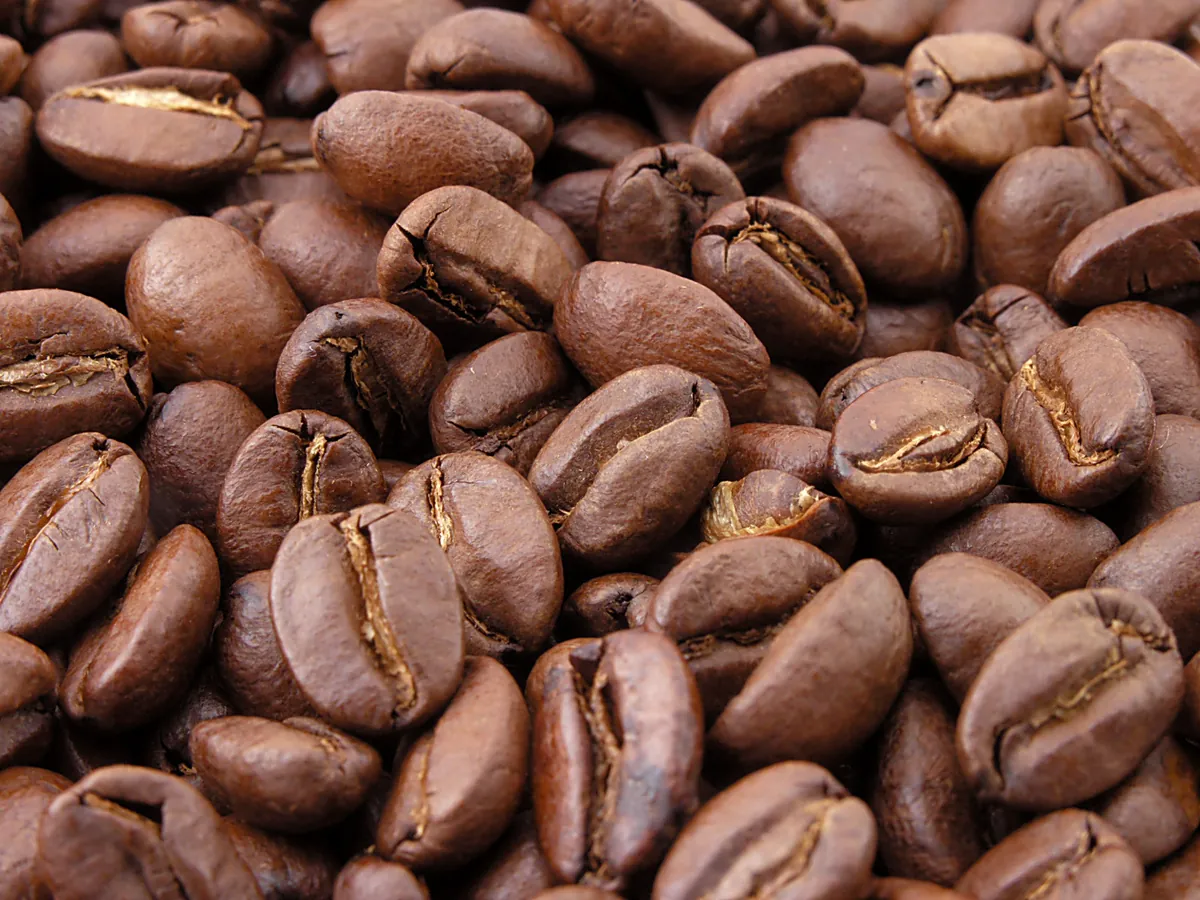
Roasted beans used as the raw material for brewed coffee. The source of the photograph does not state the species, cultivar, or roast level, so this is not a photograph showing the color or strength of the brewed liquid itself.
Raw materialShown: Coffea spp. (species and cultivar not stated in the source)Part / state: Roasted seeds
Photo: MarkSweep / Public domain / original image / ledger's original image
Scope and provenance of the photo
Identification: Identified as labelled in the source. Its relation to the encyclopedia entry is as raw material, not the brewed liquid itself.
Image shown: The full-size file from Wikimedia Commons. No cropping or color changes by NIGAMI LAB. For display, a WebP capped at 1200 px wide is served; the ledger's original image can be checked from the link above.
On this page (8 sections)
Reading the bitterness
The photograph shows roasted beans, but the subject of this entry is a single cup of coffee made by grinding them and extracting the components in water or hot water. As the roasting method and the conditions for passing the hot water through the ground coffee vary, so too does the assembly of bitterness that reaches the cup. This bitterness cannot be explained by the word caffeine alone; multiple component groups are involved, including quinides, oligomers of 4-vinylcatechol, and mozambioside roasting byproducts.
For this reason, it is not possible to determine the bitterness of the extracted liquid on the basis of the bean name alone. Roasting conditions change the generation of bitter compounds, and the manner in which hot water passes through changes the amount of those compounds that reach the cup. Which candidate appears strongest is also influenced by the analytical method, and instrument taste-sensor responses cannot be equated with the breakdown of bitterness perceived by humans.
Nor is taste sensation on the drinking side fixed. In a trial with 155 subjects, a change occurred immediately after drinking coffee in which sweetness perception increased and bitterness perception decreased; this change was repeated even in decaffeinated coffee. In large-scale genetic statistics, bitterness sensitivity to quinine and PROP was negatively related to coffee intake, while bitterness sensitivity to caffeine was positively related. Simple logic does not hold — that a person sensitive to bitterness will necessarily avoid coffee.
Sources for this overview
Checked for this overview: Quantitative chemistry and sensory research treating roasting byproducts and extraction conditions / Research showing that roasting conditions and water extraction alter bitter-compound concentrations
Contribution of mozambioside roasting products to coffee's bitter taste
Checked for this overview: Research on the bitterness contribution of mozambioside roasting byproducts
Checked for this overview: A review article organizing the fact that caffeine cannot serve as a universal representative of bitterness
Bitterness compounds in coffee brew measured by analytical instruments and taste sensing system
Checked for this overview: Methodological limitations of candidate identification by electronic taste sensor and statistical model
Checked for this overview: A trial with 155 subjects comparing taste-sensitivity immediately after normal and decaffeinated coffee consumption
Checked for this overview: Negative association between quinine and PROP bitterness sensitivity and coffee intake / Result showing that the direction of the relationship between caffeine bitterness sensitivity and intake reverses
Follow the connections
coffee brew →shows the sensory response→ bitterness →can be measured separately …→ astringency
coffee brew →has bitter contributors oth…→ caffeine →is a poor universal prototy…→ bitterness
chlorogenic acid →has a measured content in→ coffee brew
coffee brew →— perceived bitterness is s…→ sweetness →can reduce the perceived bi…→ bitterness
Structured claims — open a section to read each claim's confidence, evidence and limits
Composition and content (5)
Scope: 4 stages of roast level evaluated by instrumental chemical analysis and electronic taste sensor
Note: Candidate ranking was by PLS-R and taste sensor, not by human sensory panel.
Show data
ingredient-coffee-brew —has_candidate_bitterness_contributors→ (the claim sentence above)Scope: Multiple lines of evidence: human sensory testing, receptor assays, and quantitative chemistry
Note: A group of counterexamples to the common belief that 「コーヒーの苦味=カフェイン」 (in translation: "coffee's bitterness equals caffeine"). The quantitative contribution ratio is not recorded, since the full text was not confirmed.
Show data
ingredient-coffee-brew —has_bitter_contributors_other_than→ compound-caffeineScope: Quantification by UV-Vis spectrophotometry (330 and 272 nm, 70% ethanol extraction), compared against a standard calibration curve
Note: หนองน้ำดำ (Nong Nam Dam) village is not necessarily the same growing area as Doi Tung/Doi Chang, but it connects to this cluster in the context of arabica grown under a Royal Project in northern Thailand. Only the abstract was checked (the full-text PDF was rasterized and could not be extracted).
Show data
compound-chlorogenic-acid —has_measured_content_in→ ingredient-coffee-brewScope: Connection of the GI-standard product classification (including green beans, roasted beans, and ground coffee) to the existing ingredient-coffee-brew entry, a beverage extracted from roasted beans, as a geographically restricted version of that entry
Show data
ingredient-doi-tung-coffee —is_associated_with→ ingredient-coffee-brewNote: Connects to the existing entry ingredient-coffee-brew.
Show data
ingredient-kopi —is_a_type_of→ ingredient-coffee-brewSensory (9)
Scope: Electronic taste-sensor response to fractionated coffee extract
Note: The cited experiment does not provide confirmation by human sensory evaluation.
Show data
ingredient-coffee-brew —has_sensory_response→ sensation-bitterScope: Mendelian randomization in UK Biobank (n = 438,870, white British ancestry)
Note: This holds for quinine and PROP bitterness (-0.081 / -0.021 cups/day per SD), but reverses for caffeine bitterness, in which higher intake increases. Because the direction differs by substance, the rule 『苦味感受性が高いほど苦味飲料を避ける』 (in translation: "the higher the bitterness sensitivity, the more one avoids bitter beverages") cannot be treated as general.
Show data
ingredient-coffee-brew —has_consumption_reduced_by→ (the claim sentence above)Scope: Taste and smell sensitivity testing before and after coffee intake in 155 people
Note: Smell sensitivity did not change, and the effect was reproduced with decaf, so it cannot be attributed to caffeine alone. A short-term effect.
Show data
ingredient-coffee-brew —can_remain_changed_after→ (the claim sentence above)Scope: Layer: food. A human psychophysical test of mixtures of brewed coffee and sucrose (abstract only; concentration and number of participants not confirmed).
Show data
ingredient-coffee-brew —has_perceived_bitterness_suppressed_by→ sensation-sweetScope: Layer: food. Full-immersion-brewed coffee (light roast and dark roast) was brewed at 4°C, 22°C, and 92°C, and a trained panel of 14 (10 women, 4 men) evaluated 27 attributes. Bitterness, sourness (sour), burnt, smoky, and rubber notes all increased together with rising total dissolved solids (TDS), and for dark roast these attributes increased significantly with rising brew temperature (Liang, Batali, Ristenpart & Guinard 2024).
Note: An example where bitterness and sourness do not suppress each other, but move in the same direction depending on brew strength. Placed here as an example of co-variation rather than mutual suppression between sourness and bitterness.
Show data
ingredient-coffee-brew —has_perceived_bitterness_affected_by→ (the claim sentence above)Scope: Layer: food. Drip-brewed coffee. This is a comparison under conditions where brew strength and percent extraction were experimentally controlled, so it may not generalize directly to home brewing, where raising the water temperature also tends to move the concentration. A descriptive sensory analysis of 31 attributes by a trained panel of 12 (8 women, 4 men, ages 19-30).
Note: A counterexample to the naive expectation that “changing the water temperature changes the bitterness.” Note that this is conditional on TDS being held constant.
Show data
ingredient-coffee-brew —has_perceived_bitterness_unchanged_by→ (the claim sentence above)Scope: Layer: food. Sensory evaluation on a 5-point scale, 0 (not detectable) to 5 (strongly detected), by 18 panelists (8 women, 10 men, ages 23-31). Caffeine was added to a decaffeinated roasted coffee beverage (a commercial capsule, equivalent to 54 g/L).
Show data
ingredient-coffee-brew —has_perceived_bitterness_unchanged_by→ compound-caffeineScope: Layer: Food. QDA by a trained panel of 18 and consumer preference survey of 120. Traditional and decaffeinated espresso sweetened with sucrose, sucralose, or stevia (multiple rebaudioside A concentrations) were compared.
Show data
ingredient-coffee-brew —has_perceived_bitterness_affected_by→ compound-caffeineScope: Layer: food. An experiment contaminating natural-processed specialty coffee with quaker beans (from immature beans), with sensory evaluation and volatile compound analysis. The number and training status of the sensory panel are not stated in the abstract.
Show data
ingredient-coffee-brew —has_perceived_bitterness_affected_by→ (the claim sentence above)How processing and cooking change it (1)
Scope: Vietnam, Cholon district, Saigon (Ho Chi Minh City)
Show data
ingredient-coffee-brew —is_processed_by→ process-vietnamese-butter-roasting