Topic hub — 2026-10-21
Do people stop disliking bitter vegetables after eating them repeatedly?
A caveat first: no longer disliking a vegetable can mean coming to like it or eat more of it, or coming to find it less bitter. Most studies measured the first two, and few measured how bitter people found the food. This page does not treat these as the same and does not present a rise in liking as a fall in perceived bitterness. People often say you get used to bitter vegetables if you keep eating them. What do studies that had people eat or taste vegetables or bitter foods repeatedly, and compared liking, amount eaten or bitterness, say? This page lines up the included studies together with their conditions: who took part, how many exposures over how long, the food and whether it was called bitter, and the rating scale. It then separates what was established within one experiment, what differences between studies might explain, and what this comparison alone cannot separate. It is about perceived taste and amount eaten, not advice on feeding children or on health.
On this page (11 sections)
- What this page establishes
- What the included studies allow us to say
- Liking and amount eaten at a glance
- Bitterness ratings at a glance
- Conditions and results, study by study
- What was established within an experiment
- Candidate explanations for the differences
- What is not known — what this comparison alone cannot separate
- How studies and rows were counted
- What we looked at
- Read in the encyclopedia
What this page establishes
- That offering vegetables repeatedly tends to raise liking and amount eaten across many studies, but the pooled size is small and there is no analysis limited to bitter vegetables.
- That intake and liking rose for a vegetable the paper calls bitter, but no result on perceived bitterness was in the abstract.
- That among studies whose results we could check in the original, none measured whether eating bitter vegetables repeatedly lowers perceived bitterness; the fall in bitterness intensity that was found was for a bitter solution, not a vegetable.
- That a rise in liking does not show that people came to find a vegetable less bitter: few studies measured both, and where they did, no significant fall in bitterness was reported even as liking rose.
What the included studies allow us to say
- Liking and intake move in the same direction across many studies, but the size is small. Pooling studies that offered vegetables repeatedly, liking rose by SMD 0.35 and intake by SMD 0.23 compared with no exposure, about 0.6 points on a 9-point scale and about 10 g. This pooling is not limited to bitter vegetables; most targets were neutral to mildly disliked. For turnip, which the paper calls bitter, intake (p<0.001) and liking (p=0.008) rose after 10 days (abstract). [rows: Appleton 2018 Repeated exposure vs none; Appleton 2018 Repeated exposure vs none; Mohd Nor 2021 Turnip, after 10 days vs before; Mohd Nor 2021 Turnip, after 10 days vs before]
- Among studies whose results we could check in the original, none had people eat bitter vegetables repeatedly and measured whether they then found them less bitter. The only study whose results on vegetable bitterness we could check had people eat vegetable-flavoured gummies for 2 weeks, and no significant change in the bitterness of the kale and broccoli in the game was reported after 2 weeks. A clear fall in bitterness intensity was found for EGCG test solutions, not a vegetable (including those with added casein; 65 to 54). [rows: Davis 2024 Chopped kale and broccoli, after 2 weeks vs before; Davis 2021 After vs before 2 weeks of EGCG]
Liking and amount eaten at a glance
Results on liking (pleasantness or preference ratings) and amount eaten. Values for "After repeated exposure" and "Comparison" are as reported in the tables or text. For studies read only as abstracts, only what the abstract states is shown. These rows are not results on perceived bitterness. "Direction" is the larger of the two values; whether the difference is significant is shown by the test in the same "Direction / test" column. Select a study name to jump to its detailed table.
Results on liking and amount eaten only (not bitterness intensity). Where each value comes from (a table or a reading from a figure) is shown in its row; scales and methods differ between studies, so compare within a row, not across rows.
| Study | Comparison and condition | Measured as | After repeated exposure | Comparison (before, or no exposure) | Direction / test |
|---|---|---|---|---|---|
| Appleton 2018 | Repeated exposure vs none Just after repeated exposure to one vegetable (17 comparisons, 820 people) | standardised mean difference in liking ratings | SMD 0.35 (95% CI 0.17–0.53) | no exposure (reference) | After repeated exposure higher Tested, significant |
| Appleton 2018 | Repeated exposure vs none Just after repeated exposure to one vegetable (21 comparisons, 1130 people) | standardised mean difference in intake | SMD 0.23 (95% CI 0.07–0.39) | no exposure (reference) | After repeated exposure higher Tested, significant |
| Appleton 2018 | Repeated exposure vs none (longest follow-up) At the longest follow-up (about 1.5 months after, in this analysis) | standardised mean difference in liking ratings | SMD 0.30 (95% CI 0.14–0.45) | no exposure (reference) | After repeated exposure higher Tested, significant |
| Davis 2024 | Chopped kale, after 2 weeks vs before Guessing game with sugar-containing vegetable-flavoured gummies daily for 2 weeks (vegetable group, 18 people) | least-squares mean on a liking scale (−110 to 110) | −8 | −28 | After repeated exposure higher Tested, significant |
| Caton 2014 | Patterns of eating during exposure Artichoke purée 5–10 times (332 children, 4–38 months) | share of children (pattern of intake over exposures) | 40% in the increasing pattern (133), 21% in the eat-it-all pattern (70) | 16% with predicted intake under 10 g at the 5th exposure (53), 23% other (76) | Direction not given No test reported |
| Mohd Nor 2021 | Turnip, after 10 days vs before Steamed puréed turnip once a day for 10 days (172 children aged 3–5) | intake (no unit in the abstract) | increased (values not in the abstract) | values not in the abstract | After repeated exposure higher Tested, significant |
| Mohd Nor 2021 | Turnip, after 10 days vs before Same (172 children aged 3–5) | liking (no scale in the abstract) | higher (values not in the abstract) | values not in the abstract | After repeated exposure higher Tested, significant |
| Remy 2013 | Basic purée, after 10 exposures vs before Basic artichoke purée 10 times, 2–3 a week (infants, group of 32) | intake (g, recorded at home by parents) | +63% | before | After repeated exposure higher Tested, significant |
| Stein 2003 | Beverage, after 7 days vs before A commercial bittersweet beverage once a day for 7 days (number and age not in the abstract; not a vegetable) | pleasantness rating (no scale in the abstract) | +68% | before | After repeated exposure higher No test reported |
| de Wild 2013 | Soups, after 7 weeks vs before Endive and spinach soups 2 times a week for 7 weeks (28 toddlers analysed after meeting the criteria) | ad libitum intake (up to 200 g) | rose by about 58 g | before | After repeated exposure higher Tested, significant |
| de Wild 2017 | After 6 vegetable servings vs before (4 groups) Main meal at home 6 times over 6 weeks (103 children aged 2–4, 4 groups) | ad libitum intake at a day-care meal (mean of 4 groups) | 91 g | 53 g | After repeated exposure higher Tested, significant |
| Fisher 2012 | Broccoli, after 7 weeks vs before Raw broccoli 2 times a week for 7 weeks in 4 dressing conditions (152 preschool children) | liking (no scale in the abstract) | higher (values not in the abstract) | values not in the abstract | After repeated exposure higher No test reported |
| Capaldi 2008 | After eating it mixed with sugar vs before Broccoli or cauliflower first eaten mixed with sugar (62 undergraduates, experiment 2; the later rating conditions are not in the abstract) | liking (no scale in the abstract) | higher (values not in the abstract) | values not in the abstract | After repeated exposure higher No test reported |
Bitterness ratings at a glance
Results in which people rated bitterness intensity only. Rows for samples that are not vegetables are included (the detailed table for each row shows the sample). Where values are only in supplementary tables, only whether differences were significant is shown.
Results in which people rated bitterness only. Where each value comes from (a table or a reading from a figure) is shown in its row; scales and methods differ between studies, so compare within a row, not across rows.
| Study | Comparison and condition | Measured as | After repeated exposure | Comparison (before, or no exposure) | Direction / test |
|---|---|---|---|---|---|
| Davis 2021 | After vs before 2 weeks of EGCG 0.08% EGCG solution 4 times a day for 2 weeks (not a vegetable) | mean on a 110-point scale (37 people) | 54 | 65 | Comparison (before, or no exposure) more bitter Tested, significant |
| Davis 2024 | Chopped spinach, after 2 weeks vs before Vegetable group of the same gummy game (spinach was not in the game) | bitterness intensity (110-point scale) | lower (values in supplementary tables, not read) | values in supplementary tables | Comparison (before, or no exposure) more bitter Tested, significant |
| Davis 2024 | Chopped kale and broccoli, after 2 weeks vs before The same gummy game (kale and broccoli were in the game) | bitterness intensity (110-point scale) | no significant change (values in supplementary tables, not read) | values in supplementary tables | Direction not given Tested, not significant |
Conditions and results, study by study
For each study, the conditions for the samples, number and period of exposures, serving and who rated them, and the results. Each row is one study × one measured result, so different comparisons in the same study are separate rows. Under each row we give where it is in the paper and whether it can be used to judge whether repeatedly eating or tasting changes how much people like or eat bitter vegetables, or how bitter they find them, with the reason. Nothing is left blank: "not given", "not read" and "not applicable" are kept apart.
Appleton 2018 liking, intake
Repeated exposure and conditioning strategies for increasing vegetable liking and intake: systematic review and meta-analyses. American Journal of Clinical Nutrition — doi:10.1093/ajcn/nqy143
- How deeply checked
- Checked in full text — Full text via PMC (abstract, methods, results, discussion); the attached correction could not be retrieved and was not checked Checked by: LLM (one extracted, another checked against the source; no human check), 2026-10-21.
- Samples
- Vegetables in 43 papers and 117 comparisons (mainly carrot and green beans for infants; neutral to mildly disliked vegetables for older children and adults); no analysis limited to bitter vegetables
- Processing and cooking
- Varies by study (one vegetable offered repeatedly, paired with another taste or reward, or a variety of vegetables)
- How it was served or eaten
- Varies by study
- Who rated, on what scale
- Infants to adults (mostly young children); liking ratings (3- to 9-point scales) and intake (g) pooled as standardised mean differences (SMD); groups of about 20, many studies at high risk of bias
| Measured | Comparison and condition | After repeated exposure | Comparison (before, or no exposure) | Unit | Direction / test |
|---|---|---|---|---|---|
| Liking (pleasantness or preference ratings) | Repeated exposure vs none Just after repeated exposure to one vegetable (17 comparisons, 820 people) | SMD 0.35 (95% CI 0.17–0.53) | no exposure (reference) | standardised mean difference in liking ratings | After repeated exposure higher Tested, significant |
| P<0.01, I2=25%; about 0.6 points on a 9-point scale. There is no analysis limited to bitter vegetables, and most targets were neutral to mildly disliked vegetables. Pooled comparisons within the same people, between the exposed vegetable and another vegetable, found no significant difference (largest SMD 0.13, P=0.19) Where: Results (repeated exposure vs no exposure) For whether repeatedly eating or tasting changes how much people like or eat bitter vegetables, or how bitter they find them: Limited — Pools liking after repeated exposure to vegetables; not limited to bitter vegetables, and perceived bitterness was not measured | |||||
| Amount eaten (intake) | Repeated exposure vs none Just after repeated exposure to one vegetable (21 comparisons, 1130 people) | SMD 0.23 (95% CI 0.07–0.39) | no exposure (reference) | standardised mean difference in intake | After repeated exposure higher Tested, significant |
| P<0.01, I2=29%; about 10 g. There is no analysis limited to bitter vegetables Where: Results (repeated exposure vs no exposure) For whether repeatedly eating or tasting changes how much people like or eat bitter vegetables, or how bitter they find them: Limited — Pools intake; not limited to bitter vegetables | |||||
| Liking (pleasantness or preference ratings) | Repeated exposure vs none (longest follow-up) At the longest follow-up (about 1.5 months after, in this analysis) | SMD 0.30 (95% CI 0.14–0.45) | no exposure (reference) | standardised mean difference in liking ratings | After repeated exposure higher Tested, significant |
| P<0.01. Intake SMD 0.19 (0.04–0.35, P=0.02). For interventions offering a variety of vegetables, liking for a new vegetable at the longest follow-up was SMD 0.15 (−0.21 to 0.50, P=0.41), not significant. The authors say evidence of long-term benefit is limited Where: Results (follow-up analyses) For whether repeatedly eating or tasting changes how much people like or eat bitter vegetables, or how bitter they find them: Limited — Liking at follow-up; follow-up periods were short and varied | |||||
Davis 2021 sensory only
Repeated exposure to epigallocatechin gallate solution or water alters bitterness intensity and salivary protein profile. Physiology & Behavior — doi:10.1016/j.physbeh.2021.113624
- How deeply checked
- Checked in full text — Full author manuscript via PMC; values for the water period are only in a figure and were not transcribed Checked by: LLM (one extracted, another checked against the source; no human check), 2026-10-21.
- Samples
- Not a vegetable: a 0.08% (1.75 mM) solution of EGCG, a tea catechin; solutions with added casein were also rated
- Processing and cooking
- Crossover: 2 weeks of EGCG solution and 2 weeks of water (order counterbalanced); 4 times a day, 4 sips of 15 mL held 30 s and swallowed (240 mL a day)
- How it was served or eaten
- At each visit, 15 mL served in opaque cups, held 10 s and swallowed
- Who rated, on what scale
- 37 untrained adults (aged 19–44); bitterness intensity on a 110-point scale; liking not measured
| Measured | Comparison and condition | After repeated exposure | Comparison (before, or no exposure) | Unit | Direction / test |
|---|---|---|---|---|---|
| Bitterness intensity (sensory) | After vs before 2 weeks of EGCG 0.08% EGCG solution 4 times a day for 2 weeks (not a vegetable) | 54 | 65 | mean on a 110-point scale (37 people) | Comparison (before, or no exposure) more bitter Tested, significant |
| p<0.0001. The 65 and 54 average the EGCG test solutions, including those with added casein (the solution taken repeatedly was EGCG alone). Lower than after the 2 water weeks (p<0.0001; water-period values only in a figure). Ratings of the water sample also fell in both periods. The authors say they cannot separate a change in perceived intensity from reduced dislike, after becoming familiar, spilling into the intensity rating. Liking was not measured Where: Results (bitterness intensity of EGCG) For whether repeatedly eating or tasting changes how much people like or eat bitter vegetables, or how bitter they find them: Limited — Shows a fall in perceived bitterness, but for an EGCG solution, not a vegetable | |||||
Davis 2024 bitterness + liking
A method to "gamify" exposure to vegetable flavor and its potential influence on liking. Food Science & Nutrition 12(9):6873-6885 — doi:10.1002/fsn3.4272
- How deeply checked
- Checked in full text — Full text via PMC (Table 2, results); the supplementary tables with bitterness and sweetness values were not read Checked by: LLM (one extracted, another checked against the source; no human check), 2026-10-21.
- Samples
- Rated chopped and puréed kale, broccoli, asparagus and spinach (store-bought frozen vegetables cooked in a microwave); kale and broccoli were in the game, asparagus and spinach were not
- Processing and cooking
- Not the vegetables themselves: a guessing game with sugar-containing vegetable-flavoured gummies daily for 2 weeks (10–12 sessions); the control group had non-vegetable-flavoured gummies
- How it was served or eaten
- Samples served cold
- Who rated, on what scale
- 34 people aged 19–25 who ate few vegetables (eligibility 18–25) (18 vegetable group, 16 control); liking (−110 to 110) and bitterness and sweetness intensity (110-point scale); no correction for multiple comparisons
| Measured | Comparison and condition | After repeated exposure | Comparison (before, or no exposure) | Unit | Direction / test |
|---|---|---|---|---|---|
| Liking (pleasantness or preference ratings) | Chopped kale, after 2 weeks vs before Guessing game with sugar-containing vegetable-flavoured gummies daily for 2 weeks (vegetable group, 18 people) | −8 | −28 | least-squares mean on a liking scale (−110 to 110) | After repeated exposure higher Tested, significant |
| p=0.0075 (−11 after week 1, p=0.016). No significant change was found for chopped broccoli (8, 8, 6). No difference between groups was significant for any vegetable. In the control group, liking for kale purée fell (p=0.010). What was repeated was the sugar-containing gummies (the real vegetables were only tasted on rating days), and the authors note the pairing with sugar in the gummies may have contributed Where: Table 2; Results (liking) For whether repeatedly eating or tasting changes how much people like or eat bitter vegetables, or how bitter they find them: Limited — Liking for kale, regarded as bitter, rose, but what was repeated was sugar-containing vegetable-flavoured gummies, and the difference between groups was not significant | |||||
| Bitterness intensity (sensory) | Chopped spinach, after 2 weeks vs before Vegetable group of the same gummy game (spinach was not in the game) | lower (values in supplementary tables, not read) | values in supplementary tables | bitterness intensity (110-point scale) | Comparison (before, or no exposure) more bitter Tested, significant |
| p=0.013. Liking for chopped spinach in the same group tended to rise (−7 to 5, p=0.095), not significant. No correction for multiple comparisons Where: Results (sweetness and bitterness) For whether repeatedly eating or tasting changes how much people like or eat bitter vegetables, or how bitter they find them: Limited — From the only study whose results on perceived bitterness in vegetables we could check, but the fall was for a vegetable not in the game, one of many uncorrected comparisons | |||||
| Bitterness intensity (sensory) | Chopped kale and broccoli, after 2 weeks vs before The same gummy game (kale and broccoli were in the game) | no significant change (values in supplementary tables, not read) | values in supplementary tables | bitterness intensity (110-point scale) | Direction not given Tested, not significant |
| The text says the only significant bitterness change after 2 weeks was for chopped spinach in the vegetable group. Chopped broccoli was more bitter after week 1 (p=0.031), but this was gone after 2 weeks. No significant change in purée bitterness was reported Where: Results (sweetness and bitterness) For whether repeatedly eating or tasting changes how much people like or eat bitter vegetables, or how bitter they find them: Limited — No significant change in perceived bitterness of the game vegetables was reported after 2 weeks; values are in supplementary tables, not read | |||||
Caton 2014 intake
Learning to eat vegetables in early life: the role of timing, age and individual eating traits. PLoS ONE 9(5):e97609 — doi:10.1371/journal.pone.0097609
- How deeply checked
- Checked in full text — Full text via PMC Checked by: LLM (one extracted, another checked against the source; no human check), 2026-10-21.
- Samples
- Artichoke purée (basic, sweetened, energy-added); the paper calls it a novel vegetable and does not call it bitter
- Processing and cooking
- 5–10 exposures; intake of up to 200 g of the basic purée weighed before and after
- How it was served or eaten
- Served cold in the UK and Denmark and warm in France; up to 200 g (2 pots of 100 g) at the before and after tests
- Who rated, on what scale
- 332 children aged 4–38 months in the UK, Denmark and France; intake only, liking and bitterness intensity not measured
| Measured | Comparison and condition | After repeated exposure | Comparison (before, or no exposure) | Unit | Direction / test |
|---|---|---|---|---|---|
| Amount eaten (intake) | Patterns of eating during exposure Artichoke purée 5–10 times (332 children, 4–38 months) | 40% in the increasing pattern (133), 21% in the eat-it-all pattern (70) | 16% with predicted intake under 10 g at the 5th exposure (53), 23% other (76) | share of children (pattern of intake over exposures) | Direction not given No test reported |
| Patterns were assigned from each child's regression of intake on exposure number, using predicted values and slopes (for example, eat-it-all meant predicted intake over 75 g at exposures 1 and 5; the abstract says 75%). The shares themselves were not tested. Age differed significantly between patterns (p<0.001), with older children more often in the non-eating pattern; the energy-added condition changed least. Liking and bitterness intensity were not measured. Includes data from the French and UK trials (Remy 2013, Caton 2013); the 95 French infants are the same children as in the Remy 2013 row Where: Results (eating patterns) For whether repeatedly eating or tasting changes how much people like or eat bitter vegetables, or how bitter they find them: Limited — Patterns of eating during exposure; the paper does not call artichoke bitter and did not measure liking or perceived bitterness; the 95 French infants are the same children as in the Remy 2013 row | |||||
Mohd Nor 2021 intake, liking
The effects of taste sensitivity and repeated taste exposure on children's intake and liking of turnip (Brassica rapa subsp. rapa); a bitter Brassica vegetable. Appetite 157:104991 — doi:10.1016/j.appet.2020.104991
- How deeply checked
- Abstract only — Abstract only (full text paywalled) Checked by: LLM (one extracted, another checked against the source; no human check), 2026-10-21.
- Samples
- Turnip (called a bitter Brassica vegetable in the title); parents' questionnaires confirmed the children did not know it
- Processing and cooking
- Steamed puréed turnip once a day for 10 days; follow-up after 3 months
- How it was served or eaten
- Not given (not in the abstract)
- Who rated, on what scale
- 172 children aged 3–5 (number recruited); intake and liking; bitter sensitivity (genotypes, PROP, fungiform papillae density) also measured; no bitterness-intensity measurement or result in the abstract
| Measured | Comparison and condition | After repeated exposure | Comparison (before, or no exposure) | Unit | Direction / test |
|---|---|---|---|---|---|
| Amount eaten (intake) | Turnip, after 10 days vs before Steamed puréed turnip once a day for 10 days (172 children aged 3–5) | increased (values not in the abstract) | values not in the abstract | intake (no unit in the abstract) | After repeated exposure higher Tested, significant |
| p<0.001. Bitter sensitivity (TAS2R38 and CA6 genotypes, PROP status, fungiform papillae density) had no significant effect on intake or liking. Whether there was a control group, and the 3-month values, are not in the abstract Where: Abstract For whether repeatedly eating or tasting changes how much people like or eat bitter vegetables, or how bitter they find them: Limited — Intake of a vegetable the paper calls bitter rose; abstract only, and whether there was a control group was not checked | |||||
| Liking (pleasantness or preference ratings) | Turnip, after 10 days vs before Same (172 children aged 3–5) | higher (values not in the abstract) | values not in the abstract | liking (no scale in the abstract) | After repeated exposure higher Tested, significant |
| p=0.008. No measurement or result for bitterness intensity is in the abstract Where: Abstract For whether repeatedly eating or tasting changes how much people like or eat bitter vegetables, or how bitter they find them: Limited — Liking in the same study; no perceived-bitterness result is in the abstract | |||||
Remy 2013 intake
Repeated exposure of infants at complementary feeding to a vegetable puree increases acceptance as effectively as flavor-flavor learning and more effectively than flavor-nutrient learning. Journal of Nutrition 143(7):1194-1200 — doi:10.3945/jn.113.175646
- How deeply checked
- Abstract only — Abstract only (full text blocked by the publisher's verification page) Checked by: LLM (one extracted, another checked against the source; no human check), 2026-10-21.
- Samples
- Artichoke purée (basic, sweetened, energy-added) and carrot for comparison; the abstract does not call it bitter
- Processing and cooking
- 10 exposures, 2–3 a week; tested before, after, and at 2 weeks, 3 months and 6 months
- How it was served or eaten
- Intake and liking recorded at home by parents
- Who rated, on what scale
- 95 French infants (6.4 months) in 3 groups (32 in the basic-purée group)
| Measured | Comparison and condition | After repeated exposure | Comparison (before, or no exposure) | Unit | Direction / test |
|---|---|---|---|---|---|
| Amount eaten (intake) | Basic purée, after 10 exposures vs before Basic artichoke purée 10 times, 2–3 a week (infants, group of 32) | +63% | before | intake (g, recorded at home by parents) | After repeated exposure higher Tested, significant |
| +39% in the sweetened-purée group; no significant increase in the energy-added group. Liking rose only in the basic-purée group (+21%). Stable up to 3 months (abstract). The abstract does not call artichoke bitter. These 95 infants are also in the Caton 2014 pooled analysis Where: Abstract For whether repeatedly eating or tasting changes how much people like or eat bitter vegetables, or how bitter they find them: Limited — Artichoke in infants; the abstract does not call it bitter, and the full text could not be reached | |||||
Stein 2003 liking
Effects of repeated exposure and health-related information on hedonic evaluation and acceptance of a bitter beverage. Appetite — doi:10.1016/s0195-6663(02)00173-3
- How deeply checked
- Abstract only — Abstract only (full text paywalled) Checked by: LLM (one extracted, another checked against the source; no human check), 2026-10-21.
- Samples
- Not a vegetable: a commercial bittersweet beverage (called a bitter beverage by the paper)
- Processing and cooking
- Drunk once a day for 7 days in a setting of the participant's choosing
- How it was served or eaten
- Not given (not in the abstract)
- Who rated, on what scale
- Number and age not in the abstract; pleasantness, intensity and familiarity rated
| Measured | Comparison and condition | After repeated exposure | Comparison (before, or no exposure) | Unit | Direction / test |
|---|---|---|---|---|---|
| Liking (pleasantness or preference ratings) | Beverage, after 7 days vs before A commercial bittersweet beverage once a day for 7 days (number and age not in the abstract; not a vegetable) | +68% | before | pleasantness rating (no scale in the abstract) | After repeated exposure higher No test reported |
| Control stimuli tasted only in the laboratory did not change. Intensity was also rated, but its change is not in the abstract. Health information did not affect the perceptual changes but tended to raise a behavioural measure of acceptance Where: Abstract For whether repeatedly eating or tasting changes how much people like or eat bitter vegetables, or how bitter they find them: Limited — Liking for a bitter beverage rose; not a vegetable, abstract only | |||||
de Wild 2013 intake
Effectiveness of flavour nutrient learning and mere exposure as mechanisms to increase toddler's intake and preference for green vegetables. Appetite 64:89-96 — doi:10.1016/j.appet.2013.01.006
- How deeply checked
- Abstract only — Abstract only (no full text on the institutional repository page either) Checked by: LLM (one extracted, another checked against the source; no human check), 2026-10-21.
- Samples
- Endive and spinach soups; the abstract does not call them bitter
- Processing and cooking
- 2 times a week for 7 weeks, one soup high-energy and the other low-energy; tested after, and at 2 and 6 months
- How it was served or eaten
- Ad libitum intake (up to 200 g)
- Who rated, on what scale
- 28 of 40 toddlers (35 months) who met the criteria were analysed; intake and preference
| Measured | Comparison and condition | After repeated exposure | Comparison (before, or no exposure) | Unit | Direction / test |
|---|---|---|---|---|---|
| Amount eaten (intake) | Soups, after 7 weeks vs before Endive and spinach soups 2 times a week for 7 weeks (28 toddlers analysed after meeting the criteria) | rose by about 58 g | before | ad libitum intake (up to 200 g) | After repeated exposure higher Tested, significant |
| Intake rose for both soups regardless of energy content and stayed stable over time. Preference shifted significantly only for the soup paired with high energy. There was no unexposed control group. The abstract does not call the soups bitter Where: Abstract For whether repeatedly eating or tasting changes how much people like or eat bitter vegetables, or how bitter they find them: Limited — Intake of endive and spinach soups rose; the abstract does not call them bitter, and there was no unexposed control group | |||||
de Wild 2017 intake
Use of Different Vegetable Products to Increase Preschool-Aged Children's Preference for and Intake of a Target Vegetable: A Randomized Controlled Trial. Journal of the Academy of Nutrition and Dietetics 117(6):859-866 — doi:10.1016/j.jand.2016.11.006
- How deeply checked
- Abstract only — Abstract only Checked by: LLM (one extracted, another checked against the source; no human check), 2026-10-21.
- Samples
- Spinach (plain, creamed, ravioli) and green beans as the control; the abstract does not call them bitter
- Processing and cooking
- Served at the main meal at home 6 times over 6 weeks
- How it was served or eaten
- Ad libitum intake of cooked spinach at a day-care test meal before and after
- Who rated, on what scale
- 103 children aged 2–4 (4 groups of 25–26); intake and preference
| Measured | Comparison and condition | After repeated exposure | Comparison (before, or no exposure) | Unit | Direction / test |
|---|---|---|---|---|---|
| Amount eaten (intake) | After 6 vegetable servings vs before (4 groups) Main meal at home 6 times over 6 weeks (103 children aged 2–4, 4 groups) | 91 g | 53 g | ad libitum intake at a day-care meal (mean of 4 groups) | After repeated exposure higher Tested, significant |
| Intake rose in all 4 groups (by about 70% overall; values for each group are not in the abstract), including the group served green beans rather than spinach. There was no significant shift in preference for spinach. Children wary of new foods responded less. The abstract does not call spinach bitter Where: Abstract For whether repeatedly eating or tasting changes how much people like or eat bitter vegetables, or how bitter they find them: Limited — Spinach intake rose, but also in the group served green beans repeatedly, so an effect specific to repeating spinach itself cannot be separated | |||||
Fisher 2012 liking
Offering "dip" promotes intake of a moderately-liked raw vegetable among preschoolers with genetic sensitivity to bitterness. Journal of the Academy of Nutrition and Dietetics 112(2):235-245 — doi:10.1016/j.jada.2011.08.032
- How deeply checked
- Abstract only — Abstract only (full text paywalled) Checked by: LLM (one extracted, another checked against the source; no human check), 2026-10-21.
- Samples
- Raw broccoli (called a moderately liked vegetable by the paper)
- Processing and cooking
- At afternoon snacks 2 times a week for 7 weeks, in 4 conditions: with regular dressing as a dip, with light dressing as a dip, mixed with dressing, or plain
- How it was served or eaten
- Not given (not in the abstract)
- Who rated, on what scale
- 152 preschool children (mostly Hispanic); liking and intake; bitter sensitivity classified with PROP; no result for broccoli bitterness in the abstract; no unexposed control group
| Measured | Comparison and condition | After repeated exposure | Comparison (before, or no exposure) | Unit | Direction / test |
|---|---|---|---|---|---|
| Liking (pleasantness or preference ratings) | Broccoli, after 7 weeks vs before Raw broccoli 2 times a week for 7 weeks in 4 dressing conditions (152 preschool children) | higher (values not in the abstract) | values not in the abstract | liking (no scale in the abstract) | After repeated exposure higher No test reported |
| The rise in liking did not differ by dressing condition or by PROP bitter sensitivity. Bitter-sensitive children (70% of the Hispanic preschoolers, per the abstract) ate 80% more broccoli with dressing than plain (P<0.001). There was no unexposed control group. The paper does not call broccoli bitter, and no result for its bitterness intensity is in the abstract Where: Abstract For whether repeatedly eating or tasting changes how much people like or eat bitter vegetables, or how bitter they find them: Limited — Liking for broccoli rose; the paper does not call it bitter, there was no unexposed control group, abstract only | |||||
Capaldi 2008 liking
Decreasing dislike for sour and bitter in children and adults. Appetite 50(1):139-145 — doi:10.1016/j.appet.2007.06.008
- How deeply checked
- Abstract only — Abstract only (full text paywalled) Checked by: LLM (one extracted, another checked against the source; no human check), 2026-10-21.
- Samples
- Experiment 2 used broccoli or cauliflower (the abstract refers to the bitter taste of these vegetables); experiment 1 used grapefruit juice, not a vegetable
- Processing and cooking
- First eaten mixed with sugar; later rating conditions and number of sessions not in the abstract
- How it was served or eaten
- Not given (not in the abstract)
- Who rated, on what scale
- Experiment 2: 62 undergraduates (median age 18); liking
| Measured | Comparison and condition | After repeated exposure | Comparison (before, or no exposure) | Unit | Direction / test |
|---|---|---|---|---|---|
| Liking (pleasantness or preference ratings) | After eating it mixed with sugar vs before Broccoli or cauliflower first eaten mixed with sugar (62 undergraduates, experiment 2; the later rating conditions are not in the abstract) | higher (values not in the abstract) | values not in the abstract | liking (no scale in the abstract) | After repeated exposure higher No test reported |
| The abstract says liking for the bitter taste of these vegetables increased. The number of sessions and any bitterness-intensity results are not in the abstract (a later paper, Davis 2024, says this study also measured bitterness, but we did not confirm it in the original). The study tested pairing with sweetness, which cannot be separated from repetition alone Where: Abstract For whether repeatedly eating or tasting changes how much people like or eat bitter vegetables, or how bitter they find them: Limited — Liking for bitter-tasting vegetables rose, but with pairing with sugar, which cannot be separated as an effect of simple repetition alone; abstract only | |||||
What was established within an experiment
Only results where the same people, or groups assigned at the same time, were compared under changed conditions within one study.
- After the same people took an EGCG solution for 2 weeks, they rated the EGCG test solutions (including those with added casein) less bitter than before (65 to 54, p<0.0001) and less bitter than after 2 weeks of water (p<0.0001). [rows: Davis 2021 After vs before 2 weeks of EGCG]
- When infants were given a basic artichoke purée 10 times, intake rose by +63%; the sweetened-purée group rose by +39%, and the energy-added group showed no significant increase (abstract). [rows: Remy 2013 Basic purée, after 10 exposures vs before]
- In all 4 groups, those served spinach 6 times at home and the one served green beans, spinach intake rose (53 g to 91 g overall), with no significant shift in preference for spinach (abstract). [rows: de Wild 2017 After 6 vegetable servings vs before (4 groups)]
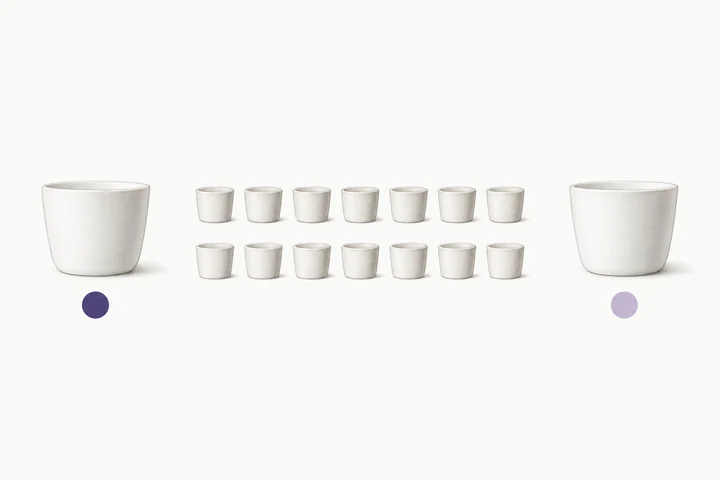
Before
2 weeks (14 day marks)
After 2 weeks
In this study, 37 adults went through a period of drinking a 0.08% solution of EGCG (a bitter compound found in green tea and elsewhere) 4 times a day for 2 weeks and a period of drinking water for 2 weeks, in swapped order. The figure shows only the bitterness of the test solutions before and after the EGCG period (the water period is not drawn). The fourteen small cups mark 14 days; they are not the number of drinks or the amount (it was 4 times a day). This is neither a vegetable nor tea. The ratings are averages over the test solutions, including ones with added casein, and were significantly lower after the 2 weeks. The purple shows only the order, not a ratio or the size of the difference. Liking was not measured. Whether perception itself changed, or reduced dislike from familiarity spilled into the intensity ratings, cannot be separated (the authors say so). This figure does not show getting used to bitter vegetables. The purple is not a real colour.
Source: Davis 2021 (Davis 2021 in the table of conditions and results by study)
Illustration: illustration desk (PurpleHeron)
Candidate explanations for the differences
Conditions that differ between studies, or between groups, and could explain differences in liking or bitterness ratings. Several conditions differ at once, so which one mattered is unknown. These are candidates, not causes.
- As a candidate reason for an apparent fall in perceived bitterness, the authors of the EGCG study suggest that reduced dislike after becoming familiar may have spilled into the intensity rating rather than perception itself changing, and say the two cannot be separated. [rows: Davis 2021 After vs before 2 weeks of EGCG]
- One candidate reason for rising liking is pairing with sweetness: liking for the bitter taste of broccoli or cauliflower rose after they were eaten mixed with sugar (abstract), and in the study where kale liking rose, participants ate sugar-containing gummies. [rows: Capaldi 2008 After eating it mixed with sugar vs before; Davis 2024 Chopped kale, after 2 weeks vs before]
- How repetition works differs between children: in the artichoke studies, 40% were in the increasing pattern while 16% had predicted intake under 10 g at the 5th exposure, and older children were more often in the non-eating pattern. [rows: Caton 2014 Patterns of eating during exposure]
What is not known — what this comparison alone cannot separate
- A rise in liking does not show that people came to find a vegetable less bitter. Most studies where liking or intake rose give no bitterness-intensity result (for abstract-only studies, none in the abstract). In the vegetable-flavoured gummy study, which measured both liking and bitterness, liking for kale rose but no significant fall in kale bitterness was reported. [rows: Appleton 2018 Repeated exposure vs none; Davis 2024 Chopped kale, after 2 weeks vs before; Davis 2024 Chopped kale and broccoli, after 2 weeks vs before]
- An effect specific to bitter vegetables cannot be separated: the pooled analysis has no bitter-only subgroup, and the artichoke, endive and spinach studies and the broccoli-with-dip study do not call these vegetables bitter. In the spinach study, spinach intake also rose in the group served green beans. [rows: Appleton 2018 Repeated exposure vs none; de Wild 2013 Soups, after 7 weeks vs before; de Wild 2017 After 6 vegetable servings vs before (4 groups); Fisher 2012 Broccoli, after 7 weeks vs before]
- Whether the effect lasts is unknown: in this analysis of the pooled study, the longest follow-up was only about 1.5 months after, and for interventions offering a variety of vegetables, liking for a new vegetable was not significant at the longest follow-up (SMD 0.15). Most studies were in young children, with few in adults. [rows: Appleton 2018 Repeated exposure vs none (longest follow-up)]
How studies and rows were counted
The number of evidence rows is not the number of studies. Table rows, ledger evidence rows, papers and research groups are counted separately.
- Sources in the table: 11, of which 2 have results on people's bitterness ratings in this table; for the others, only results on something else (liking, amount eaten) are shown, or they are used only for context.
- Rows in the table (study × measured result): 16. Rows on perceived bitterness: 3.
- Evidence rows in the lab's ledger these rows rest on: 4. One paper can supply several rows. Rows without a ledger evidence row come from other tables of the same papers, or from sources newly read for this question.
- Research groups among the studies with bitterness results in this table, as grouped in the ledger: 1 (reports from the same lab count as 1; co-authors and affiliations can overlap, so this is not a count of independent replications).
What we looked at
The sources examined for this question, why each was included or excluded, and which full texts could not be reached. We searched Europe PMC and PubMed for studies in which people repeatedly ate or tasted vegetables the papers call bitter, or bitter foods, and liking, amount eaten or bitterness was measured, and added the sources already in the lab's ledger (Japanese-language literature was not searched). Paywalled studies are marked as read from the abstract only. We included studies that repeated a food the paper calls bitter, or a vegetable often called bitter (such as artichoke, endive, spinach, broccoli, kale). Where a pooled analysis and original trials covered the same children, the UK trial was kept out of the table, and the French trial was kept for its liking values with a note in its row that the children are the same.
| Source | Decision | Why |
|---|---|---|
| Repeated exposure and conditioning strategies for increasing vegetable liking and intake: systematic review and meta-analyses (2018) doi | Included in the table | Meta-analysis of repeated vegetable exposure; read in full |
| Repeated exposure to epigallocatechin gallate solution or water alters bitterness intensity and salivary protein profile (2021) doi | Included in the table | Bitterness intensity fell with repetition; not a vegetable; read in full |
| A method to "gamify" exposure to vegetable flavor and its potential influence on liking (2024) doi | Included in the table | Measured bitterness and liking of vegetables; read in full (supplementary tables not read) |
| Learning to eat vegetables in early life: the role of timing, age and individual eating traits (2014) doi | Included in the table | Eating patterns pooled from 3 countries; read in full |
| The effects of taste sensitivity and repeated taste exposure on children's intake and liking of turnip (Brassica rapa subsp. rapa); a bitter Brassica vegetable (2021) doi | Included in the table | Turnip, called bitter by the paper; read as abstract only |
| Repeated exposure of infants at complementary feeding to a vegetable puree increases acceptance as effectively as flavor-flavor learning and more effectively than flavor-nutrient learning (2013) doi | Included in the table | Artichoke in infants; full text blocked by the publisher's verification page, read as abstract only |
| Effects of repeated exposure and health-related information on hedonic evaluation and acceptance of a bitter beverage (2003) doi | Included in the table | Adults repeatedly drinking a bitter beverage; read as abstract only |
| Effectiveness of flavour nutrient learning and mere exposure as mechanisms to increase toddler's intake and preference for green vegetables (2013) doi | Included in the table | Endive and spinach soups; read as abstract only |
| Use of Different Vegetable Products to Increase Preschool-Aged Children's Preference for and Intake of a Target Vegetable: A Randomized Controlled Trial (2017) doi | Included in the table | Spinach; read as abstract only |
| Offering "dip" promotes intake of a moderately-liked raw vegetable among preschoolers with genetic sensitivity to bitterness (2012) doi | Included in the table | Broccoli and bitter sensitivity; read as abstract only |
| Decreasing dislike for sour and bitter in children and adults (2008) doi | Included in the table | Bitter-tasting vegetables paired with sugar; read as abstract only |
| Repetition counts: repeated exposure increases intake of a novel vegetable in UK pre-school children compared to flavour-flavour and flavour-nutrient learning (2013) doi | Read as context (not in the table) | The UK artichoke trial, 1 of the 3 pooled in Caton 2014; left out of the table so the same children are not counted twice; read as abstract only |
| Modifying children's food preferences: the effects of exposure and reward on acceptance of an unfamiliar vegetable (2003) doi | Read as context (not in the table) | Sweet red pepper, not an example of a bitter vegetable; read as abstract only |
| Flavour liking and preference conditioned by caffeine in humans (2005) doi | Read as context (not in the table) | A new-flavoured drink paired with caffeine; the abstract does not call it bitter and gives no sensory results |
| Effects of Oral Topical Capsaicin Gel on Taste Perception in Healthy Subjects: A Pilot Study (2025) doi | Read as context (not in the table) | What was repeated was a capsaicin gel, not something bitter; no significant change in quinine bitterness was found; read in full |
| How we learn to like: the role of perceptual learning in development of liking, quality perception, and appreciation (2025) doi | Read as context (not in the table) | A review saying direct evidence of perceptual change is limited; no data on bitter vegetables; read in full |
| Do Human Fetuses Form Long-Lasting Chemosensory Memories? (2026) doi | Read as context (not in the table) | Prenatal exposure; measured facial expressions to kale and carrot odours at age 3, not intake, liking or bitterness ratings; read in full |
| Influence of light exposure during storage on the content of sesquiterpene lactones and photosynthetic pigments in witloof chicory (2014) doi | Excluded | The exposure is light during storage; not a study in people |
| Infant and Toddler Responses to Bitter-Tasting Novel Vegetables: Findings from the Good Tastes Study (2021) doi | Excluded | Kale purées offered in a single visit, not repeated exposure |
| Repeated exposure to models' positive facial expressions whilst eating a raw vegetable increases children's consumption of the modelled vegetable (2024) doi | Excluded | What was repeated was watching videos of someone eating, not eating |
| A Comparison of Mere-Exposure, Flavor–Flavor and Flavor–Nutrient Learning Strategies in Enhancing Legume Preferences in an Adult Sample (2026) doi | Excluded | Faba beans; the paper does not call them bitter and did not measure bitterness |
| 'Why don't you try it again?' A comparison of parent led, home based interventions aimed at increasing children's consumption of a disliked vegetable (2015) doi | Excluded | A study of disliked vegetables, not described as bitter and not limited to vegetables often called bitter (such as artichoke, endive, spinach, broccoli, kale) (abstract) |
| Repeated taste exposure increases liking for vegetables by low-income elementary school children (2010) doi | Excluded | Carrots, peas, tomatoes and bell peppers, not described as bitter and not vegetables often called bitter (abstract) |
| Acquisition of liking for spinach products (2005) doi | Excluded | Bibliographic details checked only; not even the abstract was read this time (to read next) |
| Efficacy of repeated exposure and flavour-flavour learning as mechanisms to increase preschooler's vegetable intake and acceptance (2015) doi | Excluded | Red beet and parsnip crisps, not described as bitter and not vegetables often called bitter (abstract) |
| The Lasting Influences of Early Food-Related Variety Experience: A Longitudinal Study of Vegetable Acceptance from 5 Months to 6 Years in Two Populations (2016) doi | Read as context (not in the table) | Long-term follow-up after offering an initially disliked vegetable on 8 days; no unexposed control for that part, and bitterness intensity not measured; read in full |
| Baby's First Bites(研究の計画書) (2019) doi | Excluded | A study protocol with no results |
| The Baby's First Bites RCT: Evaluating a Vegetable-Exposure and a Sensitive-Feeding Intervention in Terms of Child Health Outcomes and Maternal Feeding Behavior During Toddlerhood (2021) doi | Read as context (not in the table) | No significant group effect on vegetable intake at 18 and 24 months after a vegetable-exposure intervention; not results on liking or bitterness intensity; read in full |
Read in the encyclopedia
- Repeated dietary exposure — the condition in this question
- Acquired liking — liking that changes with eating experience
- Turnip — a vegetable the paper calls bitter
- Getting used to bitterness — the topic hub on whether you stop sensing it or stop minding it
- Is finding brassicas bitter down to a gene (TAS2R38)? — bitter sensitivity and brassica vegetables
Source ledger
Each study's source can be reached from its section above. All of the lab's sources are listed in the source ledger.
How to cite this page
Aoki, M. (NIGAMI LAB) (2026). Does repetition end dislike of bitter vegetables?. https://nigamilab.com/en/topics/repeated-exposure-bitter-veg/
Each claim card has a stable anchor (#clm-…). The dataset is CC BY 4.0; see the data page. Dataset DOI: 10.5281/zenodo.22739101