Topic hub — 2026-10-21
Does the bitterness of grated daikon change with the part, variety or grating?
A caveat first: most studies of grated daikon measured pungency (a sharp heat in the nose and on the tongue), not bitterness, and only one study found in our search had people compare bitterness. This page does not treat bitterness and pungency results as the same and does not present weaker pungency as weaker bitterness. The top of a daikon is commonly thought of as sweet and the tip as hot and bitter. What do studies that changed the part, variety, grating or time after grating and had people compare the bitterness of grated daikon say? This page lines up the included studies together with their conditions: variety, part of the root, grater, standing time, and who rated them on what scale. It then separates what was established within one experiment, what differences might explain, and what this comparison alone cannot separate. It is about perceived taste, not eating or health advice.
On this page (10 sections)
- What this page establishes
- What the included studies allow us to say
- Bitterness ratings at a glance
- Conditions and results, study by study
- What was established within an experiment
- Candidate explanations for the differences
- What is not known — what this comparison alone cannot separate
- How studies and rows were counted
- What we looked at
- Read in the encyclopedia
What this page establishes
- That only one study had people compare bitterness by part of the root, and in every cultivar tested the tip (tail) was more bitter than the top (head).
- That in the same study more people chose karami daikon as more bitter than the tail of Aokubi daikon, but the comparison differed in part of the root as well as variety.
- That grater, time after grating and additions were compared for pungency only, and no study found measured whether they change bitterness.
- That the more bitter parts also had stronger pungency and more of the pungent compound, but the cause of the bitterness and the contribution of each factor have not been tested.
What the included studies allow us to say
- Only 1 study had people compare bitterness by part of the root: in all 3 cultivars the tail was most bitter and the head least (rank sums tail 21, 26, 21; head 57, 57, 59; 20 people). In the same study, 17 of 20 people chose karami daikon (the whole root) as more bitter than the Aokubi tail, though the comparison differed in both variety and part of the root. [rows: Kawamura 1989 Tail vs head (Aokubi); Kawamura 1989 Tail vs head (Mino-wase); Kawamura 1989 Tail vs head (Shinshu-ji); Kawamura 1989 Karami daikon vs Aokubi tail]
- No study found in our search measured whether grating, time after grating or additions change bitterness. The same study compared these for pungency only: a fine metal grater gave hotter results (18 vs 2 people), 60 min of standing weakened pungency, and tentsuyu or sanbaizu weakened it. Pungency results cannot be applied to bitterness. [rows: Kawamura 1989 Fine metal vs coarse plastic grater; Kawamura 1989 Just grated vs after 60 min; Kawamura 1989 Water vs tentsuyu or sanbaizu]
Bitterness ratings at a glance
Human bitterness ratings only. Values for "Sample compared" and "Comparison" are as reported in the tables. Because smaller rank sums mean more bitter, "Direction" shows which sample was more bitter, not which value was larger; whether the difference is significant is shown by the test in the same "Direction / test" column. Select a study name to jump to its detailed table. Rows on pungency and pungent compounds are in the detailed tables by study.
Results in which people rated bitterness only. Where each value comes from (a table or a reading from a figure) is shown in its row; scales and methods differ between studies, so compare within a row, not across rows.
| Study | Comparison and condition | Measured as | Sample compared | Comparison | Direction / test |
|---|---|---|---|---|---|
| Kawamura 1989 | Tail vs head (Aokubi) Within 10 min of grating on a metal grater; the 3 parts (head, middle, tail) compared | rank sum (20 people; smaller = more bitter) | 21 (tail) | 57 (head), 42 (middle) | Sample compared more bitter Tested, significant |
| Kawamura 1989 | Tail vs head (Mino-wase) Same (3 parts) | rank sum (20 people; smaller = more bitter) | 26 (tail) | 57 (head), 37 (middle) | Sample compared more bitter Tested, significant |
| Kawamura 1989 | Tail vs head (Shinshu-ji) Same (3 parts) | rank sum (20 people; smaller = more bitter) | 21 (tail) | 59 (head), 40 (middle) | Sample compared more bitter Tested, significant |
| Kawamura 1989 | Karami daikon vs Aokubi tail Whole karami daikon vs Aokubi tail, compared 2 at a time for which is more bitter | number choosing as more bitter (20 people) | 17 people | 3 people | Sample compared more bitter Tested, significant |
Conditions and results, study by study
For each study, the conditions for the samples, grating, serving and who rated them, and the results. Each row is one study × one measured result, so different comparisons in the same study are separate rows. Under each row we give where it is in the paper and whether it can be used to judge whether the part of the root, the variety, the grating or the time after grating changes the bitterness people perceive in grated daikon, with the reason. Rows on pungency or composition alone are kept so that it is clear they cannot be used for bitterness. Nothing is left blank: "not given", "not read" and "not applicable" are kept apart.
Kawamura 1989 sensory + composition
おろし辛味大根の辛味特性について. 日本家政学会誌 40(12):1051-1056 — doi:10.11428/jhej1987.40.1051
- How deeply checked
- Checked in full text — J-STAGE PDF, all 6 pages (methods, results, summary). Sensory Tables 3-11 checked as page images; compositional Tables 1-2 read from text only Checked by: LLM (one extracted, another checked against the source; no human check), 2026-10-21.
- Samples
- Karami-daikon (harvested in Kyoto in December 1988, 2-5 days before), Aokubi (Miura, Kanagawa, Oct-Dec), Mino-wase (Kashiwa, Chiba, Oct) and Shinshu-ji (Koshoku, Nagano, Nov); the last three all within 2-4 days of harvest. Numbers of roots not given
- Processing and cooking
- Peeled thinly; all but Karami-daikon cut crosswise into thirds (head, middle, tail); grated with a metal grater (a coarse plastic grater for one comparison). Sensory samples within 10 min of grating. For samples with additives, the radish was grated into water or seasoning liquid prepared beforehand, with stirring. Standing 0, 20, 40, 60 min. Additions: water, 2% salt, 10% soy sauce, 50% tentsuyu, 2% salt + 13% vinegar, 20% sanbaizu (per 100 of grated radish) (specific addition rates of seasonings: table body not read; unconfirmed)
- How it was served or eaten
- Temperature, amount and container not given
- Who rated, on what scale
- 20 people (dietetics students of Tokyo Kasei University judged able to discriminate, plus cooking-science lab members). Ranking (pungency, umami, sweetness, bitterness; smaller rank sum = stronger) and two-sample discrimination tests. Significance given as 5%, 1%, 0.1% marks; test not named (details of the rank tables: table body not read; unconfirmed)
| Measured | Comparison and condition | Sample compared | Comparison | Unit | Direction / test |
|---|---|---|---|---|---|
| Bitterness intensity (sensory) | Tail vs head (Aokubi) Within 10 min of grating on a metal grater; the 3 parts (head, middle, tail) compared | 21 (tail) | 57 (head), 42 (middle) | rank sum (20 people; smaller = more bitter) | Sample compared more bitter Tested, significant |
| Tail and head marked at the 1% level; middle in between. In the same samples pungency was also stronger in the tail (20 vs 60), and umami and sweetness weaker Where: Table 3 For whether the part of the root, the variety, the grating or the time after grating changes the bitterness people perceive in grated daikon: Usable — Parts of the same roots ranked for bitterness by the same 20 people with the same grating | |||||
| Bitterness intensity (sensory) | Tail vs head (Mino-wase) Same (3 parts) | 26 (tail) | 57 (head), 37 (middle) | rank sum (20 people; smaller = more bitter) | Sample compared more bitter Tested, significant |
| Tail and head marked at the 1% level; pungency tail 20 vs head 60 Where: Table 3 For whether the part of the root, the variety, the grating or the time after grating changes the bitterness people perceive in grated daikon: Usable — Same method as for Aokubi, same direction in another cultivar | |||||
| Bitterness intensity (sensory) | Tail vs head (Shinshu-ji) Same (3 parts) | 21 (tail) | 59 (head), 40 (middle) | rank sum (20 people; smaller = more bitter) | Sample compared more bitter Tested, significant |
| Tail and head marked at the 1% level; pungency tail 24 vs head 55. The text says all 4 tastes differed significantly by part, but in the table umami for the head (32) has no mark Where: Table 3 For whether the part of the root, the variety, the grating or the time after grating changes the bitterness people perceive in grated daikon: Usable — Same method, same direction in a 3rd cultivar | |||||
| Number choosing which is more bitter (sensory) | Karami daikon vs Aokubi tail Whole karami daikon vs Aokubi tail, compared 2 at a time for which is more bitter | 17 people | 3 people | number choosing as more bitter (20 people) | Sample compared more bitter Tested, significant |
| 1% level. Pungency 20 vs 0 (0.1% level) for karami daikon; umami and sweetness stronger in the Aokubi tail. The part also differs (whole root vs tail), not only the variety Where: Table 4 For whether the part of the root, the variety, the grating or the time after grating changes the bitterness people perceive in grated daikon: Limited — Compares bitterness by variety, but karami daikon was whole and Aokubi was the tail, so the part differs too | |||||
| Pungent compounds (isothiocyanates) | Tail vs head (MTBeI) Head and tail of the same roots (middle not measured) | 32.63 (Aokubi), 27.23 (Mino-wase), 35.92 (Shinshu-ji) | 13.66, 14.57, 20.96 | mg/100 g ((E)-4-methylthio-3-butenyl isothiocyanate, MTBeI) | Sample compared higher No test reported |
| Karami daikon had 71.12 (the summary gives 73.7, the total extract; Table 1 and the text give MTBeI 71.12). Magnesium, which the authors name as a bitter component, was also higher in the tail (Aokubi 9.7 vs 4.9 mg/100 g), but no test links it to bitterness Where: Tables 1 and 2 For whether the part of the root, the variety, the grating or the time after grating changes the bitterness people perceive in grated daikon: Not usable — Not a bitterness comparison but the pungent compound in the same parts; no human bitterness rating; kept as context | |||||
| Pungency (sharp heat, sensory) | Fine metal vs coarse plastic grater Karami daikon only, compared 2 at a time for which is more pungent; bitterness not measured | 18 people | 2 people | number choosing as more pungent (20 people) | Sample compared higher Tested, significant |
| 0.1% level. Material and mesh differ at the same time Where: Table 5 For whether the part of the root, the variety, the grating or the time after grating changes the bitterness people perceive in grated daikon: Not usable — Only pungency was measured; cannot be used for whether grating changes bitterness | |||||
| Pungency (sharp heat, sensory) | Just grated vs after 60 min Karami daikon only; 0, 20, 40 and 60 min compared; bitterness not measured | 27 (just grated) | 71 (60 min), 49 (20 min), 53 (40 min) | rank sum (20 people; smaller = more pungent) | Sample compared higher Tested, only some pairs significant |
| Just grated and 60 min marked at the 1% level; in pairwise comparisons 0 vs 20 min was significant at 5%, 0 vs 40 min at 0.1% and 20 vs 60 min at 1%, while 20 vs 40 and 40 vs 60 min were not; no pairwise 0 vs 60 min result is given Where: Tables 6 and 7 For whether the part of the root, the variety, the grating or the time after grating changes the bitterness people perceive in grated daikon: Not usable — Only pungency was measured; cannot be used for whether time changes bitterness | |||||
| Pungency (sharp heat, sensory) | Water vs tentsuyu or sanbaizu Karami daikon only, grated into water or seasoning prepared beforehand while stirring. Per 100 of daikon, the 1st test used water 50, salt 2 plus water 48, soy sauce 10 plus water 40, or tentsuyu 50; the 2nd used water 20, salt 2 plus water 18, salt 2 plus vinegar 13 plus water 5, or sanbaizu 20. Bitterness not measured | 22 (water) | 69 (tentsuyu), 72 (sanbaizu) | rank sum (20 people; smaller = more pungent) | Sample compared higher Tested, significant |
| In 2 separate ranking tests (69 and 72 come from different tests and cannot be compared with each other), water was most pungent and tentsuyu or sanbaizu least (1% level); salt plus vinegar vs sanbaizu was not significant Where: Tables 8–11 For whether the part of the root, the variety, the grating or the time after grating changes the bitterness people perceive in grated daikon: Not usable — Only pungency was measured; cannot be used for whether additions change bitterness | |||||
Esaki 1982 composition only
大根おろし辛味成分の消長について. 家政学雑誌 33(10):513-520 — doi:10.11428/jhej1951.33.513
- How deeply checked
- Checked in full text — Full text via J-STAGE (text); values in Figs 3–7 not read from the figures Checked by: LLM (one extracted, another checked against the source; no human check), 2026-10-21.
- Samples
- Mino-wase roots (June–July 1980, near Toyota, Aichi), cut into upper, middle and lower parts
- Processing and cooking
- Grated on a plastic grater and held at 27 °C, taking 10 g at intervals into hydrochloric acid to stop the enzyme, then measuring isothiocyanates colorimetrically; samples with sanbaizu (25 mL brewed vinegar, 5 mL dark soy sauce and 1.7 g sugar per 120 g grated root; control 30 mL water), acetic acid, salt or sucrose added as well
- How it was served or eaten
- Not applicable (no sensory test beyond a tasting remark)
- Who rated, on what scale
- No panel; one tasting remark by the authors (no number, scale or test given)
| Measured | Comparison and condition | Sample compared | Comparison | Unit | Direction / test |
|---|---|---|---|---|---|
| Pungent compounds (isothiocyanates) | Lower vs upper part Grated Mino-wase, just after grating | about 3 times the upper part | upper part (reference) | isothiocyanate amount (about 3 times and halving in 30 min are stated in the text; absolute amounts are in figures) | Sample compared higher No test reported |
| The lower part also lost it fastest, halving 30 min after grating, followed by the middle and upper parts. Composition only; neither bitterness nor pungency was rated by people Where: Text (results) For whether the part of the root, the variety, the grating or the time after grating changes the bitterness people perceive in grated daikon: Not usable — Composition only, no human bitterness rating; the direction by part matches Kawamura, kept as context | |||||
| Pungent compounds (isothiocyanates) | With vs without sanbaizu or acetic acid Sanbaizu of 25 mL brewed vinegar, 5 mL dark soy sauce and 1.7 g sugar added to 120 g grated Mino-wase (pH 3.8); the control was 120 g with 30 mL water (pH 5.8); samples with acetic acid, salt or sucrose as well | more remained (values in figures) | values in figures | remaining isothiocyanate | Sample compared higher No test reported |
| Although more remained, the authors write that on tasting the plain sample seemed hotter (no number, scale or test given). Salt and sucrose are said not to affect the loss. The measured amounts and the untested tasting remark pointed opposite ways Where: Text (results), Figs 4 and 5 For whether the part of the root, the variety, the grating or the time after grating changes the bitterness people perceive in grated daikon: Not usable — Composition only; perception is only a single tasting remark | |||||
Esaki 1980 composition only
大根中の辛味成分の比色定量法. 栄養と食糧 33(3):161-167 — doi:10.4327/jsnfs1949.33.161
- How deeply checked
- Checked in full text — Full text via J-STAGE (text and summary); values in Figs 5–7 not read from the figures Checked by: LLM (one extracted, another checked against the source; no human check), 2026-10-21.
- Samples
- 7 cultivars (Aokubi-miyashige, Shirokubi-miyashige, Moriguchi, Hatsuka, Tankei-miyashige-sobuto, Horyo, Okura; near Nagoya); Tankei-miyashige-sobuto roots cut into 6 equal parts
- Processing and cooking
- Juice from ground root held at 30 °C for 30 min, then isothiocyanates measured colorimetrically
- How it was served or eaten
- Not applicable (no sensory test)
- Who rated, on what scale
- No panel
| Measured | Comparison and condition | Sample compared | Comparison | Unit | Direction / test |
|---|---|---|---|---|---|
| Pungent compounds (isothiocyanates) | Tip vs top of the root Tankei-miyashige-sobuto roots cut into 6 equal parts (7 samples); juice from ground root held at 30 °C for 30 min before measurement | about 10 times the top | top (reference) | isothiocyanate amount | Sample compared higher No test reported |
| Higher towards the tip. Composition only, no human rating Where: Text (results), summary For whether the part of the root, the variety, the grating or the time after grating changes the bitterness people perceive in grated daikon: Not usable — Composition only, no human bitterness rating; kept as context | |||||
Okano 1990 sensory only
ダイコン品種の辛味成分含量. 園芸学会雑誌 59(3):551-558 — doi:10.2503/jjshs.59.551
- How deeply checked
- Checked in full text — Full text via J-STAGE; sensory Fig. 3 and Table 3 checked as page images; individual values in Figs 1 and 2 not read Checked by: LLM (one extracted, another checked against the source; no human check), 2026-10-21.
- Samples
- 38 cultivars grown under the same conditions at a national vegetable research station (Ano; basically 3 plants each for composition). Sensory: Fig. 3 covers 7 Japanese cultivars; Table 3 covers 7 conditions from 2 other Japanese and 4 Chinese cultivars (YR Kurama tip and top). Sensory samples were also analysed by GC
- Processing and cooking
- Roots split lengthwise into 4 or 8 and grated in a food processor with a grating attachment (same preparation as for composition)
- How it was served or eaten
- Rated within 30 min of grating
- Who rated, on what scale
- 8 staff; pungency and sweetness rated on an absolute 4-point scale (0 none to 3 very), means shown; no training described; no statistical test for sensory; bitterness not measured
| Measured | Comparison and condition | Sample compared | Comparison | Unit | Direction / test |
|---|---|---|---|---|---|
| Pungency (sharp heat, sensory) | Cultivars high vs low in MTB-ITC Grated root (within 30 min). Fig. 3 covers 7 Japanese cultivars; Table 3 covers 7 conditions from 2 other Japanese and 4 Chinese cultivars (YR Kurama tip and top) | Kiriba-matsumotoji, at 500 µmol/100 mL or more of MTB-ITC: all 8 rated it very hot | for cultivars at or below 300 µmol/100 mL the relation was unclear | mean on a 4-point scale (8 people) | Sample compared higher No test reported |
| Cultivars richer in the compound were hotter, with sweetness the reverse. In Table 3, YR Kurama scored 1.6 at the tip (293 µmol/100 mL) and 0.6 at the top (66). The authors attribute the unclear relation in low cultivars possibly to panel experience or reduced discrimination with many samples, and call for a revised method. Bitterness was not measured; a remark in the discussion about cultivars known to be pungent and bitter is anecdotal Where: Fig. 3, Table 3, text For whether the part of the root, the variety, the grating or the time after grating changes the bitterness people perceive in grated daikon: Not usable — Pungency and sweetness compared by cultivar; bitterness not measured | |||||
Tsubaki 2023 sensory only
日本産辛味ダイコン主要品種の特性比較. 園芸学研究 22(1):11-18 — doi:10.2503/hrj.22.11
- How deeply checked
- Checked in full text — Full text via J-STAGE (text, Tables 1–4); values in Figs 2 and 3 not read from the figures Checked by: LLM (one extracted, another checked against the source; no human check), 2026-10-21.
- Samples
- 11 pungent daikon cultivars and lines, with Benikururi and Sobutori-miyashige as controls; sensory on roots sown 31 August and harvested 12 November 2020, a different year from the composition data (2012); middle of the root only
- Processing and cooking
- Middle of the root grated on a grater and left about 5 min (grater material and mesh not given)
- How it was served or eaten
- Tasted directly
- Who rated, on what scale
- 17 people in total (cumulative); pungency, sweetness, aroma and texture on 5-point scales (pungency 1 not hot to 5 extremely hot), means shown; no training described; no test of differences in sensory means between cultivars; correlations shown with significance marks; bitterness not measured
| Measured | Comparison and condition | Sample compared | Comparison | Unit | Direction / test |
|---|---|---|---|---|---|
| Pungency (sharp heat, sensory) | Pungent cultivars vs control cultivars Grated middle of the root (left about 5 min), 13 cultivars | 4.1 (Pirikari), 4.0 (Nora) | 1.6 (Benikururi), 1.9 (Sobutori-miyashige) | mean on a 5-point scale (17 people in total, cumulative) | Sample compared higher No test reported |
| Pungency vs isothiocyanate r=0.90 (0.1% level); sweetness vs pungency r=−0.62 (5% level). One pungent cultivar scored 2.2 (Tatara-karami). No test of differences in sensory means between cultivars, and composition came from a different harvest year. Bitterness was not measured Where: Tables 3 and 4, text For whether the part of the root, the variety, the grating or the time after grating changes the bitterness people perceive in grated daikon: Not usable — Pungency, sweetness and others compared by cultivar; bitterness not measured | |||||
What was established within an experiment
Only results where the same panel compared changed conditions within one study.
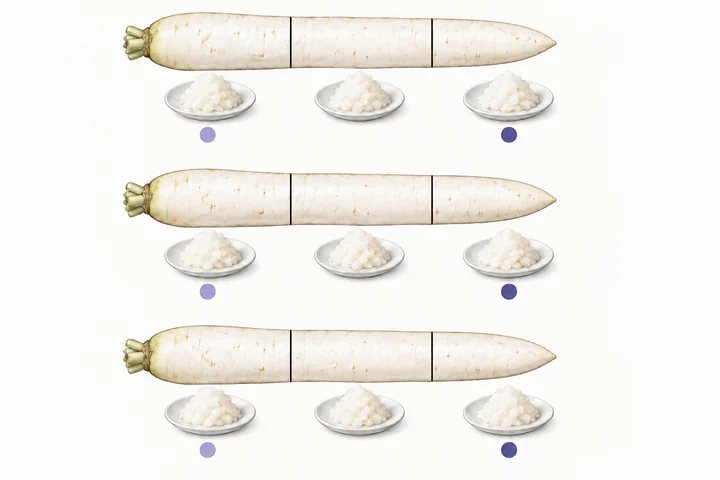
- When the same roots were split into head, middle and tail and grated the same way, the bitterness order from 20 people was tail strong and head weak in all 3 cultivars, with tail and head marked at the 1% level. [rows: Kawamura 1989 Tail vs head (Aokubi); Kawamura 1989 Tail vs head (Mino-wase); Kawamura 1989 Tail vs head (Shinshu-ji)]
- Grated karami daikon lost pungency from just after grating to 60 min of standing; in comparisons of 2 at a time, just grated vs 20 min differed at the 5% level, just grated vs 40 min at 0.1% and 20 vs 60 min at 1%, while 20 vs 40 and 40 vs 60 min did not differ significantly. Bitterness was not measured. [rows: Kawamura 1989 Just grated vs after 60 min]
Head
Middle
Tail
Rows from top: Aokubi / Mino-wase / Shinshu-ji
A study in which three daikon varieties were thinly peeled, cut into thirds along their length, grated on a metal grater and, within 10 minutes, ranked for bitterness by 20 people. In all three varieties the tail was rated more bitter than the head (1% level). The middle was also rated, ranking between head and tail, but carries no mark because it had no significance mark. No mark does not mean no bitterness, not measured, or the same as another part. The purple shows only the order within a variety, not a ratio of ranks or the size of the difference, and does not compare bitterness between varieties. The same grated samples were also more pungent at the tail, and how much pungency coloured the bitterness rankings was not separated. The radish shapes only sketch the division into thirds; they are not the real shapes or sizes of the varieties. The purple is not a real colour.
Source: Kawamura 1989 (Kawamura 1989 in the table of conditions and results by study)
Illustration: illustration desk (PurpleHeron)
Candidate explanations for the differences
Conditions that differ between parts or varieties and could explain differences in bitterness. Several conditions differ at once, so which one mattered is unknown. These are candidates, not causes.
- In the tail, the pungent compound is also higher in the same part where bitterness is stronger (Aokubi 32.63 vs 13.66 mg/100 g); other studies found about 3 times as much in the lower part of grated root as in the upper, and about 10 times as much at the tip as at the top. This is a compositional difference that coexists with bitterness in the same part; that the compound produces bitterness has not been tested. The authors separately name magnesium as a bitter component, higher in the tail (9.7 vs 4.9), but this is also their interpretation, with no experiment testing its relation to bitterness. [rows: Kawamura 1989 Tail vs head (MTBeI); Esaki 1982 Lower vs upper part; Esaki 1980 Tip vs top of the root]
What is not known — what this comparison alone cannot separate
- The cause of the difference in bitterness by part, and the contribution of each factor, have not been tested. In the tail, bitterness, pungency, the pungent compound and magnesium are all higher, and sweetness and umami lower. The experiment was not designed to separate the contributions of bitterness and pungency; the raters had been screened for discrimination ability, but the fact that heat and bitterness were strong together in the same samples cannot be separated. [rows: Kawamura 1989 Tail vs head (Aokubi); Kawamura 1989 Tail vs head (MTBeI); Kawamura 1989 Karami daikon vs Aokubi tail]
- The evidence is very thin: bitterness comes from 1 study (20 people, samples from 1988, thinly peeled), and the only variety comparison for bitterness is karami daikon vs the Aokubi tail. The 2 cultivar studies did not measure bitterness; they rated pungency, sweetness and other attributes. No study comparing peeled and unpeeled root was found. [rows: Kawamura 1989 Tail vs head (Aokubi); Kawamura 1989 Karami daikon vs Aokubi tail; Okano 1990 Cultivars high vs low in MTB-ITC; Tsubaki 2023 Pungent cultivars vs control cultivars]
How studies and rows were counted
The number of evidence rows is not the number of studies. Table rows, ledger evidence rows, papers and research groups are counted separately.
- Sources in the table: 5, of which 1 have results on people's bitterness ratings in this table; for the others, only results on something else (compounds, smell) are shown, or they are used only for context.
- Rows in the table (study × measured result): 13. Rows on perceived bitterness: 4.
- Evidence rows in the lab's ledger these rows rest on: 4. One paper can supply several rows. Rows without a ledger evidence row come from other tables of the same papers, or from sources newly read for this question.
- Research groups among the studies with bitterness results in this table, as grouped in the ledger: 1 (reports from the same lab count as 1; co-authors and affiliations can overlap, so this is not a count of independent replications).
What we looked at
The sources examined for this question and why each was included or excluded. We searched J-STAGE and Europe PMC for studies comparing the bitterness or pungency of grated daikon by part, variety, grating or time, and added the sources already in the lab's ledger (CiNii and conference abstracts were not searched). Composition-only studies without human ratings were included as material for thinking about the bitter parts and the pungent compound.
| Source | Decision | Why |
|---|---|---|
| おろし辛味大根の辛味特性について (1989) doi | Included in the table | Bitterness by part and variety; pungency by grating, time and seasoning; read in full |
| 大根おろし辛味成分の消長について (1982) doi | Included in the table | Pungent compound by part and time; read in full |
| 大根中の辛味成分の比色定量法 (1980) doi | Included in the table | Pungent compound by root part and cultivar; read in full |
| ダイコン品種の辛味成分含量 (1990) doi | Included in the table | Pungency by cultivar (sensory and composition); bitterness not measured; read in full |
| 日本産辛味ダイコン主要品種の特性比較 (2023) doi | Included in the table | Pungency of pungent daikon cultivars (sensory and composition); bitterness not measured; read in full |
| 辛味大根の辛味臭成分について (1989) doi | Read as context (not in the table) | Pungent odour compounds; a 'bitter metallic odour' is an odour description, not bitter taste; read in full |
| 「蒜山こだわり大根」の味の特徴(岡山県農林水産総合センターの研究成果の資料) | Read as context (not in the table) | Treats bitterness in sensory tests, with points for sensory bitterness scores in Fig. 1, but gives no panel size, scale definition, preparation, root part or grating, and no table of values; taste-sensor values only in a figure; a research-results document (peer review not stated); the 2-page document read in full |
| Seasonal Effects of Glucosinolate and Sugar Content Determine the Pungency of Small-Type (Altari) Radishes (2022) doi | Read as context (not in the table) | Composition only; titled pungency, the text also says bitter, but there is no human rating method (an example of the two words mixing); read in full |
| Comparative Evaluation of the Texture, Taste, and Flavor of Different Varieties of White Radish (Raphanus sativus L.) (2025) doi | Read as context (not in the table) | Electronic-tongue bitterness only, no human rating; measured the supernatant of the peeled middle blended with water and centrifuged, not grated root tasted by people; relevant parts of the full text read |
| 品種が異なる大根の品質特性と調理適性の解明 (2025) doi | Excluded | Pungency replaced by a pH reading; no human rating or bitterness measurement |
| 煮大根の香気形成について (1991) doi | Excluded | Aroma compounds of cooked daikon only |
| ダイコンのグルコシノレート含量の品種間差異 (1989) | Excluded | Glucosinolate content by cultivar; a brief note on the pungency of strips, but no panel size, scale or bitterness result |
| 辛味ダイコン‘あきたおにしぼり’における在来品種F1化の効果 (2015) doi | Excluded | No sensory bitterness result and no quantitative sensory result |
| 切り干し大根に油揚げを添加する伝統的な調理法において油揚げが嗜好性に与える効果の検証 (2020) doi | Read as context (not in the table) | Bitterness of simmered dried daikon, not grated daikon |
| いか大根(キッコーマン ホームクッキング) (2023) | Read as context (not in the table) | A recipe note with no comparative measurement |
Read in the encyclopedia
- Daikon radish — the vegetable in this question
- Pungency — a sensation rated apart from bitterness
- Does adding sugar or salt suppress bitterness? — a comparison of additions
Source ledger
Each study's source can be reached from its section above. All of the lab's sources are listed in the source ledger.
How to cite this page
Aoki, M. (NIGAMI LAB) (2026). Does grated daikon bitterness vary by part or grating?. https://nigamilab.com/en/topics/daikon-grated-bitterness/
Each claim card has a stable anchor (#clm-…). The dataset is CC BY 4.0; see the data page. Dataset DOI: 10.5281/zenodo.22739101