Laos
region / region-laos
ラオス
Laos. It covers the taste term khom and observations of cuisine.
Photographs (captions in Japanese)
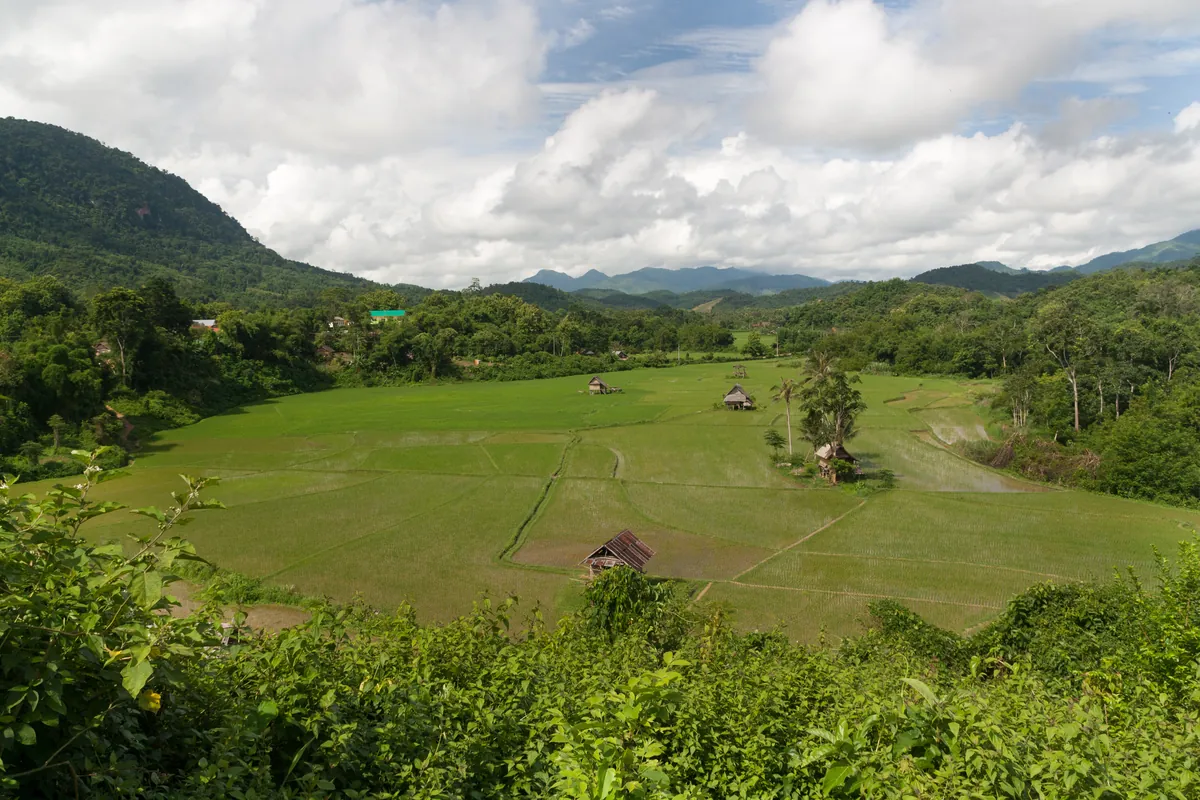
A landscape of mountains and farmland near Nong Khiaw village, Luang Prabang Province, Laos. A photograph of a regional landscape representing Laos.
Field observationShown: Not applicable (regional landscape)Part / state: Rural landscape in the mountains
Photo: Ekrem Canli (HylgeriaK) / CC BY-SA 4.0 / original image / ledger's original image
Scope and provenance of the photo
Identification: Identified as labelled in the source.
Image shown: No resizing, trimming, or color changes. The original image from Wikimedia Commons is used as it is. For display, a WebP capped at 1200 px wide is served; the ledger's original image can be checked from the link above.
On this page (5 sections)
Reading the bitterness
Laos was the setting for a study of how words for bitterness are used in practice. In a survey that collected responses from Lao speakers living around Vientiane while presenting actual taste stimuli, khom3 was recorded as a basic taste term corresponding to 「苦い」 (in translation: "bitter"). The number of participants was small, however, and the survey was not large enough to represent dialect differences across the entire Lao-speaking area.
The authors of the same study cited bitter young rattan shoots and dishes containing bitterness of animal origin as examples of Lao cuisine. These descriptions, however, were based on the authors’ own participant observation, and the authors explicitly stated that this was not a systematic investigation. It did not measure how frequently bitterness is used across Lao cuisine as a whole and should be read only as one record.
Sources for this overview
Taste in Two Tongues: A Southeast Asian Study of Semantic Convergence
Checked for this overview: Confirmed the survey finding that recorded khom3 as a basic taste term for bitter. / Confirmed the participant-observation description that cited bitter young rattan shoots and other culinary examples.
Hypotheses and recipe candidates for this entry are on the Japanese page.
Structured claims — open a section to read each claim's confidence, evidence and limits
Culture (2)
Scope: taste-stimulus presentation to Lao speakers around Vientiane
Note: Retains the paper's own tone-number notation.
Show data
region-laos —has_local_name→ (the claim sentence above)Scope: Participant observation by the authors of a paper on taste vocabulary
Note: The authors explicitly state that this was not a systematic investigation. No estimate is made of frequency across cuisine in general.
Show data
region-laos —is_documented_as_having→ (the claim sentence above)