Glinus oppositifolius
organism / organism-glinus-oppositifolius
パックケンコム
Glinus oppositifolius is a creeping herb in the carpetweed family. It is a wild plant used to add bitterness to dishes in northeastern Thailand and is called rau đắng đất in Vietnam.
Photographs (captions in Japanese)
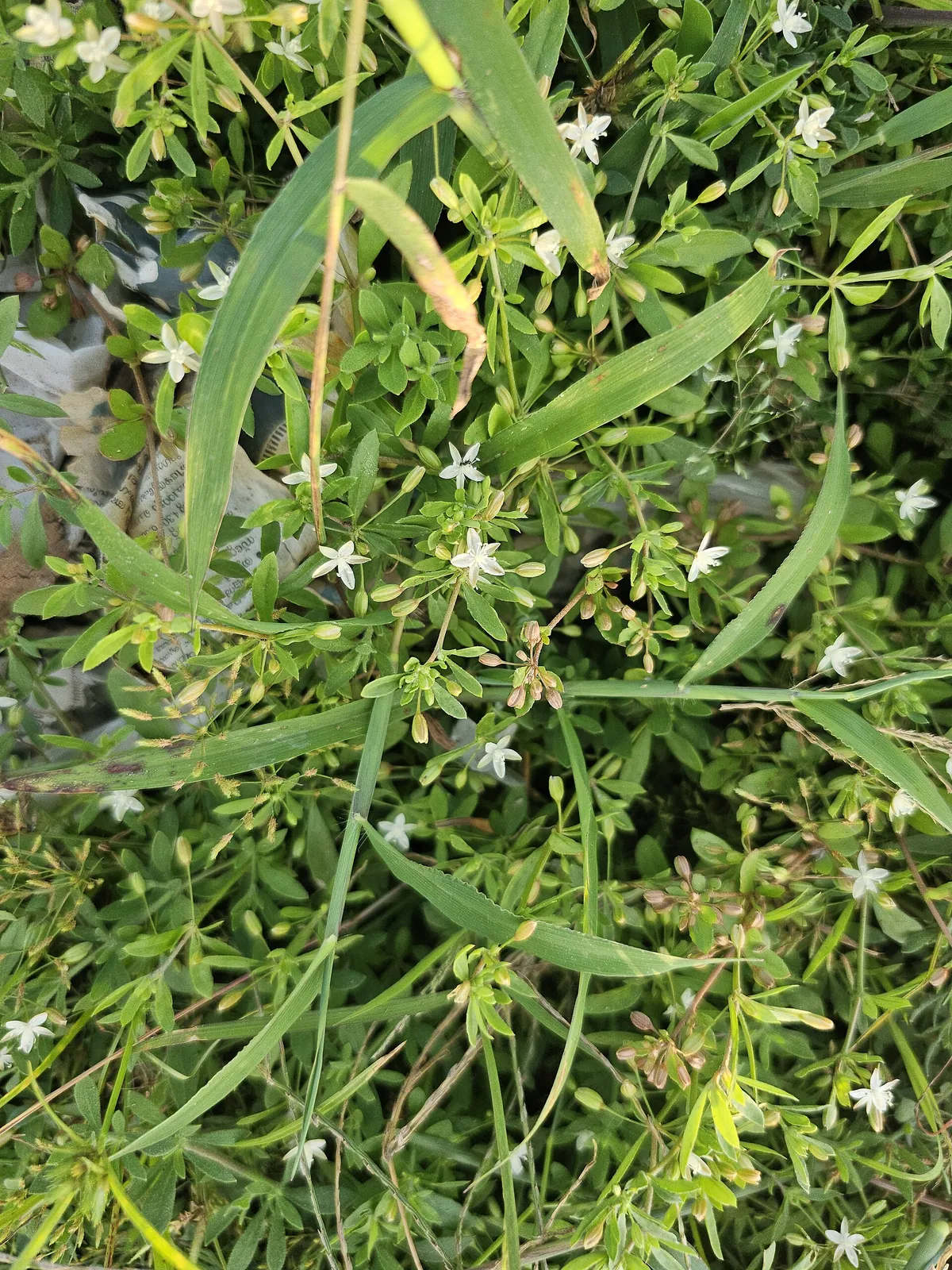
A growing plant of Glinus oppositifolius (rau đắng đất / ผักแก่นขม). Creeping opposite leaves on the ground and small white star-shaped flowers blooming between them are shown.
Shown: Glinus oppositifoliusPart / state: Opposite leaves creeping on the ground and small white star-shaped flowers (the whole plant in the flowering period)
Photo: Gannu03 / CC BY-SA 4.0 / original image / ledger's original image
Scope and provenance of the photo
Identification: Identified as labelled in the source. The source page presents the photograph as a plant in the wild in Thailand. Re-identification by NIGAMI LAB or a specialist has not been done.
Image shown: The 1920 px version from Wikimedia Commons. No cropping or color changes by NIGAMI LAB. For display, a WebP capped at 1200 px wide is served; the ledger's original image can be checked from the link above.
On this page (9 sections)
Reading the bitterness
Glinus oppositifolius is a wild plant in the carpetweed family, recorded under the local name phak kaen khom (ผักแก่นขม) in an ethnobotanical survey in Pa Tio District, Yasothon Province, northeastern Thailand. The survey lists it as a wild plant used to add bitterness to dishes, but it covers 1 region and does not specify which dishes use it.
In Vietnam it is called rau đắng đất (also rau đắng lá vòng), and a Vietnamese-language source records its use as a medicine for fever reduction, liver disease, and jaundice. The source lists saponins (including spergulacin, spergulacin A, glinosid, and spergulin A) and flavonoids as the main constituents of the whole plant. Its primary sources are not specified, however, so this information must be treated as preliminary. Edible use in soups or porridge in Vietnam cannot be confirmed from the materials available here.
Sources for this overview
Ethnobotanical study of wild edible plants in Pa Tio District, Yasothon Province, Thailand
Checked for this overview: Checked the description of its use as a wild plant to add bitterness in northeastern Thailand. / Checked its record as a wild plant in an ethnobotanical survey.
Rau dang dat - Glinus oppositifolius, Molluginaceae
Checked for this overview: Checked the Vietnamese names and the record of its use as a medicine for fever, liver disease, and jaundice. / Checked the description of saponins and flavonoids in the whole plant.
Other names: rau đắng đất (vi), rau đắng lá vòng (vi), ผักแก่นขม (th), Glinus oppositifolius (L.) Aug.DC. (la)
Follow the connections
rau dang greens →is prepared from→ Glinus oppositifolius
Structured claims — open a section to read each claim's confidence, evidence and limits
Composition and content (2)
Scope: Whole plant.
Note: An educational university page that does not explicitly cite primary literature.
Show data
organism-glinus-oppositifolius —contains→ (the claim sentence above)Scope: A connection to a plant recorded in northeastern Thailand as a wild plant that adds bitterness
Note: Does not establish identity with the Vietnamese dish name canh rau dang.
Show data
ingredient-rau-dang —is_prepared_from→ organism-glinus-oppositifoliusHow processing and cooking change it (1)
Scope: Pa Tio District, Yasothon Province, Thailand (an ethnobotanical survey of 50 people)
Note: One of the few examples where "Used in cooking to add bitterness" is stated explicitly.
Show data
organism-glinus-oppositifolius —is_used_in→ (the claim sentence above)Culture (1)
Scope: Vietnam.
Note: Edible use in southern Vietnam (soups or porridge) was not included because no accessible source was secured in this round.
Show data
organism-glinus-oppositifolius —is_documented_as_having→ (the claim sentence above)