Siamese neem tree
organism / organism-azadirachta-indica-siamensis
サダオ / Siamese neem / Azadirachta indica var. siamensis
Thai neem (sadao). Young leaves and inflorescences are eaten as bitter vegetables.
Photographs (captions in Japanese)
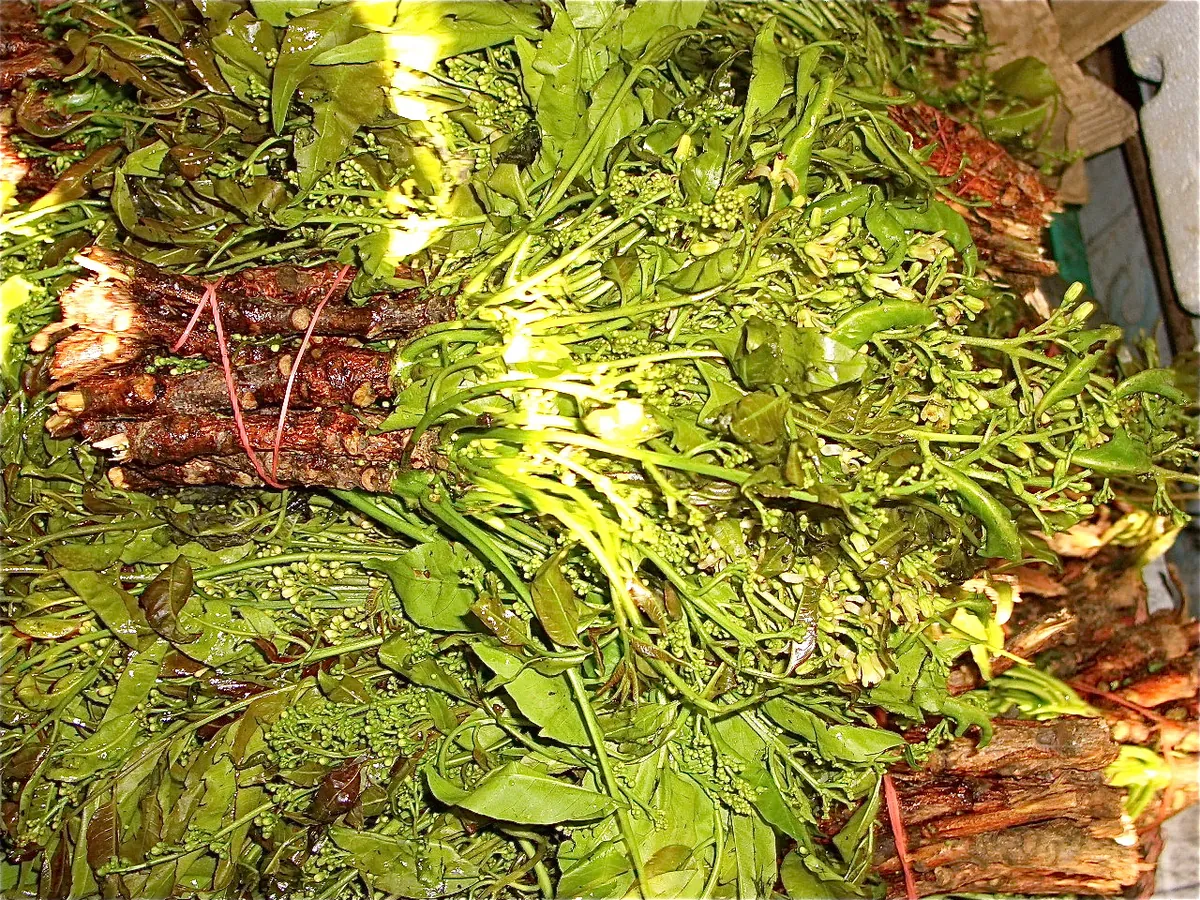
Young branches and leaves of sadao (Azadirachta indica, Thai Siamese neem). Clusters of fine green flower buds and young leaves are shown bundled at the base of a woody stem. The source page says "neem tree shoots, margosa shoots (Azadirachta indica)" and classifies it under "Leaf vegetables in Thailand".
Shown: Azadirachta indicaPart / state: Young branches and leaves just after harvest. Clusters of small green flower buds and young leaves bundled together on a woody stem
Photo: Susan Slater / CC BY-SA 4.0 / original image / ledger's original image
Scope and provenance of the photo
Identification: Identified as labelled in the source. The source page gives the scientific species name as Azadirachta indica and does not state the variety name siamensis, but from the category "Leaf vegetables in Thailand" it appears to be a plant treated as Thai sadao. Re-identification by a specialist has not been done.
Image shown: The full-size version from Wikimedia Commons. No cropping or color changes by NIGAMI LAB. For display, a WebP capped at 1200 px wide is served; the ledger's original image can be checked from the link above.
On this page (9 sections)
Reading the bitterness
Thai neem (Azadirachta indica var. siamensis) is a tree called sadao in Thailand. Young shoots, young inflorescences, and young leaves are eaten. An article on a government-affiliated site lists young shoots and inflorescences together as edible parts. Separately, a paper on antioxidant tests of Thai neem states that it supports the ethnomedical use of young leaves and flowers as a "vegetable bitter tonic" (the English term used in the paper's conclusion).
A Thai research paper introduces neem flowers as one of the vegetables commonly consumed in Thailand, alongside fruits of Thai and Chinese bitter gourd and sweet basil leaves. This is background to a paper on an enzyme assay, however, not a study of food culture itself. The use as a "vegetable bitter tonic" likewise records a traditional use; the action described as health-promoting itself has not been confirmed in a human trial.
Sources for this overview
10 สมุนไพร ที่ปลูกทานเองที่สวนหลังบ้าน
Checked for this overview: Confirmed the description of young shoots and young inflorescences as edible parts.
Antioxidant activity of Siamese neem tree (VP1209)
Checked for this overview: Confirmed the ethnomedical description of young leaves and flowers used as a bitter tonic.
Checked for this overview: Confirmed the background description of neem flowers as a commonly eaten vegetable in Thailand.
Other names: sadao (th-Latn), สะเดา (th), SADAO (th-Latn)
Follow the connections
neem young shoots →is prepared from→ Siamese neem tree
neem flowers →is prepared from→ Siamese neem tree
neem leaves →is prepared from→ Siamese neem tree
Structured claims — open a section to read each claim's confidence, evidence and limits
Composition and content (3)
Scope: Edible young shoots of Thai sadao
Show data
ingredient-neem-young-shoots —is_prepared_from→ organism-azadirachta-indica-siamensisScope: Young inflorescences of Thai sadao.
Note: The inflorescences are not treated as the same plant part as the leaves or young shoots.
Show data
ingredient-neem-flowers —is_prepared_from→ organism-azadirachta-indica-siamensisScope: Young leaves of Thai neem
Note: The plant part is linked through existing ethnomedical contextual material.
Show data
ingredient-neem-leaves —is_prepared_from→ organism-azadirachta-indica-siamensisHow processing and cooking change it (1)
Scope: Thailand.
Show data
organism-azadirachta-indica-siamensis —is_eaten_as→ (the claim sentence above)Culture (2)
Scope: Thailand.
Note: Does not assert clinical evidence for any health-promoting effect itself.
Show data
organism-azadirachta-indica-siamensis —is_used_as→ (the claim sentence above)Scope: A general-audience article from the Highland Research and Development Institute (HRDI).
Note: The list does not identify chemical bitter compounds; it includes folk accounts of medicinal action (บำรุงโลหิต เจริญอาหาร ช่วยระบาย; in translation: "nourishing the blood, stimulating appetite, and helping bowel movements").
Show data
organism-azadirachta-indica-siamensis —is_documented_as_part_of→ (the claim sentence above)