liverwurst
ingredient / ingredient-liverwurst
レバーソーセージ / Leberwurst (liverwurst / liver sausage)
Liverwurst is a standard German-speaking-region cooked paste-like sausage made with a stated proportion of pork, beef, chicken, or other liver (approximately 10–40% depending on the source). Canned and jarred preserved products (Halbkonserve/Vollkonserve) are also widely distributed.
Photographs (captions in Japanese)
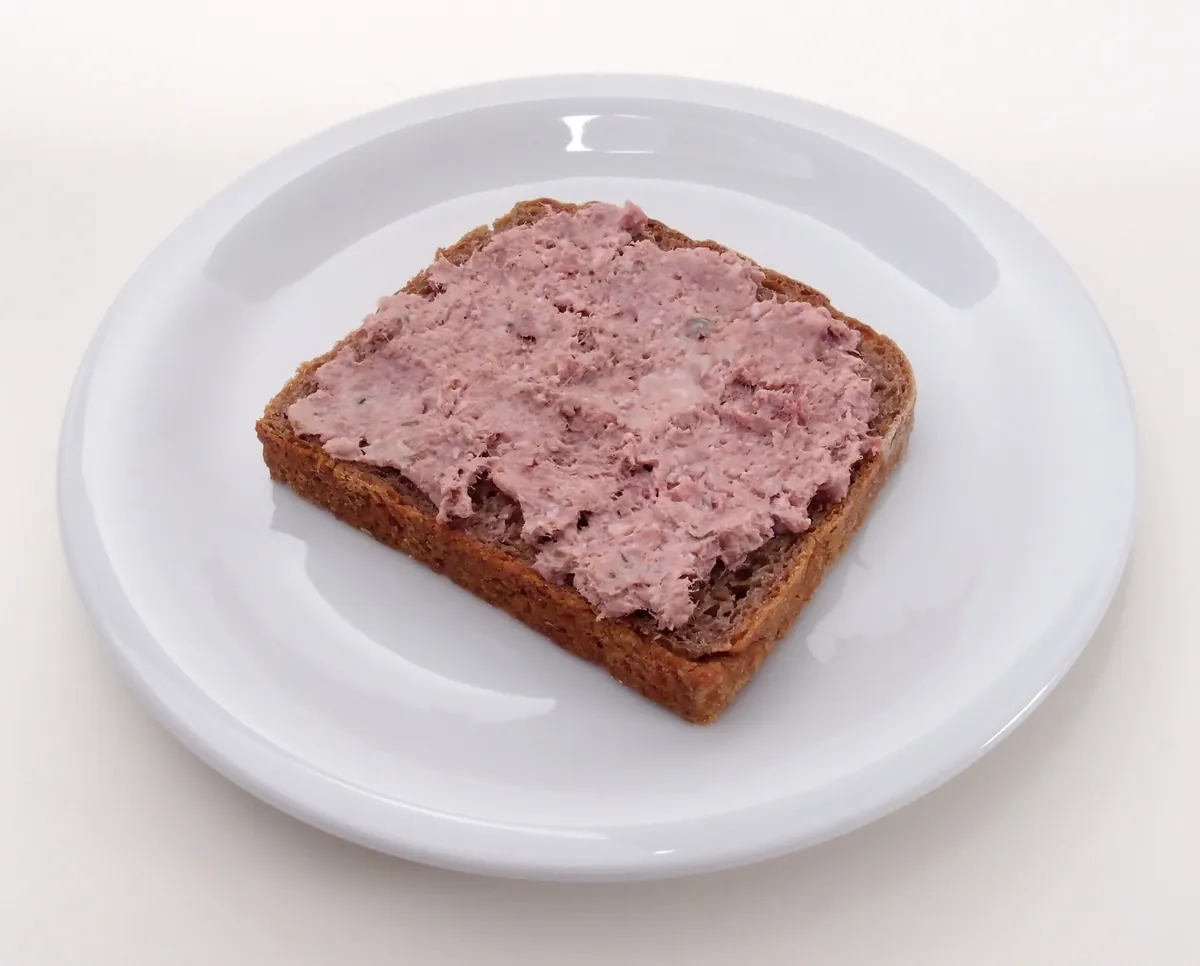
Coarse liverwurst spread on rye bread
Prepared formShown: N/A (processed product containing liver from animals such as pigs; coarse liverwurst, as written in the source)Part / state: Coarse-type liverwurst spread on bread
Photo: SKopp / CC BY-SA 4.0 / original image / ledger's original image
Scope and provenance of the photo
Identification: Identified as labelled in the source. The description clearly states "A slice of rye bread spread with coarse liverwurst". Own work. I opened the image and confirmed. A pinkish paste with a coarse texture is spread on brown bread
Image shown: The original from Wikimedia Commons, reduced to 2400 px on the long side. No cropping or color changes. For display, a WebP capped at 1200 px wide is served; the ledger's original image can be checked from the link above.
On this page (7 sections)
Reading the bitterness
The German Wikipedia article states that beef liver (Rindsleber), although chemically similar to the comparison liver, produces a bitter taste and dark color. It should be kept in mind that this statement has no footnote and presents general cooking knowledge without a cited source. The production section also describes roughly removing bile, bile ducts (Galle, Gallengänge), and attached visceral fat from the source liver.
Canned and jarred liverwurst (Halbkonserve/Vollkonserve) is known to have bitterness arising through a route separate from bile. A research project at the University of Hohenheim’s Food Materials Science unit (1990–1997) addresses the quality defect called 「苦く焦げたような加熱風味(Hocherhitzungsgeschmack)」 (in translation: "bitter, burnt-like heating flavor") in canned liverwurst and explains that Maillard reactions between free amino acids or ε-amino groups of protein-bound lysine and carbohydrates such as glucose produce the causative substances during high-temperature sterilization.
Sources for this overview
Checked for this overview: Used the description of bitterness when beef liver is used. / Used the description of preparation removing bile and bile ducts.
Hocherhitzungsgeschmack bei Leberwurst(研究プロジェクト概要)
Checked for this overview: Explained the cause of bitterness from high-temperature sterilization.
Other names: Leberwurst (de), liver sausage (en)
Structured claims — open a section to read each claim's confidence, evidence and limits
Sensory (1)
Scope: The ingredients section of the German-language Wikipedia article "Leberwurst"
Note: Note that this passage in the article carries no footnote and is presented as general culinary/food knowledge.
Show data
ingredient-liverwurst —has_perceived_bitterness_associated_with→ (the claim sentence above)How processing and cooking change it (2)
Scope: The production section of the German Wikipedia article "Leberwurst".
Note: There is no footnote.
Show data
ingredient-liverwurst —is_prepared_by→ (the claim sentence above)Scope: University of Hohenheim Food Materials Science project "Hocherhitzungsgeschmack bei Leberwurst" (period 1990-1997).
Show data
ingredient-liverwurst —has_bitterness_generated_by→ (the claim sentence above)