crostini di fegatini (toscani) / crostini neri
dish / dish-crostini-di-fegatini-toscani
クロスティーニ・ディ・フェガティーニ
Crostini di fegatini (toscani) / crostini neri is a Tuscan appetizer of chicken-liver paste simmered with aromatic vegetables, anchovies, capers, and other ingredients, then spread on thin slices of bread. In some areas it is also called (crostini neri). A recipe appears in the 1895 edition of Artusi's "Science in the Kitchen and the Art of Eating Well". It is a different dish tradition from Cibreo (Cibreo), which also uses chicken viscera.
Photographs (captions in Japanese)
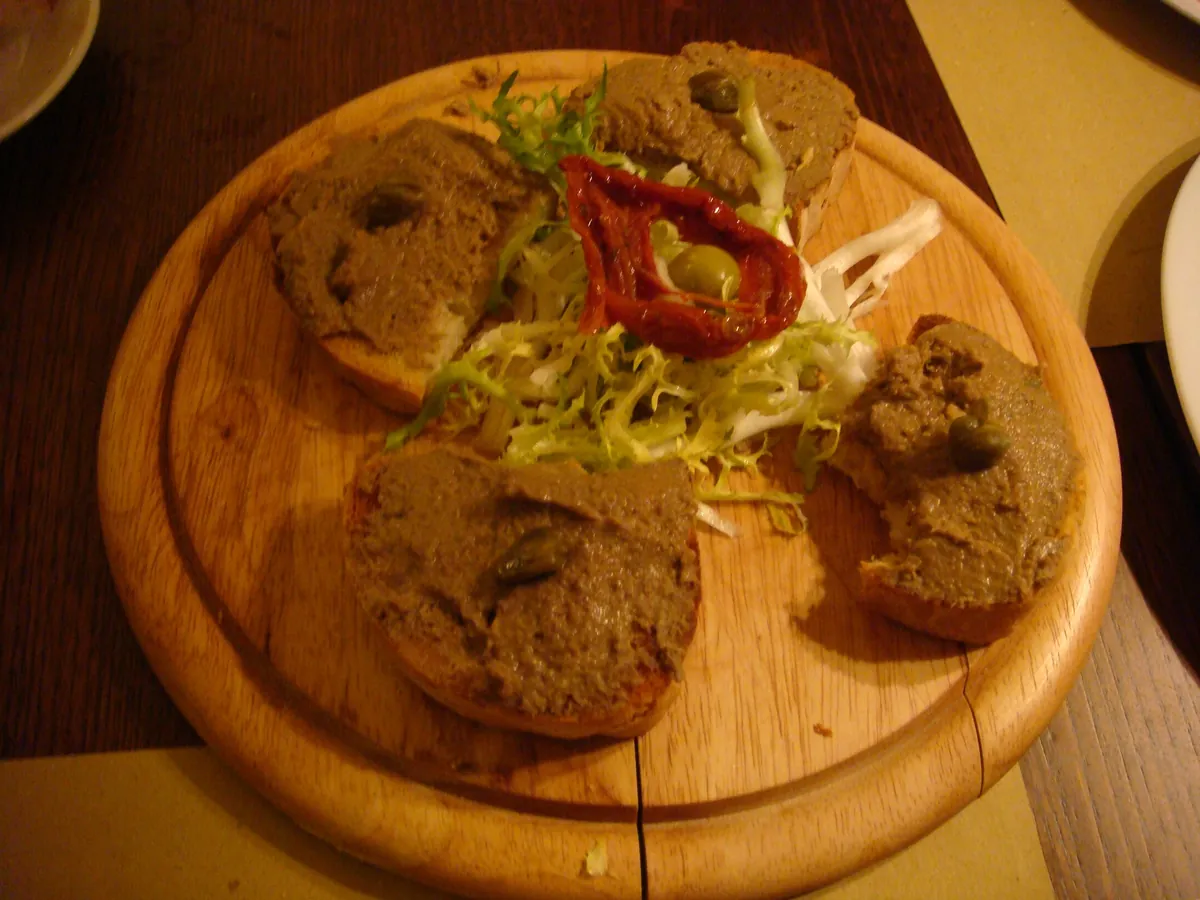
4 crostini topped with capers. Accompanied by frisée, dried tomatoes, and olives
DishShown: N/A (dish)Part / state: The finished form. Fegatini paste spread on 4 slices of bread and topped with capers
Photo: Schellack (English Wikipedia) / Public domain / original image / ledger's original image
Scope and provenance of the photo
Identification: Identified as labelled in the source. The description clearly states "Crostini toscani at an osteria in Florence". A public-domain image photographed at an osteria in Florence (Tuscany), meeting the condition of explicit regional character. I opened the image and confirmed. 4 slices of bread spread with a brown paste, capers, frisée, dried tomatoes, and olives are served on a wooden cutting board
Image shown: The original from Wikimedia Commons, reduced to 2400 px on the long side. No cropping or color changes. For display, a WebP capped at 1200 px wide is served; the ledger's original image can be checked from the link above.
On this page (7 sections)
Reading the bitterness
Artusi's cookbook 『料理の科学と美味しく食べる技法』 (in translation: "Science in the Kitchen and the Art of Eating Well") (1895 edition) gives a recipe for crostini di fegatini di pollo (chicken-liver crostini). It instructs the cook to remove the chicken liver's gallbladder (vescichetta del fiele) carefully in a basin of water without rupturing it. The text, however, does not state why this is done.
A later home-cooking blog explicitly gives bitterness as the reason for this preparation. It says to check that the gallbladder sac (sacca del fiele) has been removed and, if it remains, to remove it carefully without breaking it; breaking it would make all the meat 「アマリッシモ(amarissimo、極めて苦い)」 (in translation: "extremely bitter") and leave no option but to discard it. This is an example of a later writer expressing in terms of bitterness the reason for an operation that Artusi did not explain.
An article recommending a pairing with Tuscan Chianti describes the finished chicken-liver pâté as having 「持続的で、やや苦味を伴う(amarognolo)アロマ」 (in translation: "a persistent, slightly bitter aroma"). This is the article writer's sensory description, not a measurement from a sensory panel, and should be read with that limitation.
Sources for this overview
Checked for this overview: Used the original text's preparation instruction as evidence for this paragraph.
Crostini di fegatini al modo toscano
Checked for this overview: The description explicitly states that rupturing the sac would make the meat extremely bitter.
Patè di fegatini di pollo toscani
Checked for this overview: A description using the sensory term amarognolo.
Other names: crostini di fegatini (it), crostini di fegatini di pollo (it), crostini neri (it), patè di fegatini toscano (it)
Hypotheses and recipe candidates for this entry are on the Japanese page.
Structured claims — open a section to read each claim's confidence, evidence and limits
Sensory (1)
Scope: An article on the flavor of chicken-liver pâté (crostini di fegatini toscani) paired with Tuscan Chianti.
Note: This is the food-article writer's sensory description, not a measurement from a sensory panel.
Show data
dish-crostini-di-fegatini-toscani —has_sensory_attribute→ (the claim sentence above)How processing and cooking change it (2)
Scope: The recipe for crostini di fegatini di pollo in the 1895 edition of Artusi's 『料理の科学と美味しく食べる技法』 (in translation: "Science in the Kitchen and the Art of Eating Well").
Show data
dish-crostini-di-fegatini-toscani —is_prepared_by→ (the claim sentence above)Scope: A home-cooking blog article about crostini di fegatini.
Show data
dish-crostini-di-fegatini-toscani —has_perceived_bitterness_suppressed_by→ (the claim sentence above)