kola nut
ingredient / ingredient-kola-nut
コーラナッツ
Kola nut is the seed of Cola nitida or C. acuminata. Containing caffeine and theobromine, it has long been chewed in West Africa as an item for enjoyment and offered in hospitality. It is also a flavoring ingredient in cola-type drinks.
Photographs (captions in Japanese)
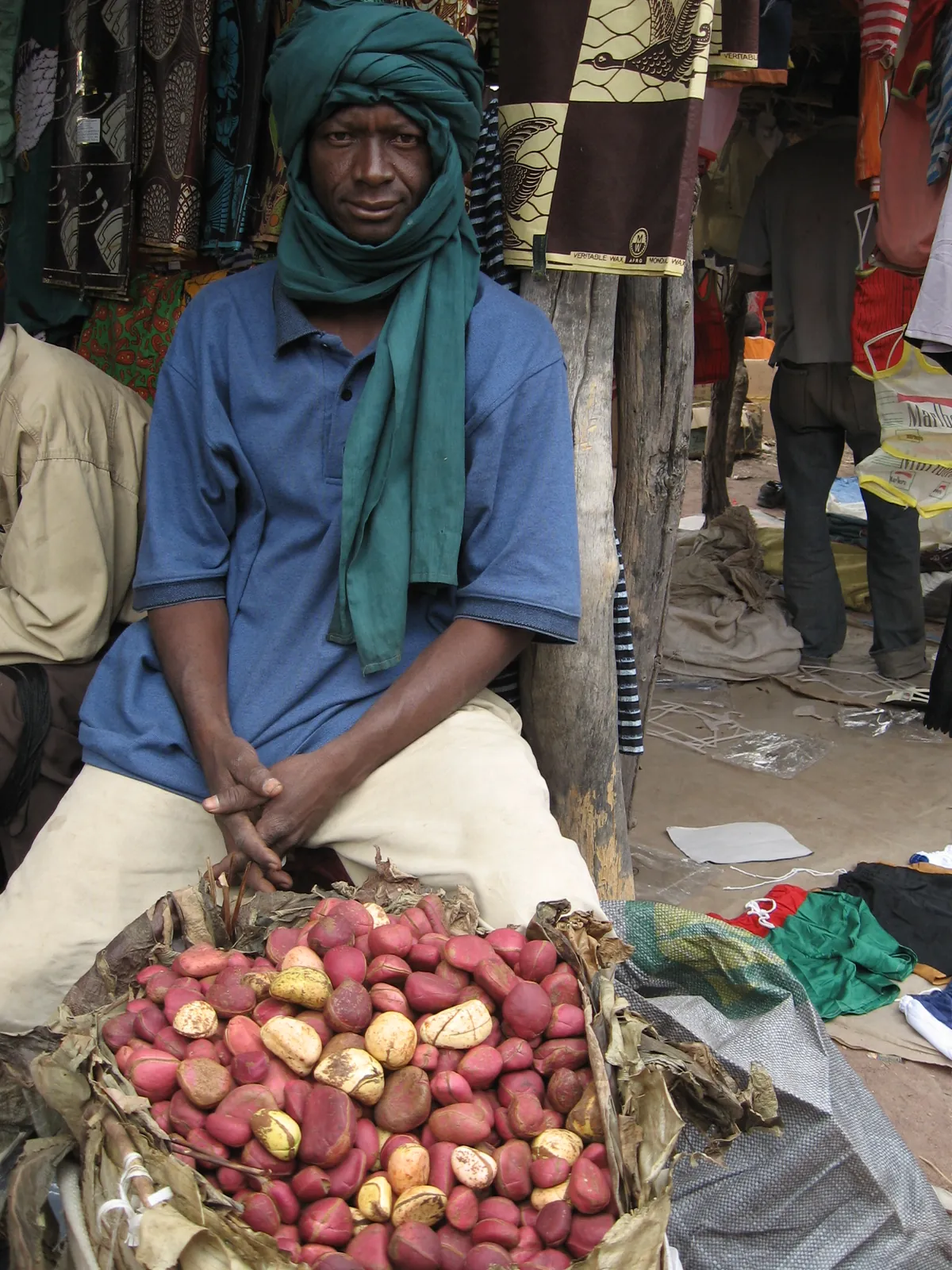
Kola nuts sold at a West African market. Seeds in 2 colors, red-purple and pale yellowish white, are heaped in a basket mixed together and held by a vendor, with the outer coat (seed coat) wrapped in dried leaves.
Shown: Cola (genus of kola trees; species not stated in the source)Part / state: Kola nuts (seeds), red-purple to cream, heaped in a basket held by a vendor at a market
Photo: Barry Pousman / CC BY 2.0 / original image / ledger's original image
Scope and provenance of the photo
Identification: Identified as labelled in the source. The source caption gives no scientific species name, and which species of the genus Cola it is cannot be identified from the photograph. The source also gives no detailed information on the shooting location.
Image shown: The full-size version from Wikimedia Commons. No cropping or color changes by NIGAMI LAB. For display, a WebP capped at 1200 px wide is served; the ledger's original image can be checked from the link above.
On this page (7 sections)
Reading the bitterness
Kola nuts are primarily the seeds of the tropical trees Cola nitida or Cola acuminata and are described as containing caffeine and theobromine as two important constituents. Both compounds also occur in cacao and tea and may contribute to bitterness, but this source gives no numerical content values.
A historical study records kola nuts as long used in West Africa for chewing, served on occasions such as naming ceremonies and weddings, and treated as signs of hospitality and wealth. It also describes Cola nitida in particular as a major trade good for centuries on north–south routes linking the forest belt with savanna and the southern Sahara. This historical account covers West Africa from precolonial to modern periods; it does not represent every regional or temporal variation.
Sources for this overview
Safety assessment of kola nut extract as a food ingredient
Checked for this overview: Checked that the source species of kola nuts are recorded as Cola nitida and C. acuminata. / Checked the description of caffeine and theobromine as important constituents.
Kola in the History of West Africa
Checked for this overview: Checked the historical account of chewing and ceremonial use in West Africa. / Checked its position as a major good in north–south trade.
Follow the connections
kola nut →is derived from→ kola tree
kola nut →contains→ caffeine →is a poor universal prototy…→ bitterness
kola nut →contains→ theobromine →contributes to→ bitterness
Structured claims — open a section to read each claim's confidence, evidence and limits
Composition and content (3)
Scope: The source of kola-nut extract used as a food ingredient.
Note: C. nitida is the linked species; C. acuminata is listed on an equal footing.
Show data
ingredient-kola-nut —is_derived_from→ organism-cola-nitidaScope: The source lists 「コーラナッツの2つの重要成分」 (in translation: "two important constituents of kola nuts") as caffeine and theobromine
Note: Content values are not reported in the abstract.
Show data
ingredient-kola-nut —contains→ compound-caffeineScope: The source lists caffeine and theobromine as 「コーラナッツの2つの重要成分」 (in translation: "2 important constituents of kola nuts").
Note: No content values are stated in the abstract.
Show data
ingredient-kola-nut —contains→ compound-theobromineCulture (2)
Scope: West Africa from the precolonial period to modern times.
Note: Based on a historical overview.
Show data
ingredient-kola-nut —is_used_as→ (the claim sentence above)Scope: West Africa from the precolonial period to modern times.
Show data
ingredient-kola-nut —was_major_trade_commodity_in→ (the claim sentence above)