African nightshade leaves
ingredient / ingredient-african-nightshade-leaves
アフリカン・ナイトシェードの葉
African nightshade leaves: a collective name for edible Solanum leaves in sub-Saharan Africa (including S. retroflexum, S. scabrum, S. nigrum, S. americanum, and S. villosum). The bitter leaves are blanched or fermented to soften their bitterness and served with staples.
Photographs (captions in Japanese)
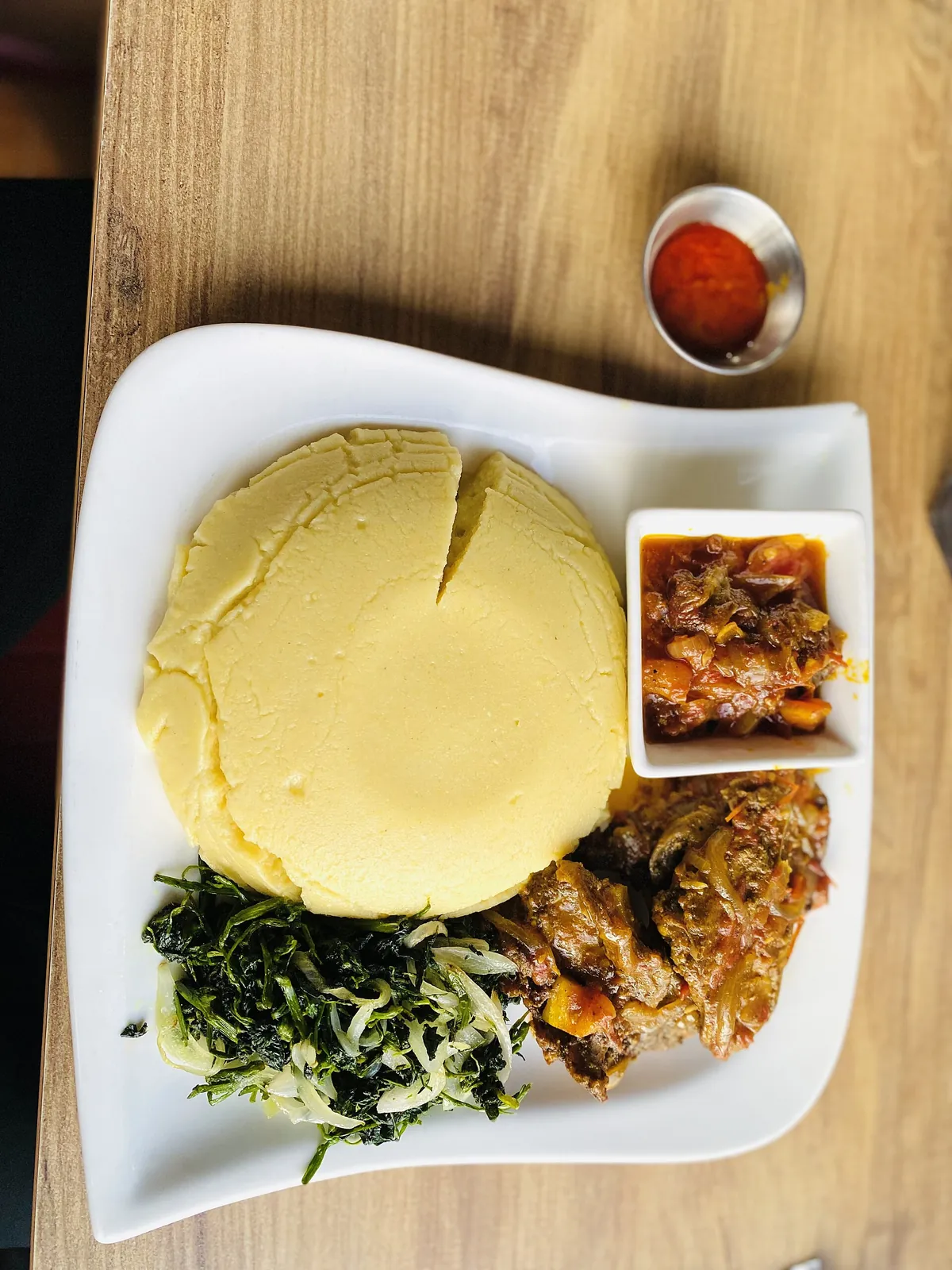
Njama njama (a leafy vegetable of the genus Solanum in the nightshade family grown in Cameroon, English name garden huckleberry), chopped and stir-simmered with onions. It is served as a side dish at the lower left of the plate with fufu corn and khati khati. The whole plate is one example of a khati khati meal and is not a specimen photograph of the leafy vegetable alone.
Prepared formShown: Solanum scabrum (written in the source as njama njama / garden huckleberry)Part / state: Njama njama (a leafy vegetable of the genus Solanum in the nightshade family) chopped and stir-simmered with onions. Placed at the lower left of the plate. Served together with corn fufu and a tomato stew of meat
Photo: Adesolive / CC BY-SA 4.0 / original image / ledger's original image
Scope and provenance of the photo
Identification: Identified as labelled in the source. The source caption describes njama njama as a plant of the nightshade family (Solanaceae), English name garden huckleberry, and the main ingredient of fufu corn and khati khati dishes. No scientific name is given, and re-identification by a specialist has not been done. The photograph shows a finished plate and is not a specimen photograph of the leafy vegetable alone.
Image shown: The 1920 px version from Wikimedia Commons. No cropping or color changes by NIGAMI LAB. For display, a WebP capped at 1200 px wide is served; the ledger's original image can be checked from the link above.
On this page (6 sections)
Reading the bitterness
African nightshade leaves are a collective term for edible leafy vegetables of the genus Solanum in sub-Saharan Africa, including several related species such as S. retroflexum, S. scabrum, S. nigrum, S. americanum, and S. villosum. A 2020 review says the cooked leaves accompany staple starch dishes such as maize porridge and tomato relish, and that some preparations ferment them with milk. These bitter leaves become a dish by first being boiled and served alongside a staple.
The bitterness is described as deriving from anti-nutritional constituents, including solanaceous glycoalkaloids. The same review says traditional preparation methods such as blanching, ordinary cooking, and fermentation have been widely used in southern Africa to reduce the bitterness from these constituents, and cites an example of blanching at 95°C for 5 minutes. It does not, however, report thresholds linking individual glycoalkaloids and concentrations to perceived bitterness or sensory values showing how much bitterness falls after processing.
Sources for this overview
Checked for this overview: The portion checked in the review describing boiled leaves served with staples and preparations fermented with milk. / The portion checked in the review attributing bitterness to solanaceous glycoalkaloids and related compounds. / The portion checked in the review describing reduction of bitterness through blanching, cooking, and fermentation, including the 95°C for 5 minutes example.
Structured claims — open a section to read each claim's confidence, evidence and limits
Composition and content (1)
Scope: Leaves.
Note: This source does not identify which glycoalkaloid is bitter at which concentration (threshold).
Show data
ingredient-african-nightshade-leaves —contains→ (the claim sentence above)How processing and cooking change it (2)
Scope: Sub-Saharan Africa, especially southern and eastern regions.
Show data
ingredient-african-nightshade-leaves —is_eaten_as→ (the claim sentence above)Scope: Traditional preparation in southern Africa; a review focusing on S. retroflexum.
Show data
ingredient-african-nightshade-leaves —has_perceived_bitterness_affected_by→ (the claim sentence above)