huazontle inflorescence
ingredient / ingredient-huazontle-inflorescence
ワソントレの花序 / Chenopodium berlandieri subsp. nuttalliae
Young huazontle inflorescences. An edible part in traditional cuisine of the Mexican Basin. A report that saponin concentration is high in the outer layer concerns seeds of a congeneric plant; saponin distribution in the inflorescences themselves was not reported in the collected sources.
Photographs (captions in Japanese)
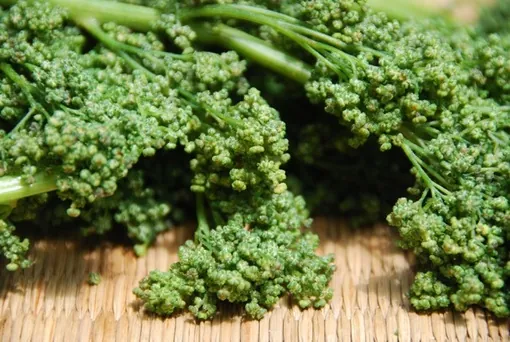
A stem of huauzontle (Chenopodium berlandieri subsp. nuttalliae) with young inflorescences. The part eaten in traditional dishes of the Valley of Mexico.
Shown: Chenopodium berlandieri subsp. nuttalliae (huauzontle)Part / state: Stem with young inflorescences
Photo: Pabs004 / CC BY-SA 3.0 / original image / ledger's original image
Scope and provenance of the photo
Identification: Identified as labelled in the source. Low resolution (510×342 px, 510 px on the long side), but adopted because it is practically the only photograph on Commons that explicitly shows this part.
Image shown: The full-size file from Wikimedia Commons. No cropping or color changes by NIGAMI LAB. For display, a WebP capped at 1200 px wide is served; the ledger's original image can be checked from the link above.
On this page (8 sections)
Reading the bitterness
Young huazontle inflorescences are analyzed in a 2025 thesis as an edible part alongside seeds. The thesis analyzes chemical composition using an inflorescence decoction and dichloromethane:MeOH extracts, supporting that this part is treated as both food and a research subject.
The thesis mentions bitterness from Chenopodium-genus saponins as background information for the species as a whole, but this generalizes findings reported for seeds of a congeneric plant to an edible inflorescence and is not a sensory test of the inflorescence itself. Sources directly showing saponin distribution within the inflorescence were outside the collection scope.
A monograph published by SIAP under Mexico’s Ministry of Agriculture and Rural Development records stems, leaves, and flowers (spike-like inflorescences) as harvested parts and states that they contain saponins, substances that give food slight bitterness. From the paragraph structure, it cannot be determined precisely whether the subject refers to the flowers just mentioned or the plant as a whole.
Sources for this overview
Checked for this overview: Confirmed the description of the inflorescence as an edible part and experimental subject. / Confirmed that the genus-level saponin bitterness description was generalized to the inflorescence as background.
Huauzontle (monografía de producto)
Checked for this overview: Confirmed the SIAP monograph’s description of slight bitterness from saponins.
Other names: huazontle (es)
Follow the connections
huazontle inflorescence →is prepared from→ huazontle / quelite cenizo
huazontle inflorescence →— bitterness is attributed …→ Chenopodium triterpenoid saponins →— sensory attribute→ bitterness
Structured claims — open a section to read each claim's confidence, evidence and limits
Composition and content (2)
Scope: Young inflorescences, as well as seeds, are used as edible parts.
Show data
ingredient-huazontle-inflorescence —is_prepared_from→ organism-chenopodium-berlandieri-nuttalliaeScope: Layer: Public source. The SIAP/SADER one-page monograph was read in full. From the paragraph structure it cannot be determined precisely whether the saponin attribution is limited to the inflorescence or refers to the whole plant.
Show data
ingredient-huazontle-inflorescence —is_documented_as_having→ (the claim sentence above)Sensory (1)
Scope: Positioning of genus (Chenopodium) level saponin description as generalization to the edible flower clusters of huazontle.
Note: A limitation is that this is not a sensory test of the flower clusters themselves.
Show data
ingredient-huazontle-inflorescence —has_bitterness_attributed_to→ compound-class-chenopodium-saponins