EVOO
ingredient / ingredient-extra-virgin-olive-oil
エキストラバージンオリーブオイル / extra virgin olive oil / Olea europaea
Virgin olive oil meeting the criteria for extra virgin classification.
Photographs (captions in Japanese)
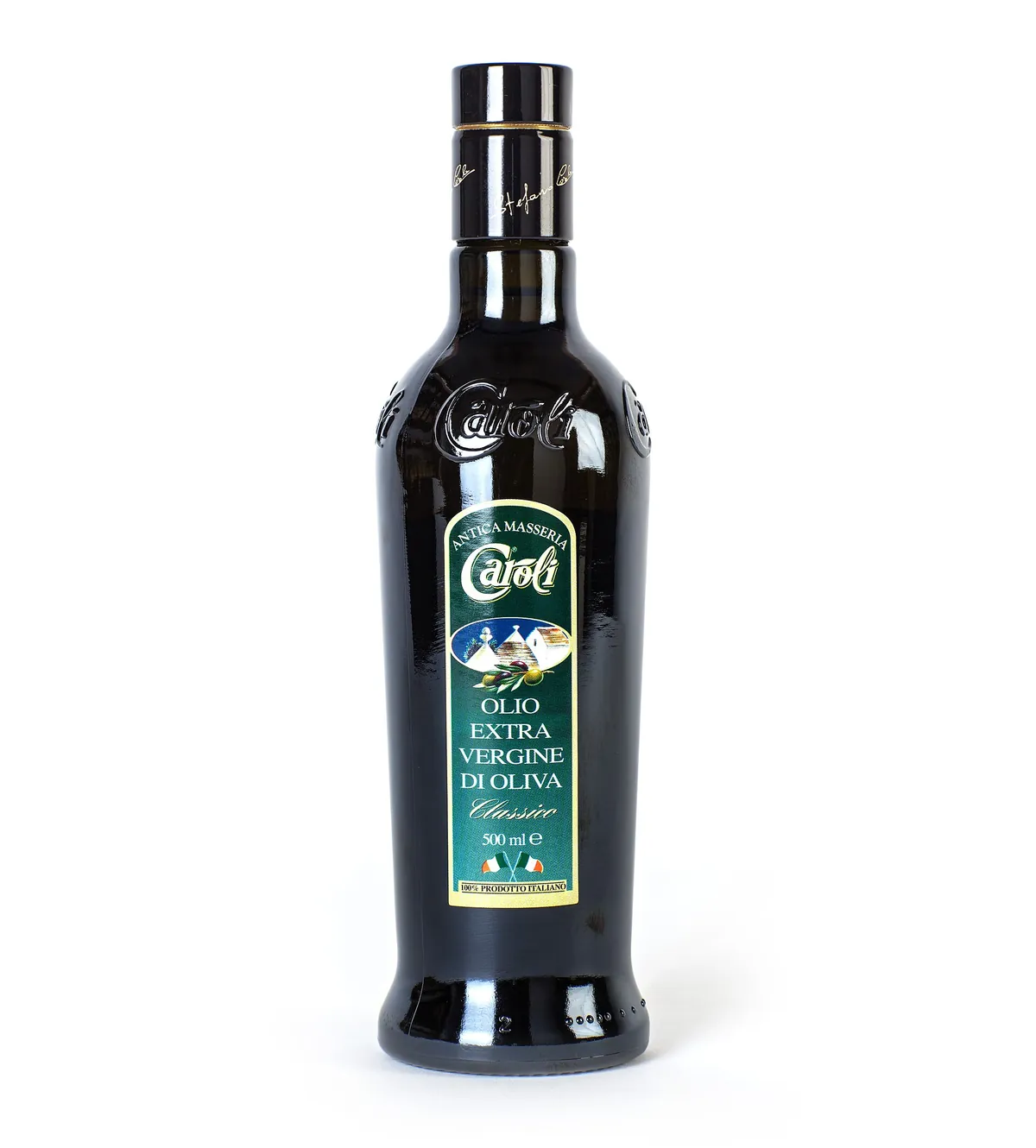
A commercial bottle of extra virgin olive oil (derived from Olea europaea). A 500 ml bottle of the brand "Caroli" from Apulia, Italy, with the label reading "OLIO EXTRA VERGINE DI OLIVA".
Shown: Olea europaeaPart / state: A commercial bottle of extra virgin olive oil (500 ml, from Apulia, Italy) labeled "Olio Extra Vergine di Oliva"
Photo: Caroliusa / CC BY-SA 4.0 / original image / ledger's original image
Scope and provenance of the photo
Identification: Identified as labelled in the source. A photograph of a bottle of a specific commercial brand, not representative of the appearance of extra virgin olive oil in general. The color and flavor of the liquid cannot be determined through the container.
Image shown: The 1920 px version from Wikimedia Commons. No cropping or color changes by NIGAMI LAB. For display, a WebP capped at 1200 px wide is served; the ledger's original image can be checked from the link above.
On this page (8 sections)
Reading the bitterness
Extra virgin olive oil refers to the most stringently-graded among virgin olive oils. In the international organoleptic evaluation method (IOC method, Rev. 11 as of 2024 revision), fruity, bitter, and pungent (a pricking sensation) are positioned as three positive attributes of the oil; bitterness is described as a primary taste perceived at the circumvallate papillae, characteristic of oils pressed from green or greenish olives. Pungency is characteristic of oils produced early in the harvest year and is recorded as a pricking tactile sensation felt especially in the throat.
However, bitterness and pungency are optional labelling terms (robust if the trained-panel median exceeds 6.0, medium if above 3.0 and at most 6.0, delicate if 3.0 or below) and are not mandatory requirements for the extra virgin grade itself. The IOC method grades oils by defect median = 0.0 and fruity-attribute median > 0.0, which aligns with EU sales standards (defect median Md = 0.0, fruitiness median Mf > 0.0). Mild oils with bitterness and pungency medians of 2.0 or less can equally be certified as extra virgin.
In a study analysing 100 extra virgin olive oils from 8 countries, 19 phenolic compounds were quantified; total phenol content ranged approximately from 52 to 315 mg GAE/kg, with oleocanthal and oleacein the most abundant at mean 77.9 mg/kg and 41.8 mg/kg respectively. In the same study, bitterness intensity showed the strongest correlation with total phenol content (r = 0.72) and also correlated with 3,4-DHPEA-EA (oleuropein aglycone, a secoiridoid) (r = 0.57); however, the paper attributes the coefficient to 3,4-DHPEA-EA in the abstract while the discussion section refers to it as 「オレウロペイン」 (in translation: "oleuropein"), leaving ambiguity—whether the correlation was to glycoside or aglycone remains unresolved within the paper itself.
Which phenolic compound is the primary driver of bitterness remains disputed across studies. A study examining 20 extra virgin oils of varying bitterness intensity reported that both oleuropein aglycone and ligstroside aglycone (in both dialdehyde and aldehyde forms) jointly contribute to bitterness, while a separate study found results strongly supporting dependence on oleuropein aglycone (3,4-DHPEA-EA). Attempts have been made to predict bitterness from chemical indicators alone; one study found that bitterness intensity could be adequately predicted from the spectrophotometric absorbance at 225 nm (K225) and total phenol content, but the functional forms of reported models differ across studies, and no single calibration equation has yet been established.
Sources for this overview
Checked for this overview: Verified the IOC method's definition of bitterness and pungency as positive attributes / Verified the statement that bitterness is not a grading criterion / Verified the IOC method grading criteria based on defect and fruitiness medians
Checked for this overview: Verified the EU sales standards for Md and Mf threshold values
Characterization of Phenolic Compounds and Their Contribution to Sensory Properties of Olive Oil
Checked for this overview: Verified phenol quantification and oleocanthal content from the analysis of 100 samples / Verified the correlation coefficients between bitterness intensity and total phenol and 3,4-DHPEA-EA
Checked for this overview: Verified the reported joint involvement of 2 aglycone types in 20-sample study
Bitter taste and phenolic compounds in extra virgin olive oil: an empirical relationship
Checked for this overview: Verified the competing claim of oleuropein aglycone dependence / Verified the exponential model prediction approach
Extra virgin olive oil bitterness evaluation by sensory and chemical analyses
Checked for this overview: Verified the K225 and total phenol bitterness prediction model
Follow the connections
EVOO →contains→ olive oil phenolic compounds →is correlated with→ bitterness
Structured claims — open a section to read each claim's confidence, evidence and limits
Composition and content (1)
Scope: A stated 100 oils in the cited composition study (the itemised total is 97)
Note: The specific compounds and their concentrations vary by cultivar, ripeness, and processing method. (2026-10-21, expansion stage N5 stage C batch 5: Codex's check against the source confirmed that the evidence comes from 1 study only and that in Table 1 the compound names are duplicated, so the correspondence with the abstract's mean values cannot be confirmed (established requires agreement among multiple independent studies); lowered from established to supported.)
Show data
ingredient-extra-virgin-olive-oil —contains→ compound-olive-phenolicsSensory (4)
Scope: Panel-assessed bitterness versus HPLC-ESI-MS-confirmed phenols in extra-quality virgin olive oil
Note: Studies disagree on which aglycone is dominant: Gutierrez-Rosales 2003 analyzed by regression the relationship between bitterness and the concentrations of the dialdehyde and aldehyde forms of oleuropein- and ligstroside-type aglycones, and its abstract concludes an essential role for 'this compound' in the singular (the abstract does not specify which compound, and garbled wording in the abstract leaves the direction of the regression unsettled), while Siliani 2006 finds the correlation depends mainly on the oleuropein aglycone (3,4-DHPEA-EA).
Show data
ingredient-extra-virgin-olive-oil —has_bitterness_attributed_to→ (the claim sentence above)Scope: Blended and single-cultivar extra virgin olive oil from studies in Italy and Spain
Note: Reported functional forms differ across studies (linear regression, validated exponential model, K225-based prediction). A single calibration has not been established. The Favati 2013 abstract says only the K225 value satisfactorily predicted bitterness intensity; how well total phenol content predicted it is not in the abstract.
Show data
ingredient-extra-virgin-olive-oil —bitterness_predictable_from→ (the claim sentence above)Scope: Cv. Coratina olives, a field trial on improved coastal karst soil in Croatia, 2 harvest years (2019-2020)
Note: Sensory evaluation was by an IOC (International Olive Council)-recognized descriptive sensory panel of 8 assessors (5 women, 3 men, average age 33), trained to comply with the IOC method, using a 0-10 cm unstructured intensity scale. Total phenol and secoiridoid concentrations showed no significant difference between irrigated and non-irrigated (chemical composition is covered in a separate claim).
Show data
ingredient-extra-virgin-olive-oil —has_perceived_bitterness_affected_by→ (the claim sentence above)Scope: 'Arbequina' olive cultivar, Spain, field trial in a single harvest year
Note: Sensory evaluation was performed by an ENAC-accredited official panel (for commercial quality grading) and by a university-affiliated descriptive panel of 8 assessors (4 women, 4 men, ages 25-55, trained to 600+ hours). Statistics: 3-way ANOVA (irrigation treatment × session × assessor).
Show data
ingredient-extra-virgin-olive-oil —has_perceived_bitterness_affected_by→ (the claim sentence above)Safety and regulation (2)
Scope: The IOC method for the sensory assessment of virgin olive oil, Rev. 11 (June 2024)
Note: The optional labelling terms robust (median > 6.0), medium (3.0 < Me <= 6.0), and delicate (<= 3.0) apply to bitterness and pungency. This is the structural mirror image of table-olive debittering, which removes the same phenolic compounds.
Show data
ingredient-extra-virgin-olive-oil —has_positive_sensory_attributes→ (the claim sentence above)Scope: The IOC sensory classification of virgin olive oil
Note: Bitterness is a positive attribute that may be labelled, but it is not a requirement for the extra virgin grade.
Show data
ingredient-extra-virgin-olive-oil —is_classified_by→ (the claim sentence above)