dandelion leaf
ingredient / ingredient-dandelion-leaf
タンポポの葉 / Taraxacum officinale
Edible dandelion leaves. They contain sesquiterpene lactone glycosides.
Photographs (captions in Japanese)
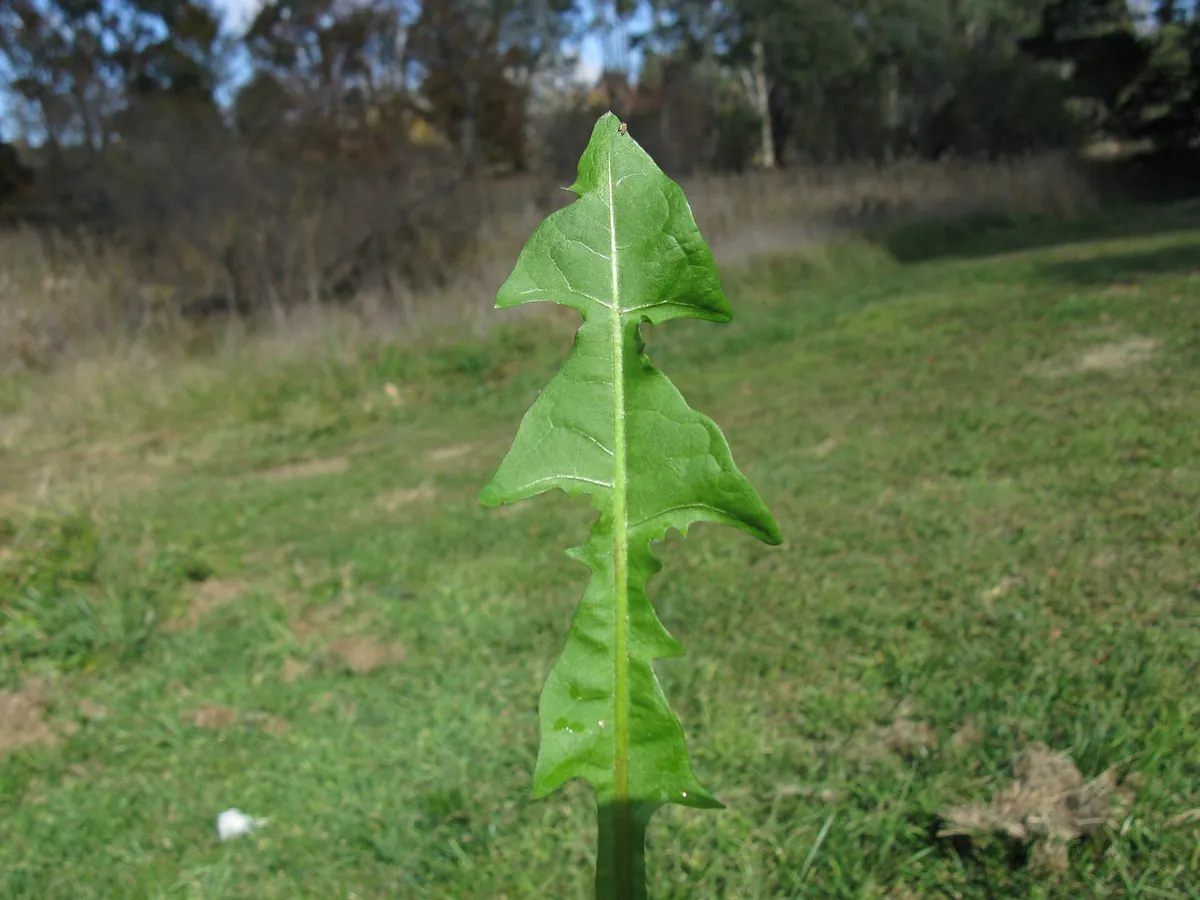
A leaf of the common dandelion (Taraxacum officinale). 1 upright leaf in grass, showing the characteristic shape with deep, irregular cuts along the edge. No flowers or roots are shown.
Shown: Taraxacum officinalePart / state: 1 simple leaf of common dandelion (including the leaf stalk) with deep cuts, standing upright from the ground
Photo: Harry Rose (South West Rocks, Australia) / CC BY 2.0 / original image / ledger's original image
Scope and provenance of the photo
Identification: Identified as labelled in the source. The source caption is an explanation of a plant naturalized in pasture in Australia and contains no information on the harvesting state as food or on the origin.
Image shown: The 1920 px version from Wikimedia Commons. No cropping or color changes by NIGAMI LAB. For display, a WebP capped at 1200 px wide is served; the ledger's original image can be checked from the link above.
On this page (8 sections)
Reading the bitterness
Dandelion leaves are one of the edible parts of Taraxacum officinale (common dandelion). The review treats the leaves as an independent plant part, organizing their chemical constituents and including their food use. The leaves appear in the encyclopedia also because they are known as a vegetable with a distinctive bitterness.
Dandelion bitterness is described as being caused mainly by a group of compounds called sesquiterpenoids. The β-glucopyranosyl ester of taraxinic acid and its hydrogenated derivative have been reported as representative constituents in the leaves. However, the extent to which individual compounds contribute to bitterness, and differences by variety or growing conditions, have not been clarified within the scope of this review.
Sources for this overview
Dandelion (Taraxacum Genus): A Review of Chemical Constituents and Pharmacological Effects
Checked for this overview: Confirmed the description treating the leaves as an independent edible plant part. / Confirmed the description identifying taraxinic acid glycosides as major constituents. / Confirmed the description attributing bitterness to sesquiterpenoids. / Confirmed its positioning as a major sesquiterpene lactone in the leaves.
Follow the connections
common dandelion →The edible part of is→ dandelion leaf
dandelion leaf →contains→ taraxinic acid beta-D-glucopyranosyl ester
dandelion leaf salad →includes→ dandelion leaf
Structured claims — open a section to read each claim's confidence, evidence and limits
Composition and content (2)
Scope: Leaves of Taraxacum officinale
Note: Reported as a major sesquiterpene lactone in the leaves.
Show data
ingredient-dandelion-leaf —contains→ compound-taraxinic-acid-glucosideScope: The leaves of Taraxacum officinale
Note: A summary of HPLC/MS and isolation studies cited by the review.
Show data
compound-taraxinic-acid-glucoside —is_major_sesquiterpene_lactone_in→ ingredient-dandelion-leafSensory (1)
Scope: A review of bitterness in the dandelion genus
Note: Does not assert the contribution rate of any individual compound.
Show data
ingredient-dandelion-leaf —has_bitterness_attributed_to→ (the claim sentence above)How processing and cooking change it (2)
Scope: The leaf part addressed by the review
Note: Regional differences in food culture and harvesting safety are outside the scope of this claim.
Show data
organism-taraxacum-officinale —has_food_part→ ingredient-dandelion-leafScope: A candidate structural component of a dish. Regional variation in ingredients is unconfirmed
Note: Source not connected. Does not indicate quantities or cooking conditions.
No source connected — this claim has not been verified yet. It is a general-knowledge placeholder, not a confirmed statement.
Show data
dish-dandelion-salad —includes→ ingredient-dandelion-leaf