日本語版

Carciofo Spinoso di Sardegna

ingredient / ingredient-artichoke-sardegna

サルデーニャ棘アーティチョーク / Cynara scolymus L.

Carciofo Spinoso di Sardegna is a food defined by a PDO specification as the spiny artichoke produced in Sardinia.

Photographs (captions in Japanese)
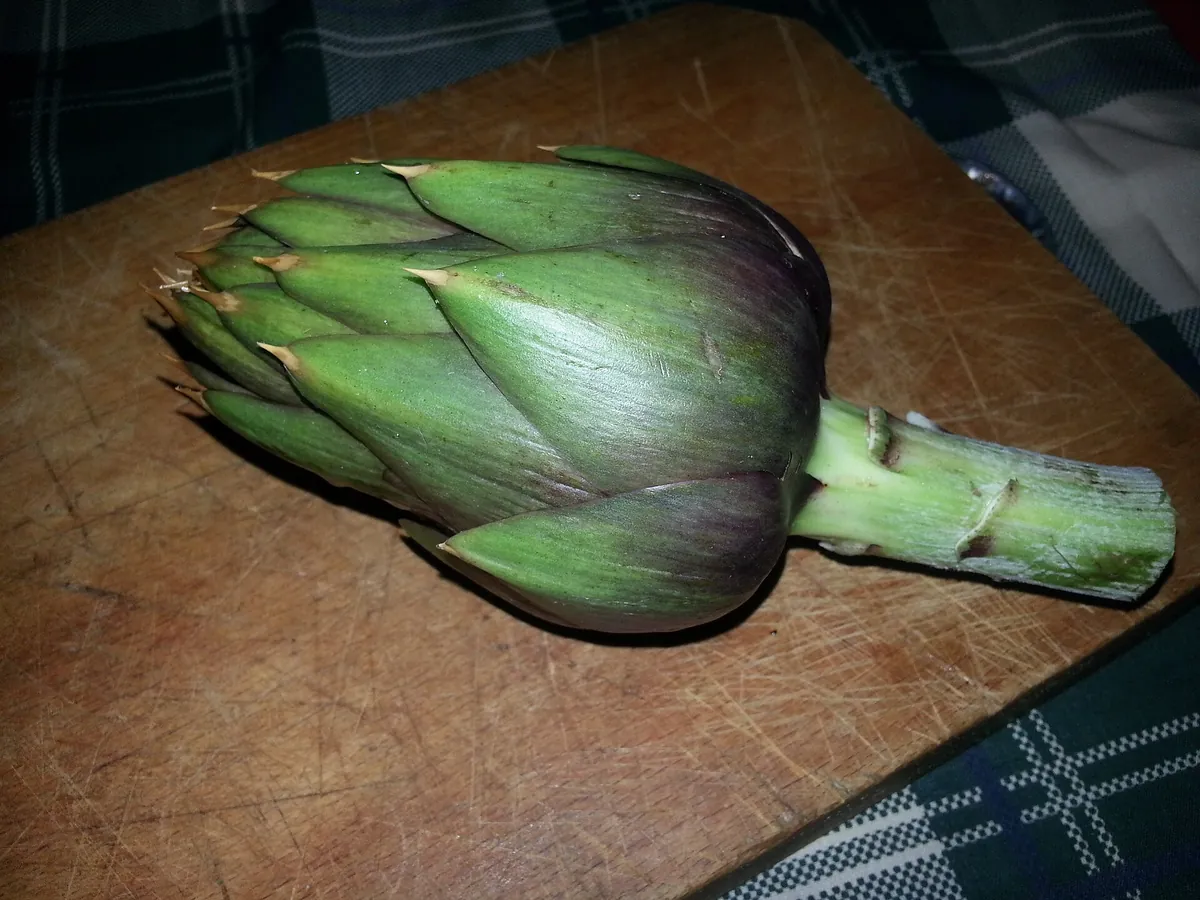
A single spindle-shaped artichoke with thorns at the tips of its green to purplish bracts, lying on its side with its thick stem still attached on a wooden cutting board.

A flower bud of an artichoke (Cynara cardunculus) with spiny bracts. Carciofo Spinoso di Sardegna is a geographical indication for the Sardinian product within this spiny artichoke group, but the origin and PDO conformity cannot be confirmed from this photograph.

Shown: Cynara cardunculusPart / state: A single flower bud of an artichoke with spiny bracts, apparently just harvested. Shown with the cut end of the stem still attached

Photo: Assianir / CC BY-SA 3.0 / original image / ledger's original image

Scope and provenance of the photo

Identification: Identified as labelled in the source. The source caption says only "artichoke with conspicuous spines (Carciofo con spine evidenti)" and does not mention origin. Whether it conforms in origin or specification to Carciofo Spinoso di Sardegna (Sardinian spiny artichoke, PDO) cannot be judged from the photograph, and re-identification by a specialist has not been done. It is included as one example of a spiny cultivar group.

Image shown: The 1920 px version from Wikimedia Commons. No cropping or color changes by NIGAMI LAB. For display, a WebP capped at 1200 px wide is served; the ledger's original image can be checked from the link above.

On this page (6 sections)
  1. Overview
  2. Sources for this overview (1)
  3. Topic hubs
  4. Related entries (10)
  5. Composition and content (1)
  6. Sensory (2)
↑

Reading the bitterness

Carciofo Spinoso di Sardegna (Sardinian spiny artichoke) is a food covered by the EU PDO for the spiny Sardinian type of Cynara scolymus. The EU sensory specification describes its taste as full-bodied and states that polyphenol derivatives and cynarin balance bitterness and sweetness.

The same specification also describes astringency. It states that the puckering astringency produced by tannins, natural constituents of the artichoke, is largely imperceptible because sweetness from carbohydrates offsets it. The specification treats bitterness and astringency as separate sensations. These are sensory descriptions in an EU protected designation of origin specification, however, not data from an independent sensory test.

Sources for this overview

  1. Single document: Carciofo Spinoso di Sardegna PDO

    European Commission / 2010 / government document / full text checked

    Checked for this overview: Confirmed the extent to which the PDO sensory specification links the balance of bitterness and sweetness to constituents. / Confirmed the sensory-specification statement that sweetness offsets astringency, and that the source is a standards document.

Structured claims — open a section to read each claim's confidence, evidence and limits

Composition and content (1)

Carciofo Spinoso di Sardegna — composition: At least 50 mg of polyphenols per 100 g of fresh substance (the specified minimum).contextual

Scope: Original Italian disciplinare, Art.2 Chimiche.

Note: A chemical minimum in a specification, not a measurement from an individual analytical paper; contextual under research protocol §3. The same article specifies carbohydrates of at least 2.5 g/100 g and sodium of at most 0.125 g/100 g, excluded because they are not directly related to bitterness.

Polyphenol content is specified as not less than 50 mg in 100 g of fresh substance. The same section lists carbohydrates of at least 2.5 g/100 g and sodium of at most 0.125 g/100 g.
Limitations: A minimum specification value, not a measured value from an individual analytical paper. The analytical method and sample size are not given.
Source: Disciplinare di Produzione della Denominazione di Origine Protetta "Carciofo Spinoso di Sardegna" (Ministero delle politiche agricole alimentari e forestali (PQAI IV), 2010) · full text checked
Show dataingredient-artichoke-sardegna —has_composition→ (the claim sentence above)
claim: clm-sardegna-polyphenol-min / type: composition / updated: 2026-09-01

Sensory (2)

Carciofo Spinoso di Sardegna — sensory attribute: A balance of bitterness and sweetness attributed to polyphenol derivatives and cynarinsupported

Scope: The EU PDO sensory specification

Note: The causal link to the compounds is recorded as the specification document's own explanation.

Defines it as full-bodied, with bitter and sweet notes balanced by polyphenol derivatives and cynarin.
Limitations: The causal link to the compounds is the specification document's own explanation, not an independent experiment.
Source: Single document: Carciofo Spinoso di Sardegna PDO (European Commission, 2010) · full text checked
Art. 2 describes a full-bodied taste combining slight bitterness and a sweetish taste (amarognolo and dolciastro) in balance, owing to the presence of polyphenol derivatives and cynarin. Art. 6 repeats that the pleasant taste results from this balanced combination of slight bitterness and a sweetish taste.
Limitations: A description in the specification document, not a measurement by a sensory panel. This is the original-language wording of the same disciplinare already recorded in the existing evidence drawn from the English-language EU Official Journal.
Source: Disciplinare di Produzione della Denominazione di Origine Protetta "Carciofo Spinoso di Sardegna" (Ministero delle politiche agricole alimentari e forestali (PQAI IV), 2010) · full text checked
Show dataingredient-artichoke-sardegna —has_sensory_attribute→ (the claim sentence above)
claim: clm-sardegna-bitter-sweet / type: sensory / updated: 2026-08-31
Carciofo Spinoso di Sardegna — sensory attribute: Tannin-derived astringency is offset by sweetness and is less noticeable.supported

Scope: EU PDO sensory specification

Note: Bitterness and astringency were made separate claims so they are not treated as identical.

The specification states that tannin-derived astringency is offset by carbohydrate-derived sweetness and is hardly noticeable.
Limitations: This was not an experiment distinguishing bitter-receptor response from astringent touch.
Source: Single document: Carciofo Spinoso di Sardegna PDO (European Commission, 2010) · full text checked
On astringency, the specification states that the presence of tannins, natural components of the artichoke, is barely perceived because it is counterbalanced by predominant sweet sensations arising from the substantial presence of carbohydrates.
Limitations: A description in the specification document, not a measurement by a sensory panel.
Source: Disciplinare di Produzione della Denominazione di Origine Protetta "Carciofo Spinoso di Sardegna" (Ministero delle politiche agricole alimentari e forestali (PQAI IV), 2010) · full text checked
Show dataingredient-artichoke-sardegna —has_sensory_attribute→ (the claim sentence above)
claim: clm-sardegna-astringency / type: sensory / updated: 2026-08-31

↑ Top of page · ← Encyclopedia (English entries)