green asparagus
ingredient / ingredient-asparagus-green
グリーンアスパラガス / Asparagus officinalis L.
Asparagus harvested after shoots emerge and elongate in sunlight without shading.
Photographs (captions in Japanese)
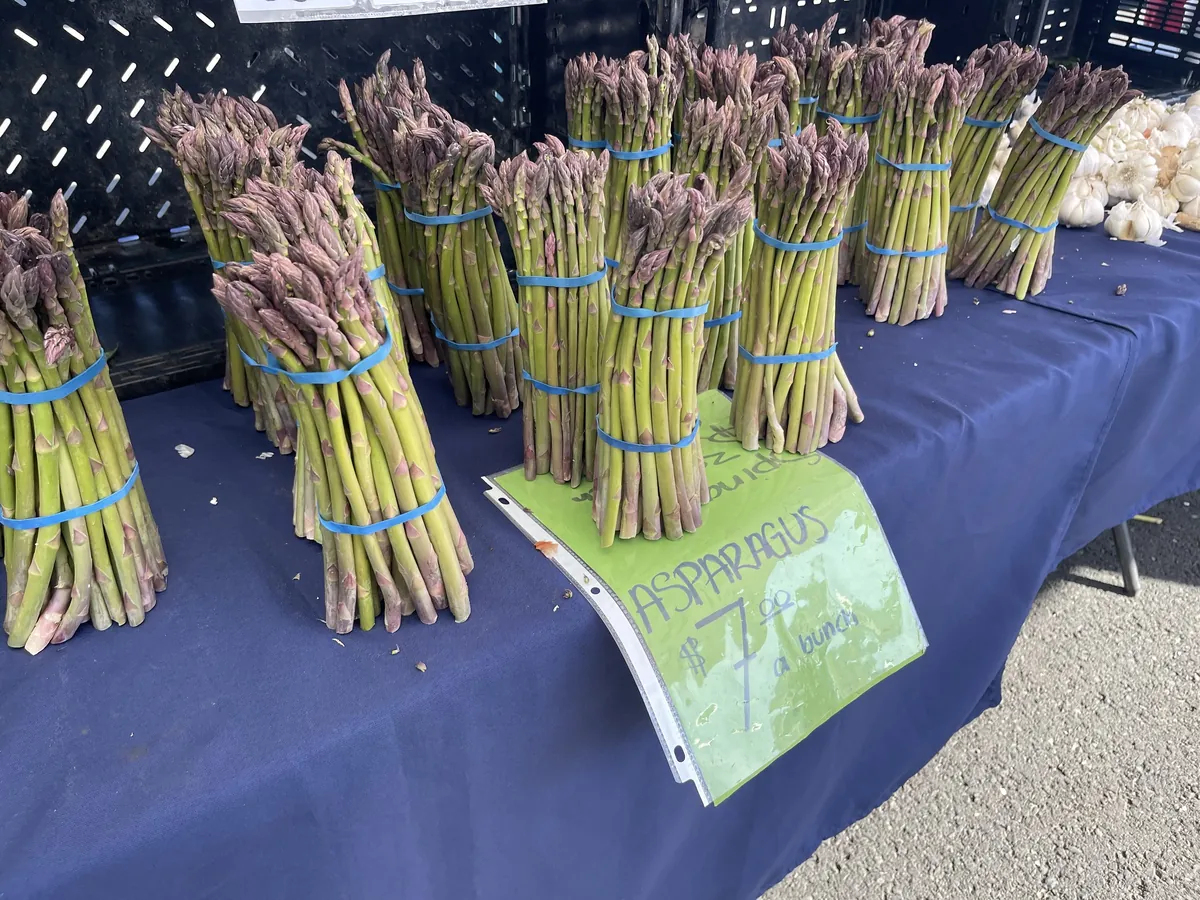
Bunches of raw green asparagus bound with rubber bands, displayed at a farm-produce stand.
Shown: Asparagus officinalisPart / state: Harvested spears (raw, uncooked, green plants grown in sunlight, including the tips)
Photo: Missvain (Sarah Stierch) / CC BY 4.0 / original image / ledger's original image
Scope and provenance of the photo
Identification: Identified as labelled in the source. Photographed at a farm-produce stand in Napa, California, USA. No cultivar name is given. I opened the image and confirmed that several bunches with bright green stalks and purplish tips are lined up on a market stand.
Image shown: The original from Wikimedia Commons, reduced to 2400 px on the long side. No cropping or color changes. For display, a WebP capped at 1200 px wide is served; the ledger's original image can be checked from the link above.
On this page (8 sections)
Reading the bitterness
Green asparagus is a cultivation type grown and harvested in sunlight after the shoots emerge and elongate without shading. It contrasts with white asparagus, which is kept in darkness below ground by adding about 20 cm of soil to the ridge and harvested there; the distinction is whether the crop is shaded.
In composition, phenolic compounds including flavonoids such as rutin are reported to be significantly more abundant in the green type. This is an example of different groups of components accumulating unevenly in the two types according to whether they are shaded.
As a flavor description citing earlier sensory analysis, green asparagus is described as having green, grassy, and bitter notes, while white asparagus has sweet corn, potato, and buttery notes. The sensory analysis was conducted in the cited earlier study, not independently in the paper discussing it. Separately, saponin concentrations that may relate to bitterness were reported to be higher in white asparagus, even though the bitter flavor note was assigned to green asparagus. The source records this as an example in which metabolite amount and flavor attribution do not correspond simply.
Sources for this overview
Checked for this overview: Used to support the contrast in shading between green and white asparagus. / Used to support the account that phenolic compounds are more abundant in green asparagus. / Used to support the flavor-note description cited from earlier sensory analysis.
Follow the connections
green asparagus →differs from→ white asparagus
rutin →occurs in→ green asparagus
green asparagus →— sensory attribute→ bitterness →can be measured separately …→ astringency
Structured claims — open a section to read each claim's confidence, evidence and limits
Composition and content (1)
Show data
compound-rutin —occurs_in→ ingredient-asparagus-greenSensory (1)
Scope: Earlier sensory analysis cited by Pegiou et al. 2021.
Note: Saponin concentration is reported to be higher in the white type, yet the bitter note is assigned to the green type. This is recorded as an example where metabolite amount and flavor attribution do not correspond simply.
Show data
ingredient-asparagus-green —has_sensory_attribute→ sensation-bitterHow processing and cooking change it (1)
Show data
ingredient-asparagus-green —differs_from→ ingredient-asparagus-white