cranberry
ingredient / ingredient-cranberry
クランベリー / Vaccinium macrocarpon Aiton
Cranberry is a fruit of the North American Vaccinium genus, reported in sensory evaluation to show moderate-to-high bitterness and astringency with strong sourness in unsweetened juice.
Photographs (captions in Japanese)
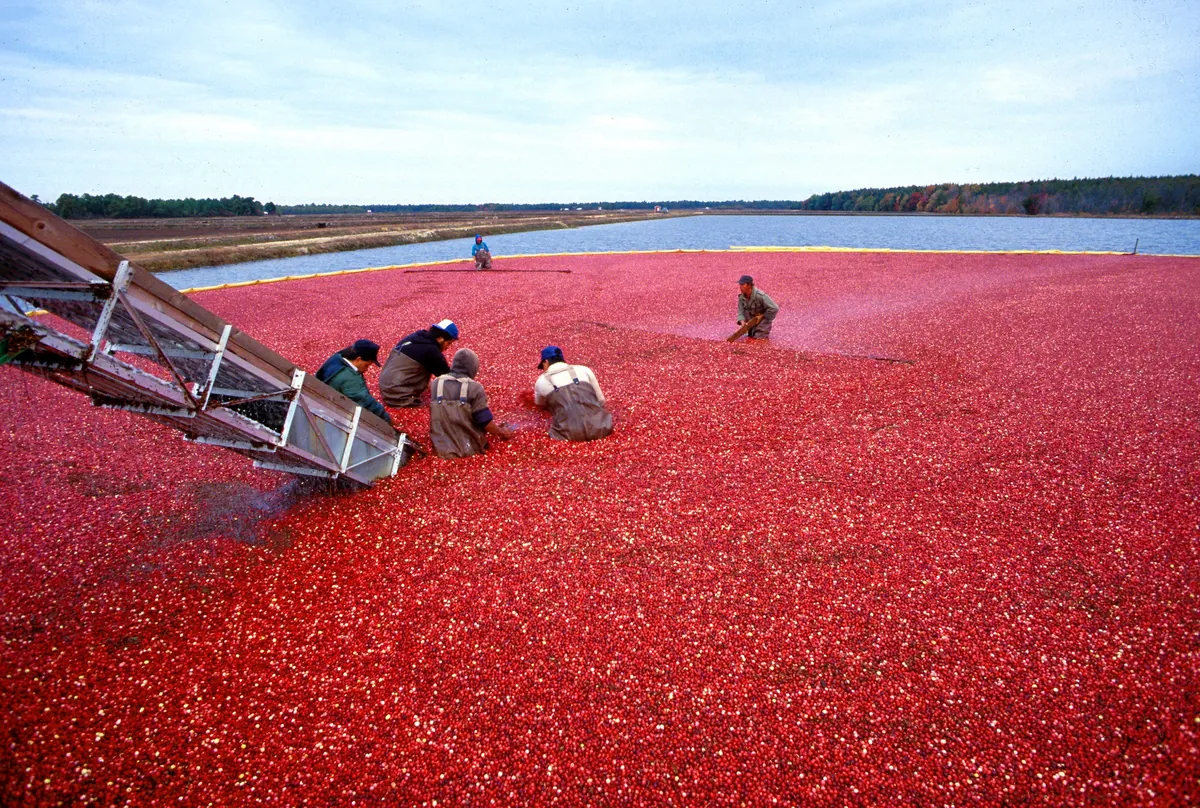
A harvest scene of red cranberries floating across the water surface. Several workers are in the background
Field observationShown: Cranberry (only a link to the English version in the page description, no scientific name given; from New Jersey)Part / state: At harvest, a mass of fully ripe fruit floating on the water surface. The fruit itself covers the whole frame, on the scale of thousands
Photo: Keith Weller, USDA-ARS / Public domain / original image / ledger's original image
Scope and provenance of the photo
Identification: Identified as labelled in the source. A public-domain image taken by USDA-ARS. Workers appear in the harvest scene, but the main subject is the fruit itself covering the frame. Original size 3157x2125. I opened the image and confirmed. Red fruit floats across the whole water surface, and several harvest workers are bending over their work. Conveyor equipment in the foreground
Image shown: The original from Wikimedia Commons, reduced to 2400 px on the long side. No cropping or color changes. For display, a WebP capped at 1200 px wide is served; the ledger's original image can be checked from the link above.
On this page (6 sections)
Reading the bitterness
A descriptive sensory evaluation of unsweetened cranberry juice using a 15-cm line scale measured 6 attributes: sweetness, bitterness, sourness, astringency, thickness, and cranberry flavor. In addition to strong sourness and sparse sweetness, unsweetened juice was reported to show 「中程度から高い苦味・渋味・クランベリー風味(moderately-high bitterness, astringency, cranberry flavor)」 (in translation: "moderately-high bitterness, astringency, cranberry flavor"). Bitterness and astringency were rated as clearly separate attributes within the same panel.
In the same research group, samples with cranberry-derived polyphenol extract (CPE) showed a tendency for astringency and bitterness ratings to increase as the added concentration increased. For PROP taste sensitivity (taster status), which is described as producing individual differences in bitterness perception, the team expected an effect based on prior research, but no significant effect on bitterness or astringency perception was actually observed. Effects of PROP sensitivity were observed for cranberry flavor, overall liking, and sourness perception in combination with sex.
Sources for this overview
Checked for this overview: Used the report of moderate-to-high bitterness as the basis for this paragraph. / Used the description listing 6 attributes as the basis for this paragraph. / An unexpected result in which PROP sensitivity had no effect.
Follow the connections
cranberry →— sensory attribute→ bitterness →can be measured separately …→ astringency
cranberry →— sensory attribute→ astringency →is not synonymous with→ bitterness
Structured claims — open a section to read each claim's confidence, evidence and limits
Sensory (3)
Scope: Unsweetened cranberry juice (CJ), descriptive sensory evaluation using a 15-cm line scale.
Note: Unsweetened cranberry juice was reported to show strong sourness, sparse sweetness, and 『moderately-high bitterness, astringency, cranberry flavor(中程度から高い苦味・渋味・クランベリー風味)』 (in translation: "moderately-high bitterness, astringency, cranberry flavor").
Show data
ingredient-cranberry —has_sensory_attribute→ sensation-bitterScope: The same evaluation, rating 6 attributes: sweetness, bitterness, sourness, astringency, thickness, and cranberry flavor.
Note: Within the same descriptive evaluation as bitterness, astringency was measured and reported simultaneously as an independent attribute.
Show data
ingredient-cranberry —has_sensory_attribute→ sensation-astringentScope: A study that also examined sensory-evaluation differences due to individual factors such as PROP taste sensitivity.
Note: A tendency for astringency and bitterness ratings to increase as the amount of CPE increased was reported. Meanwhile, although the authors expected an effect of PROP sensitivity (taster status) based on prior research, this study explicitly states that no effect of PROP sensitivity on bitterness or astringency perception was observed (PROP effects were seen for cranberry flavor, overall liking, and sourness under interaction with sex).
Show data
ingredient-cranberry —has_bitter_astringency_affected_by→ (the claim sentence above)