bitter apricot kernel
ingredient / ingredient-bitter-apricot-kernel
アンズ仁(苦仁)
Bitter apricot kernel is the kernel of a bitter apricot cultivar. It contains the cyanogenic glycoside amygdalin, which is converted to cyanide after ingestion; EFSA has assessed the acute risk of eating raw kernels.
Photographs (captions in Japanese)
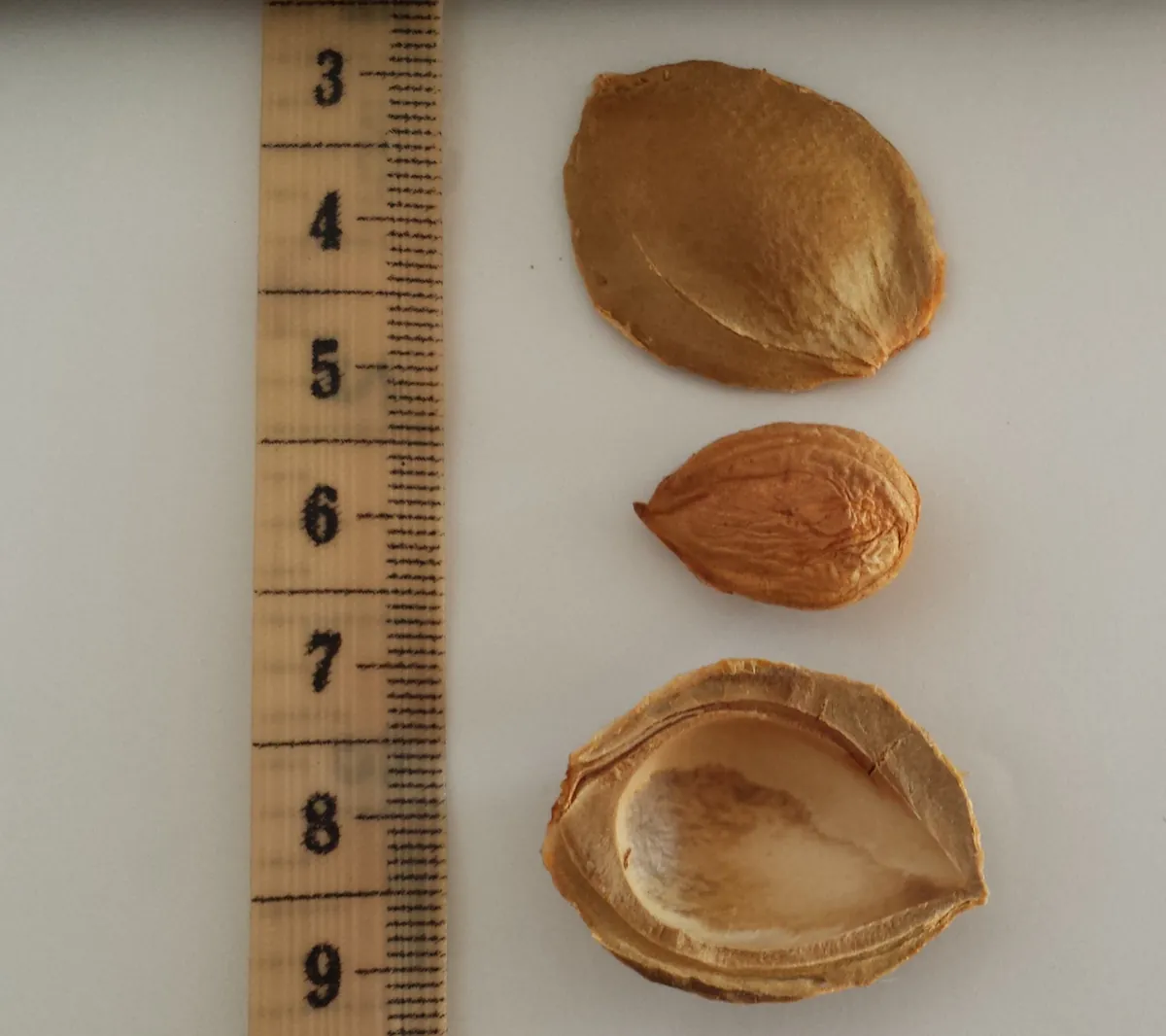
Apricot kernels (bitter kernels). Apricot seeds bought at a market in Brașov, Romania, shown as a kernel with its thin skin (top), a seed in its shell (center), and the shell split in two (bottom). A centimeter scale is included to show size. Whether they are bitter or sweet kernels cannot be determined from the photograph.
Shown: Prunus armeniaca (seed kernel; whether bitter or sweet type is not stated in the source)Part / state: A photograph comparing apricot seeds (kernels) in three forms with a centimeter scale: the kernel with its thin skin still on (top), still wrapped in its shell (center), and the shell split in two (bottom)
Photo: Iulian.serbanoiu / CC BY-SA 3.0 / original image / ledger's original image
Scope and provenance of the photo
Identification: Identified as labelled in the source. The source caption says only "Apricot kernels from Romania, and the shell of a seed split in two (centimeter scale). Bought at a local market in Brașov", and does not state the cultivar or whether the kernels are bitter or sweet. That they are bitter kernels cannot be confirmed from the photograph, and re-identification by a specialist has not been done.
Image shown: The 1920 px version from Wikimedia Commons. No cropping or color changes by NIGAMI LAB. For display, a WebP capped at 1200 px wide is served; the ledger's original image can be checked from the link above.
On this page (9 sections)
Reading the bitterness
Bitter apricot kernels contain the naturally occurring cyanogenic glycoside amygdalin, which is converted to cyanide in the body after consumption, according to an official announcement by EFSA (European Food Safety Authority). This property underlies its assessment of how much raw apricot kernel can lead to an acute risk.
EFSA’s expert panel set an acute reference dose (ARfD)—an intake level described as not producing health effects from a single exposure—of 20 µg/kg body weight for cyanide. According to its official announcement, up to 3 small raw apricot kernels (370 mg) would not exceed this level for an adult, but more than 3 small kernels or less than half a large kernel could exceed it. A single small kernel could exceed it for a young child. In a correction after publication, the wording for a large kernel was revised from 「1個超」 (in translation: "more than 1 kernel") to 「半分未満」 (in translation: "less than half a kernel"). These figures come from EFSA’s official press announcement; the underlying primary document has not been checked here, and they are not a recommendation for routine intake.
Amygdalin is a characteristic constituent of apricot kernels, but not their most abundant constituent. A range of 2–5% is cited from earlier work in the introduction to a debittering study. This was not a measurement made by that study itself.
Another experiment on bitter apricot kernels found that ultrasonically accelerated debittering shortened processing time compared with conventional methods and substantially improved β-glucosidase activity, color, and texture, while affecting oil and protein contents only slightly. Its evaluation used physical and chemical methods including UV-Vis spectroscopy, fluorescence spectroscopy, circular dichroism, electrophoresis, electron microscopy, and thermal analysis; no human sensory assessment of bitterness intensity was performed.
Sources for this overview
Apricot kernels pose risk of cyanide poisoning
Checked for this overview: Checked the announcement’s statement that amygdalin is converted to cyanide after ingestion. / Checked the ARfD value, the adult and child quantities, and the correction note.
Checked for this overview: The 2–5% amygdalin content of kernels is a value cited from earlier research. / Checked the improved physical properties and shortened processing time with ultrasonic debittering.
Follow the connections
bitter apricot kernel →contains→ amygdalin →— sensory attribute→ bitterness
Measured values (3)
| Kind | Compound | Target | Value | Conditions | Source |
|---|---|---|---|---|---|
| DoT | cyanide | bitter apricot kernel | 20 µg/kg body weight | EFSA single-exposure assessment. (Value from an official press announcement. This is not a threshold for the quantity of amygdalin itself.) | European Food Safety Authority, 2016 |
| DoT | cyanide | bitter apricot kernel | >3 pieces per intake | Raw apricot kernels (small). (Read together with the same official announcement’s statement that up to 3 small kernels (370 mg) do not exceed the level.) | European Food Safety Authority, 2016 |
| DoT | cyanide | bitter apricot kernel | <0.5 pieces per intake | Raw apricot kernels (large). (Wording after correction of the official announcement. Individual variation in cultivar and content is not captured by this figure.) | European Food Safety Authority, 2016 |
Values are the reported values of each source (with units and conditions). Thresholds and EC50 depend on the panel and method; they are not single true values.
Structured claims — open a section to read each claim's confidence, evidence and limits
Composition and content (2)
Scope: Raw apricot kernels.
Show data
ingredient-bitter-apricot-kernel —contains→ compound-amygdalinScope: Layer: Food. Concentration description in the background explanation of research on ultrasound-assisted debittering of bitter-variety apricot kernels (prior research citation).
Show data
ingredient-bitter-apricot-kernel —contains→ compound-amygdalinHow processing and cooking change it (1)
Scope: Layer: Food. An experimental study on bitter apricot kernels comparing physical properties before and after debittering with UV-Vis spectroscopy, fluorescence spectroscopy, circular dichroism, electrophoresis, environmental scanning electron microscopy, thermal analysis, and other methods.
Note: These are main experimental findings of the study itself, checked in its full text. They add an account of debittering as a processing technology, separate from EFSA’s ARfD assessment.
Show data
ingredient-bitter-apricot-kernel —can_be_debittered_by→ (the claim sentence above)Safety and regulation (1)
Scope: Consumption of raw apricot kernels.
Note: This is from an official press announcement. The underlying scientific opinion (EFSA Journal 2016;14(4):4424) has not been read, and this is not an intake recommendation. A correction changed the wording for large kernels from 「1個超」 (in translation: "more than 1 kernel") to 「半分未満」 (in translation: "less than half a kernel").
Show data
ingredient-bitter-apricot-kernel —can_exceed_acute_reference_dose_at→ (the claim sentence above)