potato
ingredient / ingredient-potato
ジャガイモ / Solanum tuberosum
Potato is an edible potato tuber. Tuber steroidal glycoalkaloid (SGA) content varies greatly among cultivars and lines, and high-content lines are described as bitter and acrid.
Photographs (captions in Japanese)
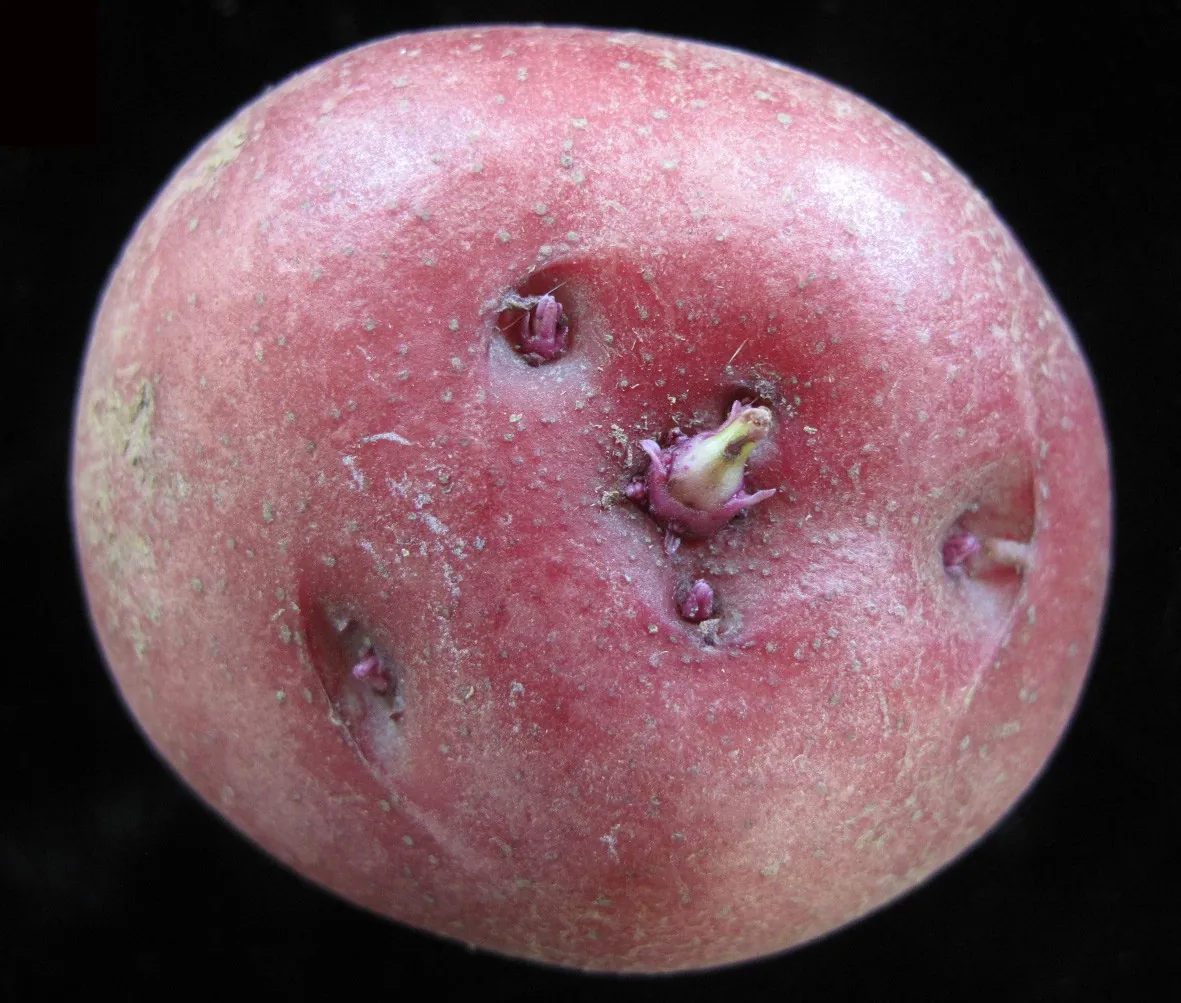
A close-up of a potato tuber with a red-purple skin. White sprouts are beginning to grow from the eyes.
Shown: Solanum tuberosumPart / state: Tuber (skin, including buds and eyes)
Photo: Ayotte, Gilles, 1948- / CC BY-SA 4.0 / original image / ledger's original image
Scope and provenance of the photo
Identification: Identified as labelled in the source. French description: "Tubercule et bourgeon de pomme de terre" (tuber and bud). No cultivar name is given. I opened the image and confirmed the red-purple tuber surface and a small new sprout growing from the central bud.
Image shown: Same size as the original on Wikimedia Commons. No cropping or color changes. For display, a WebP capped at 1200 px wide is served; the ledger's original image can be checked from the link above.
On this page (8 sections)
Reading the bitterness
The amount of steroidal glycoalkaloids (SGAs) in potato tubers varies widely by cultivar and line. In a sensory-panel evaluation of 13 clones, the 7 clones with more than 14 mg per 100 g of tuber were rated bitter, and the correlation between content and bitterness rating was reported as highly significant (r=0.93). This finding has only been checked at the abstract level. The same study found no relationship between total phenol content and bitterness or burning sensation, suggesting glycoalkaloids rather than phenols as the principal source of bitterness.
One part of the mechanism affecting these compounds involves the GAME4 gene. A review reports that silencing GAME4 (suppressing its function) can reduce SGA content in leaves and tubers by as much as 74-fold. That review itself, however, does not directly discuss a correlation between SGA content and sensory bitterness. A separate study, discussed in the preceding paragraph, individually confirmed the association between content and bitterness rating. Taken together, these findings suggest one route by which genetic mechanisms relevant to breeding could influence SGA content and, in turn, bitterness.
Some cultivars with high SGA content have in fact disappeared from the market. A review records that 'Lenape', grown in the United States, and 'Magnum Bonum', grown in Sweden, were both withdrawn after having once been widely cultivated because of high tuber SGA content. The review does not give their precise SGA contents or withdrawal years. This is a historical example suggesting how cultivar selection in breeding has greatly affected the amounts of bitterness-related compounds.
Sources for this overview
Effect of Glycoalkaloids and Phenolics on Potato Flavor
Checked for this overview: Used while stating explicitly that this has been checked only at the abstract level.
Potato steroidal glycoalkaloids: properties, biosynthesis, regulation and genetic manipulation
Checked for this overview: Explicitly noted the lack of a direct correlation with sensory bitterness in this source. / Recorded only the reason for withdrawal, without adding numerical values.
Other names: Solanum tuberosum (la)
Structured claims — open a section to read each claim's confidence, evidence and limits
Sensory (1)
Scope: 13 clones of Solanum tuberosum.
Note: Sensory-panel assessment by the flavor-profile method. Total phenol content was reported to have no significant relation to bitterness or burning sensation.
Show data
ingredient-potato —has_bitterness_correlated_with→ (the claim sentence above)Mechanism and receptors (1)
Scope: Solanum tuberosum.
Show data
ingredient-potato —has_debittering_most_likely_due_to→ (the claim sentence above)Culture (1)
Scope: History of Solanum tuberosum cultivars.
Note: The source review records only the withdrawal, without giving precise content values or withdrawal years. A quantitative primary source (Zitnak & Johnston 1970, among others) was located bibliographically on Crossref, but its abstract was not read and it is not included.
Show data
ingredient-potato —has_history→ (the claim sentence above)