chokeberry
ingredient / ingredient-aronia
アロニア / aronia (chokeberry) / Aronia melanocarpa (Michx.) Elliott
Chokeberry is a fruit of the chokeberry genus whose bitterness is measured as a separate attribute alongside sourness and astringency in a sensory evaluation panel. Astringency intensity has been reported to correlate negatively with liking.
Photographs (captions in Japanese)
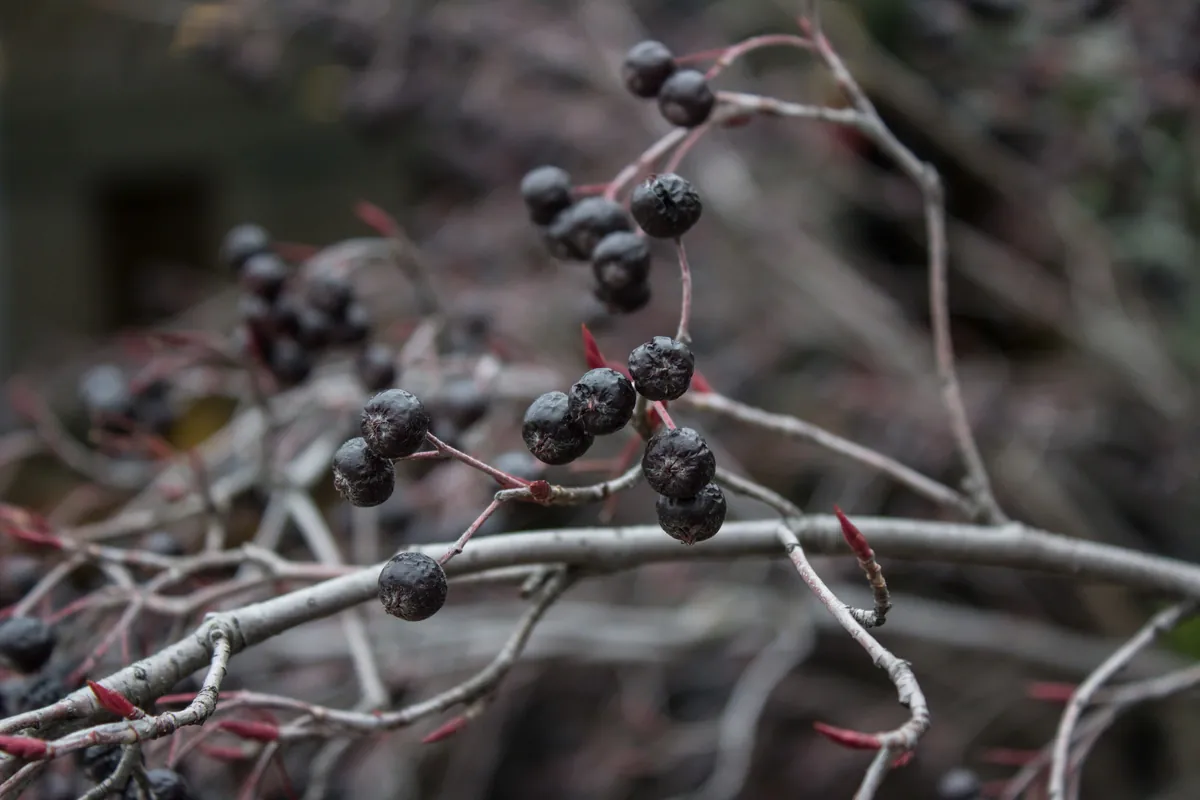
Glossy, black-purple ripe fruit in clusters on a branch of aronia (Aronia melanocarpa) after the leaves have fallen.
Field observationShown: Aronia melanocarpaPart / state: Clusters of ripe fruit remaining on the branch after leaf fall. Glossy black-purple fruits in clusters of several each on the surface
Photo: Jason Zhang (User:Hiàn) / CC BY-SA 3.0 / original image / ledger's original image
Scope and provenance of the photo
Identification: Identified as labelled in the source. The description states the scientific name, which matches entities.csv (Aronia melanocarpa (Michx.) Elliott) at the genus and species level. Original size 5184x3456. I opened the image and confirmed. As the scientific name states, it is Aronia melanocarpa, with several clusters of black-purple fruit on reddish branches
Image shown: The original from Wikimedia Commons, reduced to 2400 px on the long side. No cropping or color changes. For display, a WebP capped at 1200 px wide is served; the ledger's original image can be checked from the link above.
On this page (6 sections)
Reading the bitterness
A descriptive sensory panel of 50 participants evaluated polyphenol-rich aronia berry juice, rating sweetness, sourness, saltiness, bitterness, astringency, and liking as separate attributes. As the harvest progressed, the study reports that astringency fell to 「弱いよりやや上(just above weak)」 (in translation: "slightly above weak"), and bitterness to 「弱いよりやや下(just below weak)」 (in translation: "slightly below weak"). Bitterness showed no significant correlation with any measured chemical constituent.
In the same study’s correlation analysis, the study reports that overall liking of the juice correlated strongly and primarily with perceived sweetness intensity (ρ=0.96), while astringency correlated negatively with liking. In other words, stronger astringency was associated with lower liking. However, a correlation coefficient for bitterness and liking themselves cannot be confirmed from the study’s summary. Astringency (a puckering sensation akin to touch) and bitterness (a taste) were measured as separate attributes by the same panel, leaving a record that does not conflate them.
Sources for this overview
Characterizing and improving the sensory and hedonic responses to polyphenol-rich aronia berry juice
Checked for this overview: Used the findings that rated bitterness and astringency as separate attributes as evidence. / Used the negative correlation between astringency and liking as evidence for this paragraph.
Follow the connections
chokeberry →— sensory attribute→ bitterness →can be measured separately …→ astringency
chokeberry →— sensory attribute→ astringency →is not synonymous with→ bitterness
astringency →reduces taste preference for→ chokeberry
Structured claims — open a section to read each claim's confidence, evidence and limits
Sensory (3)
Scope: Polyphenol-rich aronia berry juice; descriptive sensory panel of 50 participants rating sweetness, sourness, saltiness, bitterness, astringency, and liking.
Note: As the harvest progressed, the study reports that astringency declined to 『just above weak(弱いよりやや上)』 (in translation: "slightly above weak") and bitterness to 『just below weak(弱いよりやや下)』 (in translation: "slightly below weak"). Bitterness was described as showing no significant correlation with any of the measured chemical constituents.
Show data
ingredient-aronia —has_sensory_attribute→ sensation-bitterScope: The same panel as above.
Note: Astringency was rated as an independent attribute in the same descriptive panel as bitterness.
Show data
ingredient-aronia —has_sensory_attribute→ sensation-astringentScope: Correlation analysis of ratings of overall liking in the same study.
Note: The study reports that liking correlated strongly and primarily with perceived sweetness intensity (ρ=0.96), while astringency correlated negatively with liking. The correlation between bitterness and liking cannot be confirmed from this abstract, so this claim records only the astringency correlation.
Show data
sensation-astringent —reduces_taste_preference_for→ ingredient-aronia