Dong
culture / culture-dong
トン族
Dong is an ethnic minority distributed across southern China, including Qiandongnan, Guizhou Province, and the Guangxi Zhuang Autonomous Region. Their practices include immediately cooking stomach and small-intestine contents from newly slaughtered livestock, without fermentation or salting, in dishes called (niubie) and (yangbie). Fermented and acid-pickled foods called (yansuan), including (baisuan) and (hongsuan), coexist in the region, but niubie and yangbie are separate, unfermented practices, not examples of those foods. Shared eating with Miao people is often mentioned.
Photographs (captions in Japanese)
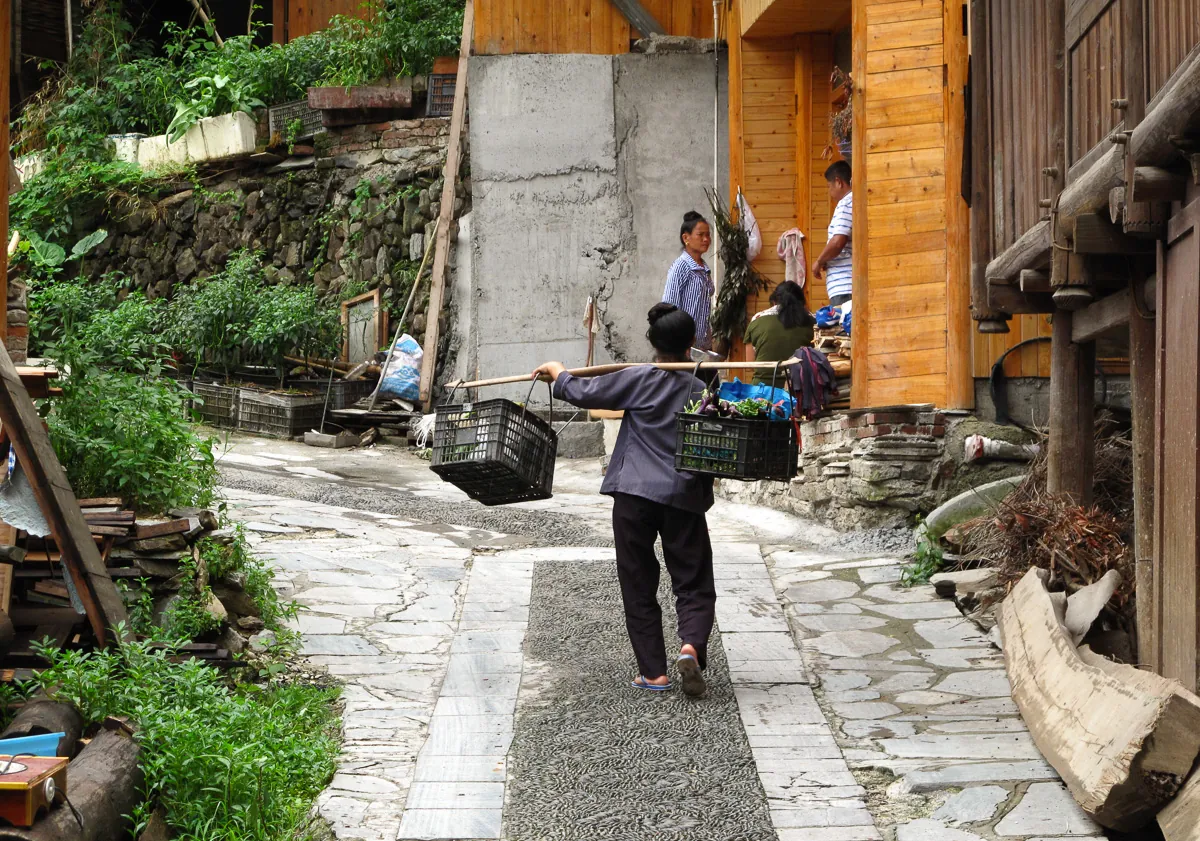
A person carrying a shoulder pole along a lane in the Dong village of Zhaoxing, Guizhou Province, and a scene of daily life in a settlement lined with wooden houses. The composition does not allow any individual to be identified.
Field observationShown: Not applicable (ethnic and everyday culture)Part / state: Scene of daily life in a settlement
Photo: Rutger van der Maar / CC BY 2.0 / original image / ledger's original image
Scope and provenance of the photo
Identification: Identified as labelled in the source. The candidates also included a portrait photograph of an individual, but under the policy (no photographs mainly of people; only group or daily-life scenes in which individuals are hard to identify are adopted), this daily-life photograph was adopted.
Image shown: No resizing, trimming, or color changes. The original image from Wikimedia Commons is used as it is. For display, a WebP capped at 1200 px wide is served; the ledger's original image can be checked from the link above.
On this page (7 sections)
Reading the bitterness
The Dong (「侗族」) are an ethnic minority centered in the Qiandongnan Miao and Dong Autonomous Prefecture of Guizhou. They have a distinctive practice of cooking 「牛瘪」 (niubie), contents of a newly slaughtered animal’s stomach and small intestine, immediately without fermentation or salting. Fermented and acid-pickled foods called 「腌酸」 (yansuan), including 「白酸」 (baisuan) and 「红酸」 (hongsuan), also occur in the region, but niubie is classified as a separate practice of immediate cooking, not an instance of fermentation. A local-history column from a prefectural broadcaster says niubie is consumed chiefly by Dong and Miao people, is prevalent in Qiandongnan counties including Liping, Congjiang, Rongjiang, and Jinping, and also occurs in parts of Guangxi.
Another article republished on a news portal is itself titled 「侗族美食牛瘪」 (in translation: "Dong delicacy niubie") and describes its prevalence in areas inhabited by Dong and Miao people: Liping, Congjiang, Rongjiang, and Jinping, as well as Sanjiang and Rongshui in Guangxi. Both articles frequently mention shared eating with Miao people, but this entry records the practice among Dong people only and does not provide a separate account for the Miao.
Sources for this overview
旮旮角角贵州史丨古已有之的“牛瘪”食俗,你可知最早出现在什么时候?
Checked for this overview: Confirmed the description of which peoples consume niubie and its prevalence in Qiandongnan counties.
Checked for this overview: Confirmed the description of niubie as Dong food and its prevalence in Guangxi.
Other names: 侗族 (zh)
Follow the connections
Niúbiě →is documented in→ Dong
Structured claims — open a section to read each claim's confidence, evidence and limits
Culture (1)
Scope: Qiandongnan Miao and Dong Autonomous Prefecture, Guizhou.
Show data
dish-niubie —is_documented_in→ culture-dong