Topic hub — 2026-10-21
Do cooking and additions reduce the bitterness and egumi of spinach?
A caveat first: the studies of whether cooking reduces it measured egumi (an acrid harshness left on the tongue and throat), not bitterness. This page does not treat egumi and bitterness results as the same and does not present reduced egumi as reduced bitterness. Spinach is often said to become easier to eat when boiled in plenty of water and soaked. What do studies that changed cooking, growing or additions and had people compare spinach bitterness or egumi say? This page lines up the included studies together with their conditions: cultivar and growing, water amount and salt, and who rated them on what scale. It then separates what was established within one experiment, what differences between studies might explain, and what this comparison alone cannot separate. It is about perceived taste, not eating or health advice.
On this page (10 sections)
- What this page establishes
- What the included studies allow us to say
- Bitterness ratings at a glance
- Conditions and results, study by study
- What was established within an experiment
- Candidate explanations for the differences
- What is not known — what this comparison alone cannot separate
- How studies and rows were counted
- What we looked at
- Read in the encyclopedia
What this page establishes
- That cooking studies measured egumi, not bitterness, and changing the amount of boiling water detected no difference in egumi.
- That salt in the boiling water made egumi seem weaker for some salt types, but a comparison of salt concentrations detected no difference.
- That few studies scored bitterness; in raw leaves open-field and commercial spinach scored differently, and in a leaf extract bitterness and oxalate taste separated into different fractions.
- That no study found in our search measured, on a bitterness scale, whether cooking lowers bitterness.
What the included studies allow us to say
- Studies of whether cooking reduces it measured egumi, not bitterness. Raising the boiling water from 5 to 20 times the leaf weight, with 1% salt, gave no detected difference in egumi. Boiling in water with 3% refined or table salt made egumi significantly weaker than plain water (p<0.01), but an experiment comparing 1–3% salt detected no significant difference. [rows: Izumi 2005a 20 vs 5 times the water; Izumi 2005b 3% refined or table salt vs distilled water; Izumi 2005b 3% salt vs distilled water]
- Few studies scored bitterness. In raw leaves, open-field spinach scored more bitter than commercial (3.0 vs 2.4), and in a leaf extract bitterness and oxalate taste separated into different fractions. No study found in our search measured, on a bitterness scale, whether cooking conditions lower bitterness. [rows: Batziakas 2019 Open field vs commercial; Horie 2006 Ethanol vs water fraction]
Bitterness ratings at a glance
Human bitterness ratings. Values for "Group compared" and "Comparison" are as reported in the tables or text (values shown only in figures are marked as such). Both egumi rows and bitterness rows are included (the detailed table for each row shows which was measured). For studies read only as abstracts, only what the abstract states is shown; where values are only in figures, only whether differences were significant is shown. "Direction" shows which sample was more bitter; whether the difference is significant is shown by the test in the same "Direction / test" column. Select a study name to jump to its detailed table.
Results in which people rated bitterness only. Where each value comes from (a table or a reading from a figure) is shown in its row; scales and methods differ between studies, so compare within a row, not across rows.
| Study | Comparison and condition | Measured as | Sample compared | Comparison | Direction / test |
|---|---|---|---|---|---|
| Izumi 2005a | 20 vs 5 times the water Spring and autumn, 1% salt in the water in every condition | 5-point scale (+2 very strong to −2 none, 12–14 people) | no significant difference detected (values only in a figure) | values only in a figure | Direction not given Tested, not significant |
| Izumi 2005b | 3% salt vs distilled water Concentration test (cv. Sunlight): 1, 2 or 3% salt vs distilled water | 5-point scale (positive = weaker egumi, 10–21 people) | tended weaker (values only in a figure) | values only in a figure | Direction not given Tested, not significant |
| Izumi 2005b | 3% refined or table salt vs distilled water Salt-type test (cv. Tonic), 3% salt in the water | 5-point scale (positive = weaker egumi, 10–21 people) | egumi significantly weaker (values only in a figure) | values only in a figure | Direction not given Tested, only some pairs significant |
| Horie 2006 | Ethanol vs water fraction Fractions of a leaf extract separated on a solid phase (at a 20-fold dilution of the leaf) | symbol ratings (small panel including the authors) | + (bitter) | − (not bitter) | Sample compared more bitter No test reported |
| Izumi 2004 | W town vs Y district Origins compared within the same month (same cooking, 1% salt in the water) | 5-point scale (+2 very strong to −2 none, 9 people) | stronger (values only in a figure) | values only in a figure | Sample compared higher Tested, only some pairs significant |
| Izumi 2008 | Growing method, cultivar and growth stage Autumn, 12 conditions after boiling (4 plots × 3 stages) | mean on a 5-point scale (+2 very strong to −2 none, 15–16 people) | range −0.88 to 0.27 | not applicable (12 conditions compared) | Direction not given Tested, not significant |
| Izumi 2005c | 100 mM NaCl vs none 5 mM oxalic acid solution (not spinach) | 5-point scale (8 people) | significantly lower (values only in a figure) | values only in a figure | Comparison higher Tested, significant |
| Batziakas 2019 | Open field vs commercial Raw leaves (not cooked) | mean on a 0–15 intensity scale (6 trained assessors) | 3.0 | 2.4 | Sample compared more bitter Tested, significant |
| Bakke 2018 | With vs without sugar or salt Broccoli, spinach and kale purées (3 vegetables reported together) | not given (not in the abstract) | lower (abstract wording) | values not in the abstract | Comparison more bitter No test reported |
Conditions and results, study by study
For each study, the conditions for the samples, preparation, serving and who rated them, and the results. Each row is one study × one measured result, so different comparisons in the same study are separate rows. Under each row we give where it is in the paper and whether it can be used to judge whether cooking, growing or additions change the bitterness or egumi people perceive in spinach, with the reason. Nothing is left blank: "not given", "not read" and "not applicable" are kept apart.
Izumi 2005a sensory only
ゆで水量の違いがホウレンソウの食味やシュウ酸ならびにカリウム含量に及ぼす影響. 日本調理科学会誌 38(4):343-349 — doi:10.11402/cookeryscience1995.38.4_343
- How deeply checked
- Checked in full text — Full text via J-STAGE (Figs 1–7, Table 3); egumi values only in figures, viewed but not transcribed Checked by: LLM (one extracted, another checked against the source; no human check), 2026-10-21.
- Samples
- Spinach from the same field in Sendai (spring cv. Altair, autumn cv. Mahoroba)
- Processing and cooking
- Boiled 1 min in 5, 7, 10 or 20 times the leaf weight of water (1% salt in every condition), then soaked 5 min in water
- How it was served or eaten
- Boiled leaves
- Who rated, on what scale
- 12–14 female students and staff, 5-point scale (+2 very strong egumi to −2 none), rating egumi plus colour, flavour, texture and overall; two-way ANOVA
| Measured | Comparison and condition | Sample compared | Comparison | Unit | Direction / test |
|---|---|---|---|---|---|
| Egumi (acrid harshness, sensory) | 20 vs 5 times the water Spring and autumn, 1% salt in the water in every condition | no significant difference detected (values only in a figure) | values only in a figure | 5-point scale (+2 very strong to −2 none, 12–14 people) | Direction not given Tested, not significant |
| No significant difference among water amounts for any of the 5 attributes in spring or autumn (which does not mean the same). Free oxalate in the same leaves differed between 5 and 20 times by about 100 mg% in spring and 30 in autumn; the drop in water temperature also differed (about 6 °C at 5 and 7 times, 4 °C at 20 times) Where: Figs 1 and 2 (egumi), Fig. 5 (water temperature), Figs 6 and 7 (oxalate) For whether cooking, growing or additions change the bitterness or egumi people perceive in spinach: Limited — Egumi compared across water amounts; bitterness was not measured and every condition had 1% salt | |||||
Izumi 2005b sensory only
食塩添加ゆでホウレンソウのえぐ味の感じ方とシュウ酸および無機成分含量との関連. 日本家政学会誌 56(1):15-21 — doi:10.11428/jhej1987.56.15
- How deeply checked
- Checked in full text — Full text via J-STAGE (Figs 1–4, 7, 8; Tables 1, 2); egumi values only in figures Checked by: LLM (one extracted, another checked against the source; no human check), 2026-10-21.
- Samples
- Concentration test with cv. Sunlight, salt-type test with cv. Tonic (different cultivars and origins)
- Processing and cooking
- Boiled 1 min in 10 times the leaf weight of water, soaked 5 min; concentration test with 0, 1, 2 or 3% salt in the water, salt-type test with 3% of Amashio (a branded sea salt), reagent NaCl, table salt or refined salt
- How it was served or eaten
- Boiled leaves
- Who rated, on what scale
- 10–21 female students and staff, 5-point scale (weaker egumi scored positive); two-way ANOVA
| Measured | Comparison and condition | Sample compared | Comparison | Unit | Direction / test |
|---|---|---|---|---|---|
| Egumi (acrid harshness, sensory) | 3% salt vs distilled water Concentration test (cv. Sunlight): 1, 2 or 3% salt vs distilled water | tended weaker (values only in a figure) | values only in a figure | 5-point scale (positive = weaker egumi, 10–21 people) | Direction not given Tested, not significant |
| No significant difference for any of the 5 attributes; egumi and colour tended to improve with more salt. The abstract reads as if salt reduced egumi, stronger than the concentration test in the text Where: Fig. 1 For whether cooking, growing or additions change the bitterness or egumi people perceive in spinach: Limited — Egumi compared across salt concentrations; bitterness was not measured | |||||
| Egumi (acrid harshness, sensory) | 3% refined or table salt vs distilled water Salt-type test (cv. Tonic), 3% salt in the water | egumi significantly weaker (values only in a figure) | values only in a figure | 5-point scale (positive = weaker egumi, 10–21 people) | Direction not given Tested, only some pairs significant |
| Among the differences stated in the text, 3% refined salt and table salt gave weaker egumi than distilled water (p<0.01); the figure also marks differences between distilled water and reagent NaCl (p<0.05) and between Amashio (a branded sea salt) and table salt (p<0.05) and refined salt (p<0.01). No difference was detected between Amashio and distilled water. Total oxalate did not differ with salt (Figs 3 and 4), and the author suggests the weaker egumi reflects the salt itself rather than less oxalate Where: Figs 2–4, 7, 8 For whether cooking, growing or additions change the bitterness or egumi people perceive in spinach: Limited — Egumi compared across salt types; bitterness was not measured, and the cultivar and origin differ from the concentration test | |||||
Horie 2006 sensory only
ホウレンソウのえぐ味はシュウ酸に由来するか. 日本調理科学会誌 39(6):357-361 — doi:10.11402/cookeryscience1995.39.6_357
- How deeply checked
- Checked in full text — Full text via J-STAGE (Tables 1 and 3) Checked by: LLM (one extracted, another checked against the source; no human check), 2026-10-21.
- Samples
- Leaf blades of greenhouse spinach at a national vegetable research institute (cv. Okame, Parade)
- Processing and cooking
- Leaves blended with water and the extract separated on a solid phase into water-eluted and ethanol-eluted fractions (fractionation in cv. Parade only; the Table 3 liquids were each at a 20-fold dilution of the leaf blade)
- How it was served or eaten
- Liquids tasted
- Who rated, on what scale
- A very small panel including the authors (size not given); bitterness and oxalate taste recorded separately with symbols (− or a number of +); no statistical test reported
| Measured | Comparison and condition | Sample compared | Comparison | Unit | Direction / test |
|---|---|---|---|---|---|
| Bitterness intensity (sensory) | Ethanol vs water fraction Fractions of a leaf extract separated on a solid phase (at a 20-fold dilution of the leaf) | + (bitter) | − (not bitter) | symbol ratings (small panel including the authors) | Sample compared more bitter No test reported |
| Oxalate was 4 mg/L in the ethanol fraction and 368 in the water fraction, with oxalate taste − and ++; bitterness and oxalate taste separated into different fractions. Panel size and tests are not given, and boiled leaves were not compared Where: Table 3 For whether cooking, growing or additions change the bitterness or egumi people perceive in spinach: Limited — Shows bitterness and oxalate taste come from different components, but no cooking or additions were compared; small panel, no test | |||||
Izumi 2004 sensory only
ホウレンソウ中のシュウ酸およびカリウム含量の季節変動と調理による変化. 日本調理科学会誌 37(3):268-272 — doi:10.11402/cookeryscience1995.37.3_268
- How deeply checked
- Checked in full text — Full text via J-STAGE (Table 1, Fig. 5); egumi values only in a figure Checked by: LLM (one extracted, another checked against the source; no human check), 2026-10-21.
- Samples
- Spinach from W town (greenhouse) and Y district of Sendai (mostly open field) in 9 months from May 2000 to March 2001 (no August or December, and no July for Y district)
- Processing and cooking
- Boiled 1 min in 10 times the leaf weight of water with 1% salt, soaked 1 min in 5 times the water and 4 min in fresh water, squeezed by hand to 80% of the original weight; same for all samples
- How it was served or eaten
- Boiled leaves
- Who rated, on what scale
- 9 female college students and staff, 5-point scale (+2 very strong to −2 none)
| Measured | Comparison and condition | Sample compared | Comparison | Unit | Direction / test |
|---|---|---|---|---|---|
| Egumi (acrid harshness, sensory) | W town vs Y district Origins compared within the same month (same cooking, 1% salt in the water) | stronger (values only in a figure) | values only in a figure | 5-point scale (+2 very strong to −2 none, 9 people) | Sample compared higher Tested, only some pairs significant |
| W town was stronger in almost every month, significant at the 1% level in May and November and at 5% in September and March; within-month differences in free oxalate between origins were 260 mg% in November and 267 in March. The 2 origins also differed in greenhouse vs open field and in cultivar Where: Fig. 5 For whether cooking, growing or additions change the bitterness or egumi people perceive in spinach: Limited — Egumi compared between origins within the same month; the origins also differ in greenhouse vs open field and cultivar, and bitterness was not measured | |||||
Izumi 2008 sensory only
秋期ホウレンソウの品種, 栽培条件, 生育期間の違いによる有機酸や糖含量等の変動および茹で調理による変化, 食味との関連. 日本調理科学会誌 41(2):126-133 — doi:10.11402/cookeryscience1995.41.2_126
- How deeply checked
- Checked in full text — Full text via J-STAGE (Tables 1 and 3) Checked by: LLM (one extracted, another checked against the source; no human check), 2026-10-21.
- Samples
- Autumn-sown cv. Upright (open field, rain shelter, glasshouse) and cv. Asagiri (open field) at 3 growth stages
- Processing and cooking
- Boiled 1 min in 7 times the leaf weight of water with 1% salt, soaked 1 min in 5 times the water and 4 min in fresh water, squeezed by hand to 80% of the original weight; same for all samples
- How it was served or eaten
- Boiled leaves
- Who rated, on what scale
- 15–16 female students, 5-point scale (+2 very strong to −2 none); two-way ANOVA
| Measured | Comparison and condition | Sample compared | Comparison | Unit | Direction / test |
|---|---|---|---|---|---|
| Egumi (acrid harshness, sensory) | Growing method, cultivar and growth stage Autumn, 12 conditions after boiling (4 plots × 3 stages) | range −0.88 to 0.27 | not applicable (12 conditions compared) | mean on a 5-point scale (+2 very strong to −2 none, 15–16 people) | Direction not given Tested, not significant |
| No significant difference in egumi under any condition (which does not mean the same); ratings were skewed towards weak. Oxalate after boiling fell with growth (300–440 mg% early, 140–230 late) Where: Table 3 For whether cooking, growing or additions change the bitterness or egumi people perceive in spinach: Limited — Egumi compared by growing method, cultivar and stage; bitterness not measured | |||||
Izumi 2005c sensory only
シュウ酸のえぐ味に及ぼす塩化ナトリウムならびに粘性の影響. 日本調理科学会誌 38(4):362-367 — doi:10.11402/cookeryscience1995.38.4_362
- How deeply checked
- Checked in full text — Full text via J-STAGE (Figs 1–7); values only in figures Checked by: LLM (one extracted, another checked against the source; no human check), 2026-10-21.
- Samples
- Not spinach: reagent oxalic acid and potassium oxalate solutions (such as 5 mM and 100 mM)
- Processing and cooking
- NaCl (50 or 100 mM) or citrus pectin at 0.2% added
- How it was served or eaten
- Solutions at 20 °C tasted with the whole mouth
- Who rated, on what scale
- 8–13 female students and staff, 5-point scale (+2 very strong to −2 none)
| Measured | Comparison and condition | Sample compared | Comparison | Unit | Direction / test |
|---|---|---|---|---|---|
| Egumi (acrid harshness, sensory) | 100 mM NaCl vs none 5 mM oxalic acid solution (not spinach) | significantly lower (values only in a figure) | values only in a figure | 5-point scale (8 people) | Comparison higher Tested, significant |
| p<0.01; NaCl 50 mM in 100 mM potassium oxalate also lowered egumi (13 people), and 0.2% citrus pectin lowered it in 5 mM oxalic acid (p<0.05) but not significantly in 50 mM potassium oxalate. NaCl at 50–100 mM is about 0.3–0.6%, a different amount from the 1–3% in boiling water Where: Figs 3–5 For whether cooking, growing or additions change the bitterness or egumi people perceive in spinach: Not usable — An experiment with oxalate solutions, not spinach leaves | |||||
Batziakas 2019 sensory only
Reducing food losses and improving the quality of locally produced spinach. Kansas State University doctoral dissertation, Chapter 4, pp.127-157 — source
- How deeply checked
- Checked in the full text of the underlying thesis — Full text of chapter 4 of the doctoral thesis (Table 4.2) Checked by: LLM (one extracted, another checked against the source; no human check), 2026-10-21.
- Samples
- Organic cv. Corvair grown in Kansas (open field, high tunnel) and commercial organic baby spinach (cultivar and harvest date unknown)
- Processing and cooking
- Not cooked. Grown samples were washed, drained, stored at 0.5 °C and harvested 5 days before evaluation; the commercial sample was bought 2 days before and stored at 0.5 °C and 95% RH (washing not stated). Post-harvest handling not matched
- How it was served or eaten
- 2–3 raw unseasoned leaves (about 10 g) at room temperature
- Who rated, on what scale
- 6 assessors with over 120 hours of descriptive training, 0–15 intensity scale, 3 replicates; ANOVA and Fisher's LSD
| Measured | Comparison and condition | Sample compared | Comparison | Unit | Direction / test |
|---|---|---|---|---|---|
| Bitterness intensity (sensory) | Open field vs commercial Raw leaves (not cooked) | 3.0 | 2.4 | mean on a 0–15 intensity scale (6 trained assessors) | Sample compared more bitter Tested, significant |
| Overall p=0.010; the high tunnel (2.8) was not found to differ significantly from either. The commercial sample came from a different origin, with unknown cultivar and time from harvest to evaluation. There was no egumi attribute, and related attributes such as astringency did not differ significantly Where: Table 4.2 For whether cooking, growing or additions change the bitterness or egumi people perceive in spinach: Limited — Raw-leaf bitterness compared by growing; not a comparison of cooking or additions, and the commercial sample differs in many ways | |||||
Bakke 2018 sensory only
Mary Poppins was right: Adding small amounts of sugar or salt reduces the bitterness of vegetables. Appetite 126:90-101 — doi:10.1016/j.appet.2018.03.015
- How deeply checked
- Abstract only — Abstract only (full text paywalled) Checked by: LLM (one extracted, another checked against the source; no human check), 2026-10-21.
- Samples
- Broccoli, spinach and kale purées (preparation not in the abstract)
- Processing and cooking
- Experiment 1: 0, 0.6, 1.2 or 1.8% sugar, or 0 or 0.2% salt; Experiment 2: 0 or 2% sugar; Experiment 3: 0, 1 or 2% sugar
- How it was served or eaten
- Not given (not in the abstract)
- Who rated, on what scale
- Experiment 1: descriptive analysis by 9 adults with more than 20 h of green-vegetable-specific training; Experiment 2: forced choice (bitterness) by 84 adults; Experiment 3: liking rated by 99 adults on a 9-point scale; test names not in the abstract
| Measured | Comparison and condition | Sample compared | Comparison | Unit | Direction / test |
|---|---|---|---|---|---|
| Bitterness intensity (sensory) | With vs without sugar or salt Broccoli, spinach and kale purées (3 vegetables reported together) | lower (abstract wording) | values not in the abstract | not given (not in the abstract) | Comparison more bitter No test reported |
| The abstract says small amounts of sugar or salt lowered bitterness in all 3 vegetables; values and tests for spinach alone are not in the abstract Where: Abstract For whether cooking, growing or additions change the bitterness or egumi people perceive in spinach: Limited — The abstract reports adding sugar or salt and comparing bitterness, but values and tests for spinach alone were not checked in full text | |||||
What was established within an experiment
Only results where the same panel compared changed conditions within one study.
- Boiling the same way with only the salt type changed, leaves boiled in 3% refined or table salt had significantly weaker egumi than those boiled in plain water (p<0.01); no significant difference was detected for Amashio, a branded sea salt. [rows: Izumi 2005b 3% refined or table salt vs distilled water]
- Changing the boiling water from 5 to 20 times the leaf weight, with 1% salt, detected no significant difference in egumi in spring or autumn, although free oxalate in the same leaves differed by about 100 mg% in spring. [rows: Izumi 2005a 20 vs 5 times the water]
- When 6 trained assessors rated raw leaves, open-field spinach scored 3.0 and commercial 2.4, a significant difference, while the high tunnel (2.8) was not found to differ significantly from either (overall p=0.010). [rows: Batziakas 2019 Open field vs commercial]
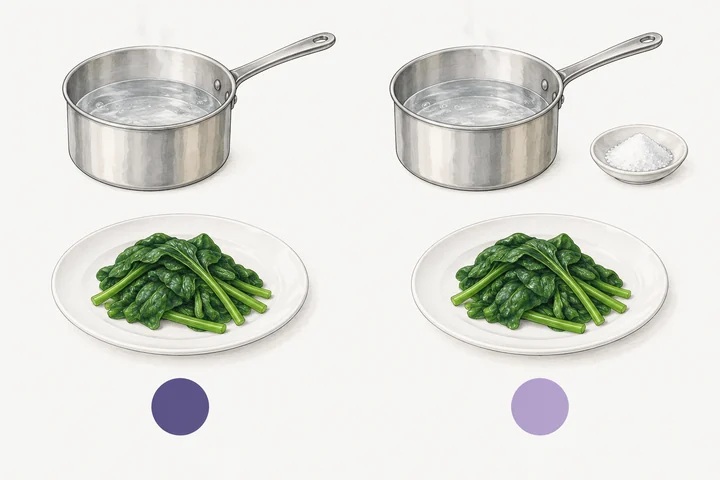
Boiled in distilled water
Boiled in 3% salt water
Purple mark: egumi (harsh, acrid taste), not bitterness
A study in which spinach (cultivar Tonic) was boiled for 1 minute in water 10 times its weight and then soaked in water for 5 minutes, comparing distilled water with water containing 3% refined or table salt. Egumi was significantly weaker in the leaves boiled in salt water. The mark shows the order of egumi only and is not a measure of bitterness. The right side stands for the direction shared by the refined-salt and table-salt conditions; it is not a mix of the two salts, nor does it mean the two had equal values. The tested Amashio salt (a branded sea salt) showed no significant difference from distilled water, and an experiment with another cultivar comparing salt concentrations found no difference either, so more salt cannot be said to work better. The figure also makes no claim that oxalic acid was reduced. The purple is not a real colour.
Source: Izumi 2005b (Izumi 2005b in the table of conditions and results by study, the salt-type experiment)
Illustration: illustration desk (PurpleHeron)
Candidate explanations for the differences
Conditions that differ between studies, or between samples, and could explain differences in egumi or bitterness. Several conditions differ at once, so which one mattered is unknown. These are candidates, not causes.
- A candidate explanation for egumi differences is the amount of free oxalate: egumi differed significantly when free oxalate differed by 260–267 mg% between origins in the same month, but not with the about 100 mg% difference in another study's water-amount comparison. This is a contrast across studies, not a threshold showing that amount alone sets egumi. [rows: Izumi 2004 W town vs Y district; Izumi 2005a 20 vs 5 times the water]
- As a candidate reason why salted boiling makes egumi seem weaker, the author points to the salt itself rather than reduced oxalate: in a 5 mM oxalic acid solution, 100 mM NaCl or 0.2% pectin significantly lowered egumi (pectin did not significantly lower it in 50 mM potassium oxalate). These were solutions, not leaves, and the salt amounts differ from those in boiling water. [rows: Izumi 2005c 100 mM NaCl vs none; Izumi 2005b 3% refined or table salt vs distilled water]
What is not known — what this comparison alone cannot separate
- Egumi (boiled leaves, 5-point scale) and bitterness (raw leaves on a 15-point scale, purées) differ in sample and scale and cannot be set side by side; weaker egumi does not mean weaker bitterness. [rows: Izumi 2005a 20 vs 5 times the water; Batziakas 2019 Open field vs commercial]
- The report that sugar or salt lowered bitterness in purées is an abstract covering broccoli and kale together, so values for spinach alone were not checked. The egumi studies all used small panels, mostly of young women. [rows: Bakke 2018 With vs without sugar or salt; Izumi 2008 Growing method, cultivar and growth stage]
How studies and rows were counted
The number of evidence rows is not the number of studies. Table rows, ledger evidence rows, papers and research groups are counted separately.
- Sources in the table: 8, of which 3 have results on people's bitterness ratings in this table; for the others, only results on something else (compounds, smell) are shown, or they are used only for context.
- Rows in the table (study × measured result): 9. Rows on perceived bitterness: 9.
- Evidence rows in the lab's ledger these rows rest on: 0. One paper can supply several rows. Rows without a ledger evidence row come from other tables of the same papers, or from sources newly read for this question.
- Research groups among the studies with bitterness results in this table, as grouped in the ledger: 3 (reports from the same lab count as 1; co-authors and affiliations can overlap, so this is not a count of independent replications).
What we looked at
The sources examined for this question, why each was included or excluded, and which full texts could not be reached. We searched J-STAGE and Europe PMC for studies in which people rated spinach bitterness or egumi while cooking, growing or additions were varied, and added the sources already in the lab's ledger (CiNii was not searched). Paywalled studies are marked as read from the abstract only.
| Source | Decision | Why |
|---|---|---|
| ゆで水量の違いがホウレンソウの食味やシュウ酸ならびにカリウム含量に及ぼす影響 (2005) doi | Included in the table | Water amount and egumi; read in full |
| 食塩添加ゆでホウレンソウのえぐ味の感じ方とシュウ酸および無機成分含量との関連 (2005) doi | Included in the table | Salt in boiling water and egumi; read in full |
| ホウレンソウのえぐ味はシュウ酸に由来するか (2006) doi | Included in the table | Bitterness and oxalate taste separated; read in full |
| ホウレンソウ中のシュウ酸およびカリウム含量の季節変動と調理による変化 (2004) doi | Included in the table | Egumi by origin and month; read in full |
| 秋期ホウレンソウの品種, 栽培条件, 生育期間の違いによる有機酸や糖含量等の変動および茹で調理による変化, 食味との関連 (2008) doi | Included in the table | Egumi by growing method, cultivar and stage; read in full |
| シュウ酸のえぐ味に及ぼす塩化ナトリウムならびに粘性の影響 (2005) doi | Included in the table | Salt or pectin added to oxalate solutions; read in full |
| Reducing food losses and improving the quality of locally produced spinach (2019) | Included in the table | Raw-leaf bitterness by growing; read in the full thesis chapter |
| Mary Poppins was right: Adding small amounts of sugar or salt reduces the bitterness of vegetables (2018) doi | Included in the table | Sugar or salt and purée bitterness; abstract only |
| Masking Vegetable Bitterness to Improve Palatability Depends on Vegetable Type and Taste Phenotype (2013) doi | Excluded | A study of asparagus, Brussels sprouts and kale, not including spinach |
Read in the encyclopedia
- Spinach — the vegetable in this question
- Egumi — a sensation rated apart from bitterness
- Does adding sugar or salt suppress bitterness? — a comparison of additions
Source ledger
Each study's source can be reached from its section above. All of the lab's sources are listed in the source ledger.
How to cite this page
Aoki, M. (NIGAMI LAB) (2026). Do cooking and additions reduce spinach bitterness?. https://nigamilab.com/en/topics/spinach-bitter-egumi/
Each claim card has a stable anchor (#clm-…). The dataset is CC BY 4.0; see the data page. Dataset DOI: 10.5281/zenodo.22739101