Topic hub — 2026-10-20
Do oil or mayonnaise soften green pepper bitterness?
For people who dislike green pepper, the usual advice is to fry it in oil or pair it with mayonnaise or cheese. How far have studies confirmed that this softens its bitterness? We keep bitterness on the tongue apart from the pepper's characteristic smell. This page lines up the included studies together with their conditions: the form of the pepper (liquid or stir-fried), what was added and what it was compared with, and who rated it and how. It then separates what was established within one experiment, what differences between studies might explain, and what this comparison alone cannot separate.
On this page (10 sections)
- What this page establishes
- What the included studies allow us to say
- Bitterness ratings at a glance
- Conditions and results, study by study
- What was established within an experiment
- Candidate explanations for the differences
- What is not known — what this comparison alone cannot separate
- How studies and rows were counted
- What we looked at
- Read in the encyclopedia
What this page establishes
- That, in the sources searched, no study had people compare the bitterness of pepper with oil alone against pepper with nothing added.
- That the only human bitterness comparisons were conference presentations by company researchers, comparing additions with each other (mayonnaise or yolk tasting less bitter than oil or egg white).
- That the peer-reviewed paper examined smell, not bitterness: oil, butter, cheese, milk and yogurt made the pepper's smell seem weaker.
What the included studies allow us to say
- In the sources searched, no study had people compare the bitterness of green pepper with oil alone against pepper with nothing added. The only human bitterness comparisons were 3 conference presentations by company researchers, and they compared additions with each other: mayonnaise, egg yolk or sesame dressing tasted less bitter than oil, egg white or salt. [rows: Nishimura 2015 mayonnaise vs oil; Kewpie 2016 yolk vs white; Tamura 2021 sesame dressing]
- The only peer-reviewed full paper (Aoki 2017) examined smell, not bitterness: mixing vegetable oil, butter, cheese, milk or yogurt into roasted green pepper made its characteristic smell seem significantly weaker (no significant difference with skim-milk solution; mayonnaise was not tested). So there is peer-reviewed evidence that these soften the smell, while for bitterness the claim still rests on company presentations. [rows: Aoki 2017 smelled odour; Aoki 2017 odour compound]
Bitterness ratings at a glance
Only the results in which people rated bitterness. Values for "With the addition" and "Comparison" are as reported. "Direction" shows which sample was more bitter; gaps the paper does not treat as a difference are shown as "about the same". Select a study name to jump to its detailed table.
Results in which people rated bitterness only. Where each value comes from (a table or a reading from a figure) is shown in its row; scales and methods differ between studies, so compare within a row, not across rows.
| Study | Comparison and condition | Measured as | With the addition | Comparison | Direction / test |
|---|---|---|---|---|---|
| Nishimura 2015 | mayonnaise vs oil Cooked with mayonnaise vs with vegetable oil (bitter melon and green pepper) | sensory evaluation (panel and scale not given) | less bitter | — (reference) | Comparison more bitter No test reported |
| Kewpie 2016 | yolk vs white Pepper liquid: with egg yolk vs with egg white | bitterness intensity (0–6, 20 people; approximate readings from the figure) | about 3.6 | about 4.5 | Comparison more bitter Tested, significant |
| Kewpie 2016 | emulsion size Pepper liquid: fine vs coarse mayonnaise emulsion | bitterness intensity (0–6, 20 people; approximate readings from the figure) | about 3.4 | about 4.1 | Comparison more bitter Tested, significant |
| Kewpie 2016 | acid-denatured yolk Pepper liquid: acid-denatured yolk vs yolk | bitterness intensity (0–6, 20 people; approximate readings from the figure) | about 3.7 | about 4.5 | Comparison more bitter Tested, significant |
| Tamura 2021 | sesame dressing Stir-fried pepper: 7.5 g sesame dressing vs equivalent salt | sensory evaluation (20 people; scale not given) | less bitter | — (reference) | Comparison more bitter Tested, significant |
Conditions and results, study by study
For each study, the conditions for the pepper's form, the addition and the evaluation, and the results. Each row is one study × one measured result, so bitterness and smell are separate rows. Under each row we give where it is in the source and whether it can be used to judge whether the addition softens bitterness, with the reason. Nothing is left blank: "not given", "not read" and "not applicable" are kept apart.
Nishimura 2015 sensory only
マヨネーズによる野菜の苦味低減効果. 日本調理科学会平成27年度大会研究発表要旨集 27 [2P-25] — doi:10.11402/ajscs.27.0_174
- How deeply checked
- Abstract only — Full text of a 1-page conference abstract; the abstract gives no values Checked by: LLM (one extracted, another checked against the source; no human check), 2026-10-20.
- Samples
- Bitter melon and green pepper (cultivar and cut not given; results not separated from bitter melon)
- Processing and cooking
- Cooked with mayonnaise vs cooked with vegetable oil (temperature, time and amounts not given)
- How it was served or eaten
- Cooked samples were tasted
- Who rated, on what scale
- Sensory evaluation (panel size, scale and statistics not given) and a taste-sensing system
| Measured | Comparison and condition | With the addition | Comparison | Unit | Direction / test |
|---|---|---|---|---|---|
| Bitterness intensity (sensory) | mayonnaise vs oil Cooked with mayonnaise vs with vegetable oil (bitter melon and green pepper) | less bitter | — (reference) | sensory evaluation (panel and scale not given) | Comparison more bitter No test reported |
| No values or tests in the abstract; in this sensory test oil was the comparison and nothing was compared with no addition (the taste-sensor test did compare mayonnaise-added and plain samples) Where: Abstract (Results) For whether the addition softens bitterness: Limited — People compared bitterness, but abstract only, with no values or panel size, not separated from bitter melon, and this sensory test had no no-addition comparison | |||||
Kewpie 2016 sensory only
マヨネーズを使った野菜調理の研究成果を発表. キユーピー ニュースリリース No.47(日本調理科学会平成28年度大会発表概要) — source
- How deeply checked
- Checked in full text — Full text and Figures 1–3 of the company's release (an excerpt of a conference presentation); values are approximate readings from the figures. The conference abstract for the same talk describes only taste-sensor tests Checked by: LLM (one extracted, another checked against the source; no human check), 2026-10-20.
- Samples
- Raw green pepper blended and mixed 1:3 with water
- Processing and cooking
- Egg yolk vs egg white / yolk-type mayonnaises differing only in emulsion state (fine vs coarse) / yolk mixed with vinegar and left about 1 day vs yolk (amounts, recipes and droplet sizes not given; no plain pepper liquid in the human tests)
- How it was served or eaten
- Pepper liquid with the additions was tasted (not a dish)
- Who rated, on what scale
- 20 company researchers (12 men, 8 women) rated bitterness on 7 levels (0–6 on the figure axis); figures show means, SDs and 5% significance marks; training, replicates and test method not given
| Measured | Comparison and condition | With the addition | Comparison | Unit | Direction / test |
|---|---|---|---|---|---|
| Bitterness intensity (sensory) | yolk vs white Pepper liquid: with egg yolk vs with egg white | about 3.6 | about 4.5 | bitterness intensity (0–6, 20 people; approximate readings from the figure) | Comparison more bitter Tested, significant |
| Marked significant at 5%; no comparison with plain liquid Where: Figure 1 For whether the addition softens bitterness: Limited — People compared bitterness, but only between additions, with no plain liquid; a liquid, not a dish; company researchers as panel | |||||
| Bitterness intensity (sensory) | emulsion size Pepper liquid: fine vs coarse mayonnaise emulsion | about 3.4 | about 4.1 | bitterness intensity (0–6, 20 people; approximate readings from the figure) | Comparison more bitter Tested, significant |
| Marked significant at 5%; no comparison with plain liquid Where: Figure 2 For whether the addition softens bitterness: Limited — As above | |||||
| Bitterness intensity (sensory) | acid-denatured yolk Pepper liquid: acid-denatured yolk vs yolk | about 3.7 | about 4.5 | bitterness intensity (0–6, 20 people; approximate readings from the figure) | Comparison more bitter Tested, significant |
| Marked significant at 5%; the same “yolk” scored about 3.6 in Figure 1 and about 4.5 in Figure 3, so values cannot be compared across tests Where: Figure 3 For whether the addition softens bitterness: Limited — As above | |||||
Tamura 2021 sensory only
深煎りごまドレッシングによるピーマンの苦味および臭いに対する低減効果. 日本調理科学会令和3年度大会研究発表要旨集 32(J-STAGE論文番号 93) — doi:10.11402/ajscs.32.0_93
- How deeply checked
- Abstract only — Full text of a 2-page conference abstract; no values are given Checked by: LLM (one extracted, another checked against the source; no human check), 2026-10-20.
- Samples
- 50 g green pepper stir-fried in a pan (cultivar, cut and heat not given)
- Processing and cooking
- Seasoned after frying with 7.5 g of a deep-roasted sesame dressing (the company's product) vs with the equivalent amount of salt
- How it was served or eaten
- Stir-fried pepper was tasted
- Who rated, on what scale
- 20 people (scale, training and test method not given); smell was measured only by instrument
| Measured | Comparison and condition | With the addition | Comparison | Unit | Direction / test |
|---|---|---|---|---|---|
| Bitterness intensity (sensory) | sesame dressing Stir-fried pepper: 7.5 g sesame dressing vs equivalent salt | less bitter | — (reference) | sensory evaluation (20 people; scale not given) | Comparison more bitter Tested, significant |
| The abstract says bitterness was significantly reduced but gives no values or test method; the comparison was salt, not nothing; which component of the dressing worked is unknown Where: Abstract (Results) For whether the addition softens bitterness: Limited — People compared stir-fried pepper and reported significance, but abstract only, no values, and the comparison was salt | |||||
Aoki 2017 sensory only
乳製品によるピーマン加熱臭の抑制効果. 日本食品科学工学会誌 64(12):559-566 — doi:10.3136/nskkk.64.559
- How deeply checked
- Checked in full text — Read in the full text of the J-STAGE PDF (Table 1, Figures 5 and 6); a peer-reviewed paper Checked by: LLM (one extracted, another checked against the source; no human check), 2026-10-20.
- Samples
- Store-bought green pepper; each fruit halved lengthwise, each half cut into 16 pieces, dry-roasted in a pan for 10 min
- Processing and cooking
- After roasting, mixed 2 min at 70–75 °C with: processed cheese (1/3 of the pepper weight), yogurt, milk or 10% skim-milk solution (protein equal to 7% of the pepper weight), butter or rapeseed oil (fat equal to 9% of the pepper weight), or water (same weight as the milk); compared with pepper alone; the added amounts were not equal
- How it was served or eaten
- Not applicable (smelled, not eaten)
- Who rated, on what scale
- 17 women in their 20s at Tokyo Kasei University smelled samples warmed 2 min at 60 °C, the added one first and then pepper alone, rating against pepper alone as 0 on −2 to +2; one-sample t-test (differences between additions not tested); the odour compound (2-isobutyl-3-methoxypyrazine) measured instrumentally 6 times; bitterness not measured
| Measured | Comparison and condition | With the addition | Comparison | Unit | Direction / test |
|---|---|---|---|---|---|
| Grassy smell | odour compound Mixed with roasted pepper: vegetable oil, butter, cheese, milk, yogurt vs pepper alone | oil 9, butter 9, cheese 5, milk 7, yogurt 4 | 100 (pepper alone) | relative amount of the odour compound in the headspace (%, 6 runs) | Comparison higher No test reported |
| Low-fat skim-milk solution gave 31 and water 42 (a reference condition); liquid dairy was about 2 times the pepper weight (calculated from Table 1), so a possible contribution of dilution cannot be separated; the added amounts differ by addition Where: Figure 5, Table 1 For whether the addition softens bitterness: Not usable — An odour compound, not bitterness | |||||
| Grassy smell | smelled odour Mixed with roasted pepper: vegetable oil, butter, cheese, milk, yogurt vs pepper alone | oil −0.53, butter −1.53, cheese −1.35, milk −1.47, yogurt −1.88 | 0 (pepper alone) | mean on −2 to +2 (17 people, smell only) | Comparison higher Tested, significant |
| All 5 significantly weaker; skim-milk solution (−0.12) and water (+0.47) showed no significant difference; differences between additions were not tested; nothing was eaten and bitterness was not measured Where: Figure 6 For whether the addition softens bitterness: Not usable — A smell rating, not bitterness | |||||
What was established within an experiment
Only results where the same panel compared changed conditions within one study.
- When 20 people compared raw pepper liquid with different additions, yolk (about 3.6) was less bitter than white (about 4.5), fine mayonnaise (about 3.4) less than coarse (about 4.1), and acid-denatured yolk (about 3.7) less than yolk (about 4.5) (all significant at 5%; approximate readings from figures). Plain liquid was not compared. [rows: Kewpie 2016 yolk vs white; Kewpie 2016 emulsion size; Kewpie 2016 acid-denatured yolk]
- Mixed into roasted pepper, the odour compound in the headspace fell to 9 with oil, 9 with butter, 5 with cheese, 7 with milk and 4 with yogurt (pepper alone = 100), and 17 people smelled a significantly weaker odour with oil (−0.53), butter (−1.53), cheese (−1.35) and others. [rows: Aoki 2017 odour compound; Aoki 2017 smelled odour]
- The abstract reports that stir-fried pepper dressed with 7.5 g of sesame dressing was significantly less bitter than pepper seasoned with salt matched to the dressing's salt content (20 people; no values). [rows: Tamura 2021 sesame dressing]
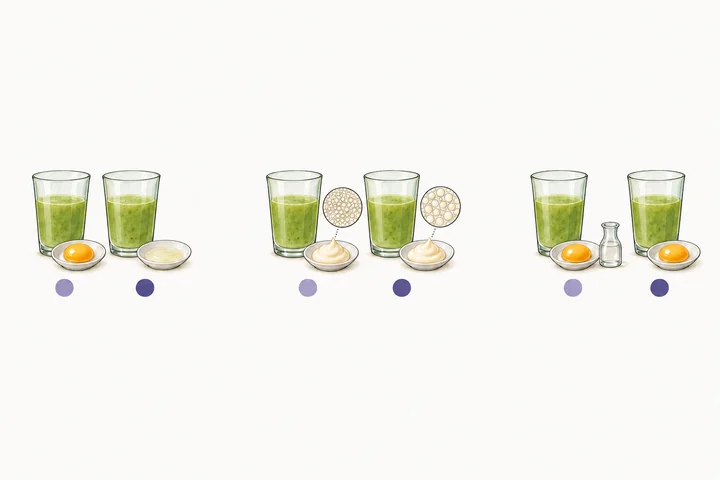
Yolk vs white
Fine vs coarse mayo
Acid-set yolk vs yolk
In each pair the left glass was less bitter (do not compare across pairs)
Additions to a liquid of raw green pepper ground and mixed 1 to 3 with water. The three pairs are separate tests, so do not compare shades across pairs (that is why the same egg yolk is light in the left pair and dark in the right pair). Within each pair the left addition was rated less bitter (significant at 5% in all three). The purple shows only the order within a pair, not a ratio or the size of the difference. The magnifying circles sketch fine versus coarse droplets; they are not real sizes or a mechanism of trapping bitter compounds. The small vinegar bottle in the right pair belongs to the left glass (yolk mixed with vinegar and left for about a day); it is not oil. The amount on each dish does not show the amount added (amounts, recipes and droplet sizes are not given). This is not a comparison with plain liquid or with cooked dishes. The purple is not a real colour.
Source: Kewpie 2016 (Kewpie 2016 in the table of conditions and results by study)
Illustration: illustration desk (PurpleHeron)
Candidate explanations for the differences
Conditions that differ between studies, or between additions, and could explain differences in bitterness. Several conditions differ at once, so which one mattered is unknown. These are candidates, not causes.
- Fat holding the odour. Fat-containing additions cut the odour compound sharply, and the authors inferred fat mattered more than protein. If green pepper “bitterness” is partly experienced together with its smell, weaker smell could make bitterness less noticeable, but no study has checked this by eating. [rows: Aoki 2017 odour compound; Aoki 2017 smelled odour]
- Yolk protein and emulsion. Yolk, finer emulsions and acid-denatured yolk tasted less bitter. One presentation (2015) proposed that emulsion droplets take up bitter compounds; another (2016) that acid changes the proteins. Acid treatment and emulsion state were varied, but the mechanism has not been established. [rows: Kewpie 2016 yolk vs white; Kewpie 2016 emulsion size; Kewpie 2016 acid-denatured yolk; Nishimura 2015 mayonnaise vs oil]
- Dilution. Liquid dairy was about 2 times the pepper weight, and water alone lowered the odour compound to 42. The part due to dilution was not separated from the effect of the addition itself. [rows: Aoki 2017 odour compound; Aoki 2017 smelled odour]
What is not known — what this comparison alone cannot separate
- How much oil or mayonnaise lowers bitterness compared with pepper with nothing added: human bitterness comparisons were only between additions, or against salt or oil. [rows: Nishimura 2015 mayonnaise vs oil; Kewpie 2016 yolk vs white; Tamura 2021 sesame dressing]
- The link between bitterness and smell: weaker smell was confirmed, but no study separately tested whether it changed perceived bitterness (the sesame-dressing study reports lower bitterness and smell but did not examine their link). [rows: Aoki 2017 smelled odour; Tamura 2021 sesame dressing]
- Who rated: all the bitterness comparisons were presentations by researchers at the company that makes the additions (conference abstracts and company releases), not peer-reviewed papers. [rows: Nishimura 2015 mayonnaise vs oil; Kewpie 2016 yolk vs white; Tamura 2021 sesame dressing]
How studies and rows were counted
The number of evidence rows is not the number of studies. Table rows, ledger evidence rows, papers and research groups are counted separately.
- Sources in the table: 4, of which 3 have results on people's bitterness ratings in this table; for the others, only results on something else (compounds, smell) are shown, or they are used only for context.
- Rows in the table (study × measured result): 7. Rows on perceived bitterness: 5.
- Evidence rows in the lab's ledger these rows rest on: 5. One paper can supply several rows. Rows without a ledger evidence row come from other tables of the same papers, or from sources newly read for this question.
- Research groups among the studies with bitterness results in this table, as grouped in the ledger: 1 (reports from the same lab count as 1; co-authors and affiliations can overlap, so this is not a count of independent replications).
What we looked at
The sources examined for this question, why each was included or excluded, and which full texts could not be reached. We searched J-STAGE, CiNii and PubMed for studies comparing green pepper bitterness or smell with oil, mayonnaise, egg, dairy, heating or cutting, and added the sources already in the lab's ledger.
| Source | Decision | Why |
|---|---|---|
| マヨネーズによる野菜の苦味低減効果 (2015) doi | Included in the table | People compared bitterness of vegetables cooked with mayonnaise or oil; abstract only |
| マヨネーズを使った野菜調理の研究成果を発表 (2016) | Included in the table | People compared yolk, white, emulsion and acid in pepper liquid; a company release |
| 深煎りごまドレッシングによるピーマンの苦味および臭いに対する低減効果 (2021) doi | Included in the table | People compared sesame dressing and salt on stir-fried pepper; abstract only |
| 乳製品によるピーマン加熱臭の抑制効果 (2017) doi | Included in the table | Peer-reviewed full paper; oil and dairy weakened the odour of heated pepper (bitterness not measured) |
| マヨネーズによる野菜の苦味低減効果の検討 第2報 (2016) doi | Excluded | Conference abstract for the same talk, with taste-sensor tests only; the human tests are in the company release (included) |
| ピーマンの苦味を感じるメカニズムの一端を解明 同時に卵黄タンパク質がピーマンの苦味を抑制する可能性も示唆 (2024) | Excluded | A cultured-cell bitter-receptor test, not human tasting |
| タキイ種苗×お茶の水女子大学 共同研究成果「ピーマンの苦味成分」を解明 (2012) | Read as context (not in the table) | Source of the explanation that pepper bitterness combines quercitrin astringency with pyrazine aroma; no panel size or statistics in the text checked |
| Studies on flavor and taste of green pepper Trial studies of childpipento (bitterness green pepper) for school lunch and SHOKUIKU (2013) doi | Excluded | Compares cultivars; no oil or dairy |
| 緑および赤ピーマンの調理に関する研究 (1984) doi | Excluded | Preference across cooking methods; bitterness intensity was not rated |
| Taste intensities of ten vegetables commonly consumed in the Netherlands. (2016) doi | Full text not reachable | Red pepper, and the full text was not reached |
Read in the encyclopedia
- Green pepper — the vegetable in this question
- Quercitrin — a compound linked to green pepper bitterness
- Research note on green pepper bitterness — following its bitter compounds and ways of eating it
- Does adding sugar or salt suppress bitterness? — a comparison of sugar and salt
Source ledger
Each study's source can be reached from its section above. All of the lab's sources are listed in the source ledger.
How to cite this page
Aoki, M. (NIGAMI LAB) (2026). Do oil or mayonnaise soften green pepper bitterness?. https://nigamilab.com/en/topics/pepper-oil/
Each claim card has a stable anchor (#clm-…). The dataset is CC BY 4.0; see the data page. Dataset DOI: 10.5281/zenodo.22739101