Topic hub — 2026-10-20
Does salting or boiling bitter melon lower its bitterness?
If bitter melon tastes too bitter, rub it with salt or blanch it briefly: cookbooks often say so. What do studies in which people actually tasted the result say? This page lines up the included studies together with their conditions: how the fruit was cut, how strong the salt was and for how long, how it was rinsed and squeezed, what form was tasted, and who rated it on what scale. It then separates what was established within one experiment, what differences between studies might explain, and what this comparison alone cannot separate.
On this page (10 sections)
- What this page establishes
- What the included studies allow us to say
- Bitterness ratings at a glance
- Conditions and results, study by study
- What was established within an experiment
- Candidate explanations for the differences
- What is not known — what this comparison alone cannot separate
- How studies and rows were counted
- What we looked at
- Read in the encyclopedia
What this page establishes
- That in one study, slices rubbed with salt then rinsed and squeezed, and slices boiled briefly, tasted significantly less bitter than raw slices.
- That juice from bitter melon soaked in brine and blanched showed no significant difference in bitterness, so the studies are split.
- That, in the sources searched, no study was found measuring bitter compounds being drawn out by salting, and the effect has not been separated from leftover saltiness and the like.
- That soaking in water alone showed no significant difference from raw.
What the included studies allow us to say
- Some studies in which people tasted the result did find salt rubbing or boiling lowered bitterness: in one where 11 people compared 1 mm slices, slices rubbed with 1% salt then rinsed and squeezed, and slices boiled 3 min, were significantly less bitter than raw. But juice from bitter melon soaked in brine and blanched showed no significant difference in bitterness, and the same group's earlier abstract also reported no significant difference. In the included studies, the results are split. [rows: Araki 2013 salt + hot rinse; Araki 2013 salt + water rinse; Araki 2013 boiled; Rashima 2017 brine + blanch; Araki 2011 2011 abstract]
- In the sources searched, no study was found that measured bitter compounds being drawn out by salt rubbing. The salt-rubbing trial that found lower bitterness (Araki 2013) measured neither the salt left nor the bitter compounds, so a part due to compounds leaving cannot be separated from a part due to saltiness, squeezing and the like. [rows: Araki 2013 salt + hot rinse; Araki 2013 salt + water rinse; Maehashi 2008 added salt; Kawakami 2009 grassy smell]
Bitterness ratings at a glance
Only the results in which people rated bitterness. Values for "Pretreated" and "Comparison" are as reported. "Direction" shows which sample was more bitter; gaps the paper does not treat as a difference are shown as "about the same". Select a study name to jump to its detailed table.
Results in which people rated bitterness only. Where each value comes from (a table or a reading from a figure) is shown in its row; scales and methods differ between studies, so compare within a row, not across rows.
| Study | Comparison and condition | Measured as | Pretreated | Comparison | Direction / test |
|---|---|---|---|---|---|
| Araki 2013 | boiled Boiled 3 min vs raw | mean ± SD on a 5-point scale (11 people) | −0.3 ± 1.3 | 1.2 ± 1.0 (raw) | Comparison more bitter Tested, significant |
| Araki 2013 | salt + hot rinse Rubbed with 1% salt, rinsed in hot water and squeezed, vs raw | mean ± SD on a 5-point scale (11 people) | −0.5 ± 1.1 | 1.2 ± 1.0 (raw) | Comparison more bitter Tested, significant |
| Araki 2013 | salt + water rinse Rubbed with 1% salt, rinsed in water and squeezed, vs raw | mean ± SD on a 5-point scale (11 people) | 0.4 ± 1.2 | 1.2 ± 1.0 (raw) | Comparison more bitter Tested, significant |
| Araki 2013 | water soak Soaked in water 5 min vs raw | mean ± SD on a 5-point scale (11 people) | 1.1 ± 1.4 | 1.2 ± 1.0 (raw) | About the same Tested, not significant |
| Araki 2013 | dishes As dishes: with pretreatment (for okonomiyaki, boiled 1 min) vs without (raw bitter melon with the pith; grated for okonomiyaki) | 3-point scale with the pretreated recipe as 0 (11 people) | 0 (reference) | 0.1 ± 0.4 / −0.1 ± 0.2 | About the same Tested, not significant |
| Araki 2011 | 2011 abstract Slicing, salt rubbing, boiling and other pretreatments (comparison not given) | Not given | Not given | Not given | Direction not given Tested, not significant |
| Nakama 2008 | salt rub Rubbed with 1% salt vs raw | scoring method (16 people) | Not given | Not given | Direction not given Tested, significant |
| Nakama 2008 | boiled Boiled 1 min in water vs raw | scoring method (16 people) | Not given | Not given | Direction not given No test reported |
| Rashima 2017 | brine + blanch Juice from fruit soaked 60 min in 3.5% (w/v) brine and blanched 3 min vs juice from fruit neither soaked nor blanched | mean ± SD on a 15 cm line scale (cm; 10 panelists × 2) | 10.6 ± 1.1 | 10.7 ± 1.7 | About the same Tested, not significant |
| Maehashi 2008 | added salt Extract with 1% salt added vs without | relative value on a 10 cm line scale (5 people; approximate readings from the chart) | about 2.4 | about 3.9 | Comparison more bitter Tested, significant |
Conditions and results, study by study
For each study, the conditions for the fruit, the pretreatment, the form tasted and the rating, and the results. Each row is one study × one measured result, so different pretreatments in the same study are separate rows. Under each row we give where it is in the paper and whether it can be used to judge whether pretreatment lowers bitterness, with the reason. Nothing is left blank: "not given", "not read" and "not applicable" are kept apart.
Araki 2013 sensory only
「緑のカーテン」ゴーヤの苦味軽減とエコ・クッキングでの活用. 日本家庭科教育学会誌 56(1):35-42 — doi:10.11549/jjahee.56.1_35
- How deeply checked
- Checked in full text — Read in the full text of the J-STAGE PDF (Tables 1–3) Checked by: LLM (one extracted, another checked against the source; no human check), 2026-10-20.
- Samples
- Bitter melon (cultivar and origin not given); seeds and pith removed, sliced 1 mm thick
- Processing and cooking
- Boiled 3 min / rubbed with 1% salt for 1 min, left 4 min, rinsed 10 s in hot water / the same rinsed in water (both squeezed to 70% of weight) / soaked in water 5 min / raw
- How it was served or eaten
- Slices tasted as they were
- Who rated, on what scale
- 11 people (eco-cooking instructors and junior-college students); 5-point scale (−2 very weak to +2 very strong); two-way ANOVA and t-test; training and replicates not given
| Measured | Comparison and condition | Pretreated | Comparison | Unit | Direction / test |
|---|---|---|---|---|---|
| Bitterness intensity (sensory) | boiled Boiled 3 min vs raw | −0.3 ± 1.3 | 1.2 ± 1.0 (raw) | mean ± SD on a 5-point scale (11 people) | Comparison more bitter Tested, significant |
| Significantly less bitter than raw (5% level) Where: Table 2, p. 38 For whether pretreatment lowers bitterness: Limited — The same 11 people compared it with raw, with a test; but training is not stated, and the result is for 1 mm slices | |||||
| Bitterness intensity (sensory) | salt + hot rinse Rubbed with 1% salt, rinsed in hot water and squeezed, vs raw | −0.5 ± 1.1 | 1.2 ± 1.0 (raw) | mean ± SD on a 5-point scale (11 people) | Comparison more bitter Tested, significant |
| Significantly less bitter than raw (5% level) Where: Table 2, p. 38 For whether pretreatment lowers bitterness: Limited — As above; it was rinsed in hot water and squeezed to 70% of weight after rubbing, so salt, heat and squeezing were applied together and their contributions cannot be separated | |||||
| Bitterness intensity (sensory) | salt + water rinse Rubbed with 1% salt, rinsed in water and squeezed, vs raw | 0.4 ± 1.2 | 1.2 ± 1.0 (raw) | mean ± SD on a 5-point scale (11 people) | Comparison more bitter Tested, significant |
| Significantly less bitter than raw (5% level) Where: Table 2, p. 38 For whether pretreatment lowers bitterness: Limited — As above; rinsed in water and squeezed to 70% of weight after rubbing | |||||
| Bitterness intensity (sensory) | water soak Soaked in water 5 min vs raw | 1.1 ± 1.4 | 1.2 ± 1.0 (raw) | mean ± SD on a 5-point scale (11 people) | About the same Tested, not significant |
| No significant difference from raw Where: Table 2, p. 38 For whether pretreatment lowers bitterness: Limited — As above | |||||
| Bitterness intensity (sensory) | dishes As dishes: with pretreatment (for okonomiyaki, boiled 1 min) vs without (raw bitter melon with the pith; grated for okonomiyaki) | 0 (reference) | 0.1 ± 0.4 / −0.1 ± 0.2 | 3-point scale with the pretreated recipe as 0 (11 people) | About the same Tested, not significant |
| No significant difference for either dish (champuru / okonomiyaki). Because pretreated slices tasted more bitter as they stood and lost colour and texture (p. 38), the authors devised versions without pretreatment Where: Table 3, p. 40 For whether pretreatment lowers bitterness: Limited — Compared within dishes; besides pretreatment, use of the pith and slicing versus grating also differ | |||||
Araki 2011 sensory only
「緑のカーテン」ゴーヤの苦味軽減料理の提案とエコ・クッキングの応用. 日本調理科学会大会研究発表要旨集 23:166 — doi:10.11402/ajscs.23.0.166.0
- How deeply checked
- Abstract only — Conference abstract (no related full paper was found) Checked by: LLM (one extracted, another checked against the source; no human check), 2026-10-20.
- Samples
- Bitter melon (details not given)
- Processing and cooking
- Slicing, salt rubbing, boiling and so on (details not given)
- How it was served or eaten
- Not given
- Who rated, on what scale
- Not given
| Measured | Comparison and condition | Pretreated | Comparison | Unit | Direction / test |
|---|---|---|---|---|---|
| Bitterness intensity (sensory) | 2011 abstract Slicing, salt rubbing, boiling and other pretreatments (comparison not given) | Not given | Not given | Not given | Direction not given Tested, not significant |
| The abstract says no significant reduction in bitterness was seen; the comparison, values and panel size are not given Where: Abstract For whether pretreatment lowers bitterness: Limited — Abstract only, with no comparison, values or panel size | |||||
Nakama 2008 sensory only
野菜の苦味を抑制するトレハロースの効果. 日本調理科学会大会研究発表要旨集 20:180 — doi:10.11402/ajscs.20.0.180.0
- How deeply checked
- Abstract only — Conference abstract (no related full paper was found) Checked by: LLM (one extracted, another checked against the source; no human check), 2026-10-20.
- Samples
- Bitter melon (origin, cultivar and cut not given)
- Processing and cooking
- Rubbed with 1% salt / boiled 1 min in water (rubbing time and rinsing not given). The study is about trehalose and also has groups soaked in trehalose before salting or boiled in trehalose solution (this table takes only the ordinary pretreatments)
- How it was served or eaten
- Not given
- Who rated, on what scale
- 16 people, scoring method, ANOVA (scale range and training not given)
| Measured | Comparison and condition | Pretreated | Comparison | Unit | Direction / test |
|---|---|---|---|---|---|
| Bitterness intensity (sensory) | salt rub Rubbed with 1% salt vs raw | Not given | Not given | scoring method (16 people) | Direction not given Tested, significant |
| Reported as significantly different, but the direction and values are not in the abstract Where: Abstract For whether pretreatment lowers bitterness: Limited — Abstract only, with no direction or values | |||||
| Bitterness intensity (sensory) | boiled Boiled 1 min in water vs raw | Not given | Not given | scoring method (16 people) | Direction not given No test reported |
| The abstract does not report the result of the boiled-versus-raw bitterness comparison Where: Abstract For whether pretreatment lowers bitterness: Limited — Abstract only; the result of the boiled-versus-raw bitterness comparison itself is not reported | |||||
Rashima 2017 sensory only
Influence of sodium chloride treatment and polysaccharides as debittering agent on the physicochemical properties, antioxidant capacity and sensory characteristics of bitter gourd (Momordica charantia) juice. Journal of Food Science and Technology 54(1):228-235 — doi:10.1007/s13197-016-2454-y
- How deeply checked
- Checked in full text — Read in the full text on PMC (Table 5 and Methods) Checked by: LLM (one extracted, another checked against the source; no human check), 2026-10-20.
- Samples
- Ripe light-green bitter melon bought at a supermarket (Malaysia, cultivar not given); seeds removed, cut 2 cm thick
- Processing and cooking
- Soaked in 3.5% (w/v) brine at 25 °C for 60 min, rinsed and blanched at 96 °C for 3 min; the comparison was neither soaked nor blanched
- How it was served or eaten
- The clarified juice was tasted (both with 0.3% (w/v) citric acid added, pasteurised at 90 °C for 10 s and centrifuged)
- Who rated, on what scale
- 10 trained panelists; 15 cm line scale (anchored with caffeine solutions); 2 replicates; ANOVA with Duncan's test
| Measured | Comparison and condition | Pretreated | Comparison | Unit | Direction / test |
|---|---|---|---|---|---|
| Bitterness intensity (sensory) | brine + blanch Juice from fruit soaked 60 min in 3.5% (w/v) brine and blanched 3 min vs juice from fruit neither soaked nor blanched | 10.6 ± 1.1 | 10.7 ± 1.7 | mean ± SD on a 15 cm line scale (cm; 10 panelists × 2) | About the same Tested, not significant |
| No significant difference; the same treatment significantly lowered sourness (5.5 vs 8.8) Where: Table 5 For whether pretreatment lowers bitterness: Limited — Trained panel, line scale and a test; but the fruit was soaked rather than rubbed, tasted as juice, and blanching is combined in | |||||
Maehashi 2008 sensory only
Reduction of Bitterness of the Bitter Gourd by Katsuobushi. 日本食品科学工学会誌 (Nippon Shokuhin Kagaku Kogaku Kaishi) 55(4):186-190 — doi:10.3136/nskkk.55.186
- How deeply checked
- Checked in full text — Read in the full text of the J-STAGE PDF (Figures 1, 3 and 5); values are approximate readings from the charts Checked by: LLM (one extracted, another checked against the source; no human check), 2026-10-20.
- Samples
- Supermarket bitter melon, blended with water, centrifuged and freeze-dried into an extract
- Processing and cooking
- Not applicable (salt was added to the extract, not used as a pretreatment)
- How it was served or eaten
- The extract was dissolved at 20 mg/mL and tasted
- Who rated, on what scale
- 5 people selected by taste discrimination; 10 cm line scale; t-test
| Measured | Comparison and condition | Pretreated | Comparison | Unit | Direction / test |
|---|---|---|---|---|---|
| Bitterness intensity (sensory) | added salt Extract with 1% salt added vs without | about 2.4 | about 3.9 | relative value on a 10 cm line scale (5 people; approximate readings from the chart) | Comparison more bitter Tested, significant |
| 1% salt lowered it significantly (p < 0.05); 0.5% salt showed a downward trend that was not significant Where: Figure 3, p. 188 For whether pretreatment lowers bitterness: Not usable — Not a pretreatment but the effect of adding salt; material for weighing the salt left after rubbing | |||||
Kawakami 2009 sensory only
キュウリとニガウリの調理塩揉み工程における香気の変化. 日本家政学会誌 60(10):877-885 — doi:10.11428/jhej.60.877
- How deeply checked
- Checked in full text — Read in the full text of the J-STAGE PDF (Table 1 and Discussion) Checked by: LLM (one extracted, another checked against the source; no human check), 2026-10-20.
- Samples
- Bitter melon from Ibaraki bought at a store; 100 g sliced 1.5 mm thick
- Processing and cooking
- Rubbed for 1 min with 0, 1 or 2% salt
- How it was served or eaten
- Not applicable (the smell was assessed)
- Who rated, on what scale
- 15 people rated smell intensity on 3 levels; Kruskal–Wallis test; bitterness was not measured
| Measured | Comparison and condition | Pretreated | Comparison | Unit | Direction / test |
|---|---|---|---|---|---|
| Grassy smell | grassy smell Rubbed with 1% or 2% salt vs without salt | “mellow” | “intensely grassy” | 3-level smell intensity and free comments (15 people) | Comparison higher Tested, significant |
| Significant difference between no salt and 1% or 2%; none between 1% and 2%; bitterness was not measured Where: Table 1, p. 879 For whether pretreatment lowers bitterness: Not usable — Grassy smell, not bitterness | |||||
Donya 2007 composition only
Effects of Processing Methods on the Proximate Composition and Momordicosides K and L Content of Bitter Melon Vegetable. Journal of Agricultural and Food Chemistry 55(14):5827-5833 — doi:10.1021/jf070428i
- How deeply checked
- Abstract only — Abstract only (full text with the publisher) Checked by: LLM (one extracted, another checked against the source; no human check), 2026-10-20.
- Samples
- A Sri Lankan cultivar of bitter melon
- Processing and cooking
- Blanching (temperature and time not given in the abstract), as well as frying, drying and others
- How it was served or eaten
- Not applicable (compound analysis)
- Who rated, on what scale
- No sensory evaluation is described in the abstract
| Measured | Comparison and condition | Pretreated | Comparison | Unit | Direction / test |
|---|---|---|---|---|---|
| Bitter glycosides (momordicosides) | blanching and bitter glycosides Blanched vs raw (presence of momordicosides K and L) | not detected | detected | presence or absence (not amounts) | Comparison higher No test reported |
| No bitterness evaluation is given in the abstract; whether the compounds broke down or leached into the water cannot be told from it Where: Abstract For whether pretreatment lowers bitterness: Not usable — Presence of compounds; the abstract gives no evaluation of perceived bitterness | |||||
What was established within an experiment
Only results where the same panel compared changed conditions within one study.
- In a study where 11 people compared portions of the same fruit, slices boiled 3 min (−0.3), salt-rubbed with a hot rinse (−0.5) and salt-rubbed with a water rinse (0.4) were significantly less bitter than raw (1.2), while slices soaked 5 min in water (1.1) showed no significant difference (5-point scale, −2 to +2). [rows: Araki 2013 boiled; Araki 2013 salt + hot rinse; Araki 2013 salt + water rinse; Araki 2013 water soak]
- In the same study, pretreated slices tasted more bitter as they stood and lost colour and texture. Versions made without pretreatment, using raw bitter melon with the pith (grated for okonomiyaki), showed no significant difference in bitterness from the pretreated versions (champuru and okonomiyaki). [rows: Araki 2013 dishes]
- In a study where 10 trained panelists compared juice from fruit soaked 60 min in 3.5% brine and blanched with untreated juice, bitterness showed no significant difference (10.6 vs 10.7). The same treatment significantly lowered sourness (5.5 vs 8.8). [rows: Rashima 2017 brine + blanch]
- Simply adding salt lowers perceived bitterness: adding 1% salt to a bitter melon extract lowered bitterness significantly (from about 3.9 to about 2.4; 5 people). [rows: Maehashi 2008 added salt]
- In a study that measured grassy smell rather than bitterness, slices rubbed with 1% or 2% salt smelled significantly less grassy than slices rubbed without salt and were called “mellow” (15 people, assessed by smell). [rows: Kawakami 2009 grassy smell]
- In blanched bitter melon, the bitter glycosides momordicosides K and L were not detected (abstract only; no bitterness evaluation is given in the abstract). [rows: Donya 2007 blanching and bitter glycosides]
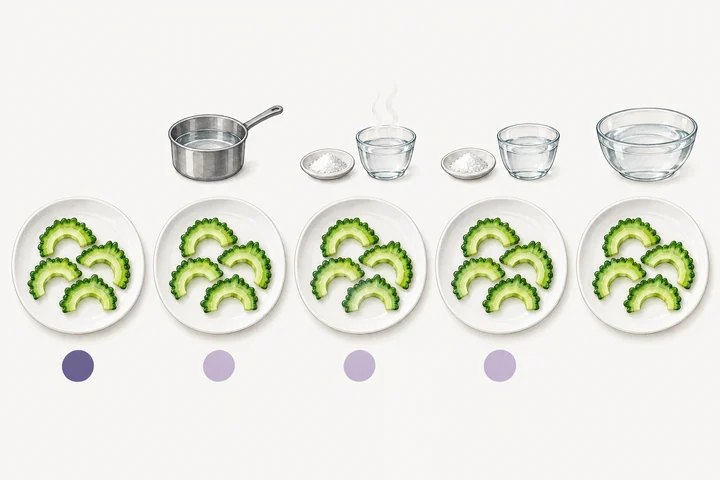
Raw
Boiled
Salt + hot
Salt + water
Soaked
A study comparing 1 mm slices (seeds and pith removed) boiled for 3 minutes, rubbed with 1% salt and rinsed in hot water, rubbed with salt and rinsed in water (both squeezed to 70% of their weight), soaked in water for 5 minutes, and raw. The same light shade for the middle three is a category meaning each was rated significantly less bitter than raw; it does not mean the three were close, equal or not different (differences among them were not tested). The soaked plate has no mark because its difference from raw was not significant; this does not mean no bitterness, not measured, or the same. The study measured neither the amount of bitter compounds nor how much went into the water. The utensils only sketch the preparation. The purple is not a real colour.
Source: Araki et al. 2013 (Araki 2013 in the table of conditions and results by study)
Illustration: illustration desk (PurpleHeron)
Candidate explanations for the differences
Conditions that differ between studies, or between pretreatments, and could explain differences in bitterness. Several conditions differ at once, so which one mattered is unknown. These are candidates, not causes.
- Leftover salt. Since adding salt lowers perceived bitterness, salt remaining after rubbing may play a part. The studies that found lower bitterness did not measure how much salt remained after rinsing. [rows: Maehashi 2008 added salt; Araki 2013 salt + water rinse]
- The form eaten and squeezing. The study that found lower bitterness tasted 1 mm slices squeezed to 70% of their weight; the one that found no significant difference compared juices. Rubbing versus soaking and slices versus juice differ at the same time. [rows: Araki 2013 salt + water rinse; Rashima 2017 brine + blanch]
- Heat. Hot rinsing, boiling and blanching may break down bitter glycosides or leach them out (one report found them undetectable after blanching). But the link between that change and perceived bitterness was not measured in the sources examined here. [rows: Donya 2007 blanching and bitter glycosides; Araki 2013 boiled; Araki 2013 salt + hot rinse]
- Grassy smell. That salt rubbing weakens the grassy smell may affect how easy the vegetable is to eat and how its bitterness is rated; how much this leaks into bitterness ratings has not been measured separately. [rows: Kawakami 2009 grassy smell]
What is not known — what this comparison alone cannot separate
- Whether bitter compounds left or bitterness just became harder to notice: the salt-rubbing trial that found lower bitterness (Araki 2013) did not measure the bitter compounds. [rows: Araki 2013 salt + water rinse; Araki 2013 salt + hot rinse]
- Why the studies disagree. Rubbing versus soaking, slices versus juice, salt concentration and time, panels (10–16 people, training stated or not) and scales all differ at once. [rows: Araki 2013 salt + water rinse; Rashima 2017 brine + blanch; Nakama 2008 salt rub]
- The conflict between 2 reports from the same group: the earlier abstract reports no significant difference, the later paper a significant reduction. Whether the panel or conditions changed cannot be told from the abstract. [rows: Araki 2011 2011 abstract; Araki 2013 salt + hot rinse]
- Differences in dishes. That versions with and without pretreatment showed no significant difference in bitterness cannot be attributed to pretreatment alone, because use of the pith and slicing versus grating also differed. [rows: Araki 2013 dishes]
How studies and rows were counted
The number of evidence rows is not the number of studies. Table rows, ledger evidence rows, papers and research groups are counted separately.
- Sources in the table: 7, of which 5 have results on people's bitterness ratings in this table; for the others, only results on something else (compounds, smell) are shown, or they are used only for context.
- Rows in the table (study × measured result): 12. Rows on perceived bitterness: 10.
- Evidence rows in the lab's ledger these rows rest on: 3. One paper can supply several rows. Rows without a ledger evidence row come from other tables of the same papers, or from sources newly read for this question.
- Research groups among the studies with bitterness results in this table, as grouped in the ledger: 4 (reports from the same lab count as 1; co-authors and affiliations can overlap, so this is not a count of independent replications).
What we looked at
The sources examined for this question, why each was included or excluded, and which full texts could not be reached. We searched PubMed, Europe PMC, J-STAGE and CiNii for studies on bitter melon bitterness and pretreatments such as salting, boiling and soaking, and added the sources already in the lab's ledger.
| Source | Decision | Why |
|---|---|---|
| 「緑のカーテン」ゴーヤの苦味軽減とエコ・クッキングでの活用 (2013) doi | Included in the table | People compared 5 pretreatments on the same fruit, with a test; read in full |
| 「緑のカーテン」ゴーヤの苦味軽減料理の提案とエコ・クッキングの応用 (2011) doi | Included in the table | An earlier report from the same group; abstract only, included because its conclusion conflicts with the later paper |
| 野菜の苦味を抑制するトレハロースの効果 (2008) doi | Included in the table | Compared salt rubbing and boiling with raw (the subject is trehalose); abstract only, and the ordinary-pretreatment comparisons taken here have no direction or values |
| Influence of sodium chloride treatment and polysaccharides as debittering agent on the physicochemical properties, antioxidant capacity and sensory characteristics of bitter gourd (Momordica charantia) juice (2017) doi | Included in the table | Trained panelists compared juice after brine soaking and blanching; read in full |
| Reduction of Bitterness of the Bitter Gourd by Katsuobushi (2008) doi | Included in the table | Not a pretreatment, but shows that adding salt lowers bitterness; read in full |
| キュウリとニガウリの調理塩揉み工程における香気の変化 (2009) doi | Included in the table | Shows that salt rubbing changes grassy smell; bitterness not measured; read in full |
| Effects of Processing Methods on the Proximate Composition and Momordicosides K and L Content of Bitter Melon Vegetable (2007) doi | Included in the table | Bitter glycosides undetectable after blanching; abstract only |
| Influences of Lactiplantibacillus plantarum dy-1 Fermentation on the Bitterness of Bitter Melon Juice, the Composition of Saponin Compounds, and Their Bioactivities (2024) doi | Excluded | The bitterness values for pasteurised versus fresh juice come from an electronic tongue, not human rating; the subject is fermentation |
| Evaluate the effect of β-cyclodextrin on the sensory and physicochemical properties of bitter gourd extract during thermal processing (2024) doi | Full text not reachable | Heated extracts for 20 min; the abstract does not say how heating alone changed bitterness, and the full text is subscription-only |
| Optimization of salt curing of bitter gourd (Momordica charantia L.) with blanching as pre-treatment using response surface methodology (2016) doi | Full text not reachable | Optimised salt-curing conditions; the abstract gives no sensory bitterness values; full text subscription-only |
| Strategies to improve palatability and increase consumption intentions for Momordica charantia (bitter melon): a vegetable commonly used for diabetes management (2011) doi | Excluded | Mixed bitter melon into dishes; not a study comparing with salt pretreatment |
| 農林水産省「うちの郷土料理」ゴーヤーチャンプルー 沖縄県 | Read as context (not in the table) | Recommends lightly salting and squeezing if bitterness bothers you; no measurement of the effect |
| チャンプルースタディレシピ集 改訂第2版 | Read as context (not in the table) | Recommends a quick dip in boiling water or light salt rubbing and rinsing; the two are not compared |
| เคล็ดลับลดความขมจากผักรสขม(スアンドゥシット大学のコラム) (2024) | Read as context (not in the table) | Recommends removing seeds and pith, washing in brine and soaking 10–20 min; no measurement of the effect |
| 宮崎県工業技術センター・食品開発センター研究報告(サイクロデキストリン) (2001) | Excluded | Adds cyclodextrins to juice, which is not a pretreatment (a public prefectural report exists) |
Read in the encyclopedia
- Bitter melon — the vegetable in this question
- Momordicoside K / L — bitter glycosides reported undetectable after blanching (Japanese pages)
- Goya champuru — a dish also compared with and without pretreatment
- Bitter melon bitterness — the topic hub covering additions, fermentation and bitter compounds
- Did salting bitter melon draw out its bitterness? — a research note on the brine study and the debate over the main bitter compounds
Source ledger
Each study's source can be reached from its section above. All of the lab's sources are listed in the source ledger.
How to cite this page
Aoki, M. (NIGAMI LAB) (2026). Does salting or boiling bitter melon cut its bitterness?. https://nigamilab.com/en/topics/goya-salt-rub/
Each claim card has a stable anchor (#clm-…). The dataset is CC BY 4.0; see the data page. Dataset DOI: 10.5281/zenodo.22739101