liangcha
ingredient / ingredient-liangcha
涼茶
Liangcha is a collective term for Lingnan cooling teas and herbal drinks made by extracting plant materials, not limited to Camellia sinensis, in water. Records of cultural use and studies confirming effects on the body are treated separately.
Photographs (captions in Japanese)
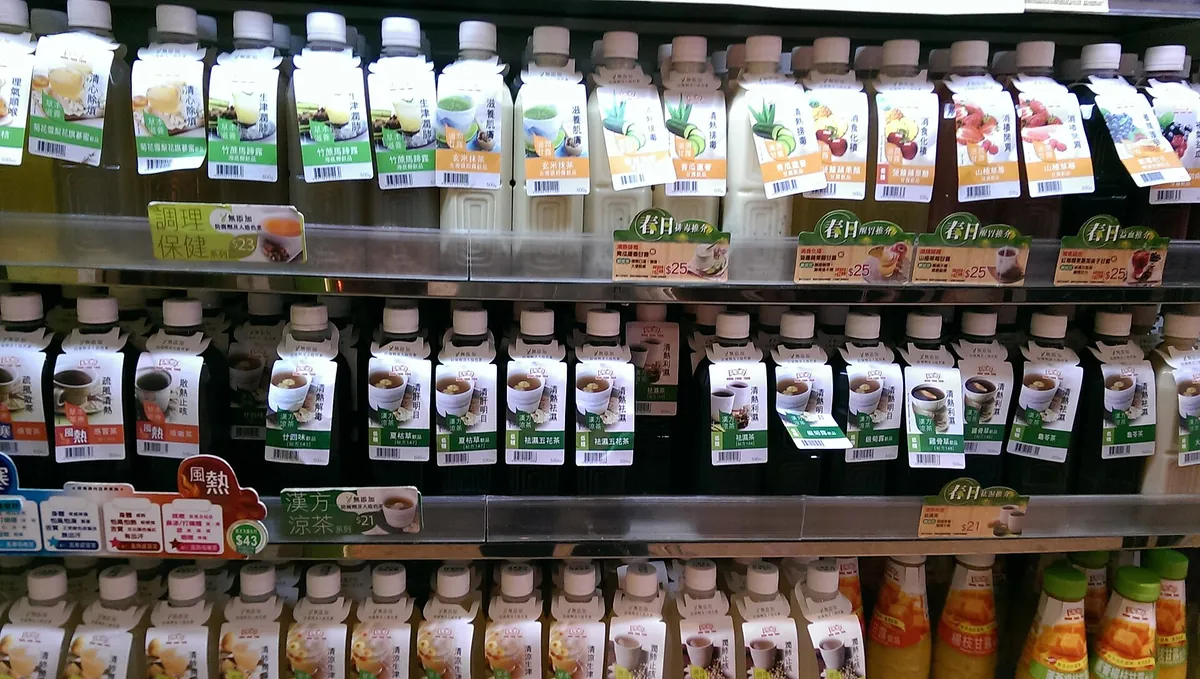
A group of commercial bottles of liang cha (Cantonese-style herbal tea drinks from China). Displayed with a "Chinese herbal liang cha" shelf label, they are several brands of bottles that advertise effects such as "clearing heat" and "removing dampness", showing that liang cha is distributed as a bottled drink.
Shown: No applicable taxon (a group of liang cha drinks made from several plant materials)Part / state: Various bottled liang cha drinks (including the "Chinese herbal liang cha" series) lined up on a supermarket shelf in Hong Kong
Photo: Map cla1401 / CC BY-SA 3.0 / original image / ledger's original image
Scope and provenance of the photo
Identification: Identified as labelled in the source. The scientific name is not given because the individual brands and source plants cannot be determined from the labels visible on the bottles. The photograph is a display of bottled products and does not show liang cha poured into a bowl.
Image shown: The 1920 px version from Wikimedia Commons. No cropping or color changes by NIGAMI LAB. For display, a WebP capped at 1200 px wide is served; the ledger's original image can be checked from the link above.
On this page (9 sections)
Reading the bitterness
Liangcha (cooling tea) is a collective term for herbal drinks of the Lingnan region (southern China, including Guangdong and Guangxi) made by decocting or infusing plant materials not limited to the Chinese tea plant (Camellia sinensis) in water. An ethnobotanical survey of 12 sociolinguistic groups and 300 people in Lingnan conducted from 2010 to 2012 recorded it as a drink made by extracting diverse parts, including leaves, fruits, flowers, bark, seeds, and roots, from one or more species in water. Because the subjects covered as many as 238 taxa, the term does not refer to a single recipe. The same survey states that gathering and cultivating liangcha have cultural and economic value and that its consumption has become part of Lingnan regional culture and lifestyle. How bitterness is softened and discussed is also part of the region’s liangcha culture.
The art of preparing liangcha was registered in 2006 as a traditional craft belonging to Guangdong Province in the first group of China’s national-level intangible cultural heritage. However, this registration indicates cultural status and does not guarantee the safety or effects on the body of individual products. It has also been recorded that producers and distributors of market products began adding sweeteners to soften bitter flavors, but their types and amounts, and how much bitterness they actually suppressed, have not been measured. A cultural article posted on the Guangzhou municipal government website in 2023 introduces local elders’ account that liangcha bitterness is divided roughly into three grades, with higher grades having heavier flavor and darker color, but this is not a standardized scale and has not been confirmed by a reproducible survey.
Sources for this overview
Ethnobotanical survey of cooling herbal drinks from southern China
Checked for this overview: Confirmed the definition involving water extraction of diverse plant parts. / Confirmed the survey result that it is part of Lingnan regional culture. / Confirmed the record of adding sweeteners to soften bitterness.
Checked for this overview: Confirmed the registration record as national-level intangible cultural heritage.
Checked for this overview: Confirmed the local account dividing bitterness into three levels.
Other names: 凉茶 (zh), liáng chá (zh-Latn)
Follow the connections
liangcha →is documented as part of→ Lingnan
Hypotheses and recipe candidates for this entry are on the Japanese page.
Structured claims — open a section to read each claim's confidence, evidence and limits
How processing and cooking change it (2)
Scope: An ethnobotanical survey of Lingnan
Note: Plant species, parts, and combinations vary widely; this is a description as a general term.
Show data
ingredient-liangcha —is_prepared_from→ (the claim sentence above)Scope: An observation from an ethnobotanical paper on the liangcha (herbal tea) industry of Lingnan
Note: A practice record from producers and distributors. Not a sensory test that measured the effect size of perceptual suppression.
Show data
ingredient-liangcha —is_prepared_with→ (the claim sentence above)Safety and regulation (1)
Scope: Registration information submitted by the Guangdong Provincial Department of Culture
Note: The registration indicates cultural status; it does not guarantee safety or efficacy.
Show data
ingredient-liangcha —is_listed_as→ (the claim sentence above)Culture (2)
Scope: a 2010–2012 study of 300 people across 12 sociolinguistic groups
Note: A reported traditional-medicine use is separate from evidence of efficacy.
Show data
ingredient-liangcha —is_documented_as_part_of→ region-lingnanScope: a 2023 cultural article published on the Guangzhou municipal government's website
Note: Not a standardized scale — a regional narrative recorded in a news article. A replication study is needed.
Show data
ingredient-liangcha —is_classified_by→ (the claim sentence above)