Awa bancha
ingredient / ingredient-awa-bancha
阿波晩茶
Awa bancha is a post-fermented tea traditional to Kamikatsu in Katsuura District, Naka in Naka District, and Minami in Kaifu District, Tokushima Prefecture. Tough tea leaves picked late in summer are heated, for example by boiling in a large cauldron, to stop oxidative fermentation, then placed in tubs or barrels for lactic-acid fermentation.
Photographs (captions in Japanese)
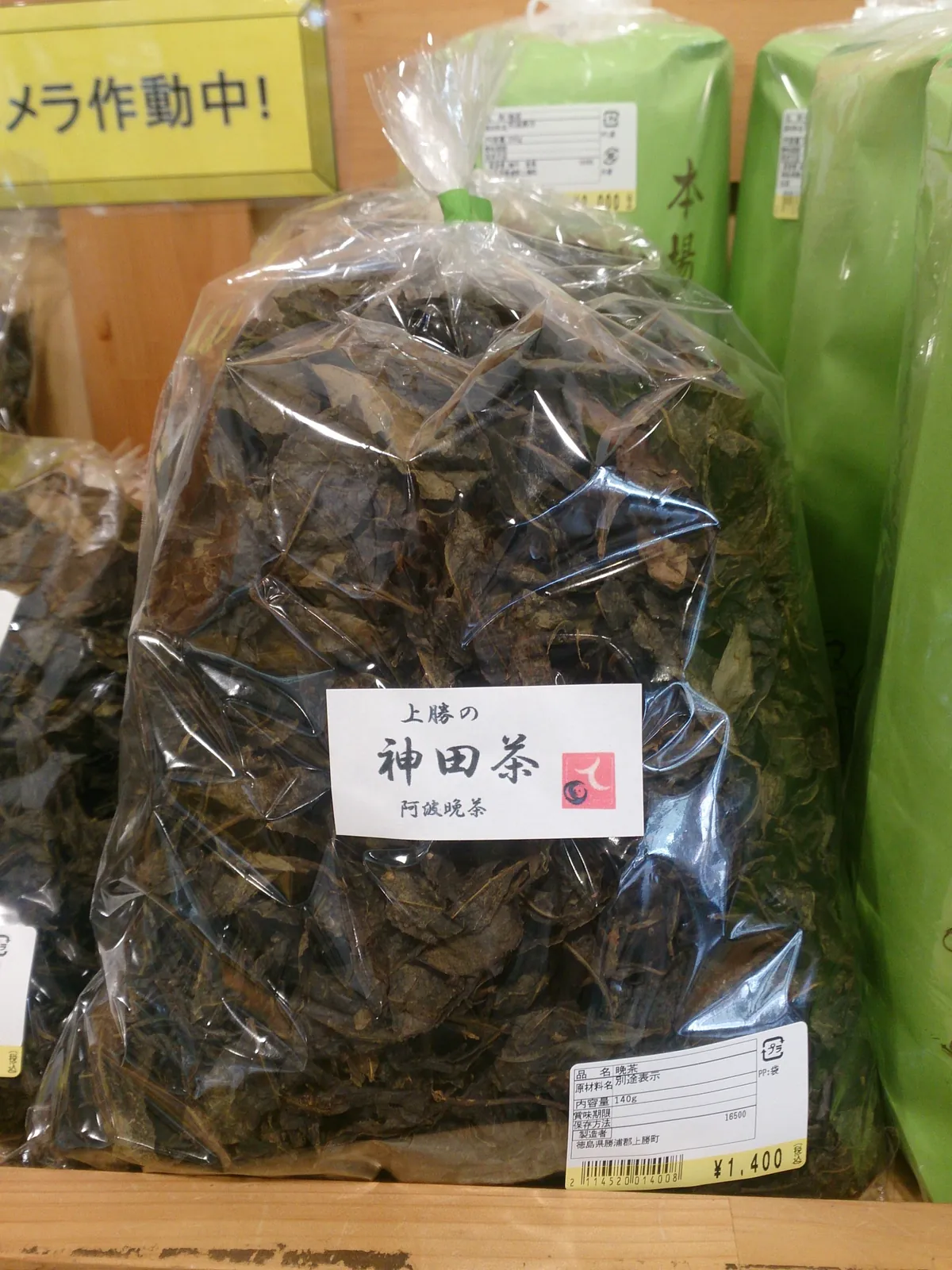
Leaves of Kanda-cha (described as a kind of Awa-bancha). The file name indicates "Kanda-cha", one type within the region, but the English description on the file page describes it as Awabancha itself: "Awabancha, Fermented tea in Tokushima Prefecture, Japan".
Shown: No applicable taxon (Kanda-cha, described as a kind of Awa-bancha)Part / state: Leaves of Kanda-cha (described as a kind of Awa-bancha)
Photo: Shugyoso / CC BY-SA 4.0 / original image / ledger's original image
Scope and provenance of the photo
Identification: Identified as labelled in the source. This is the only photograph (1) on Wikimedia Commons confirmed to explicitly take Awabancha as its subject (a full-text search of Category:Fermented tea and of "阿波晩茶" and "Awabancha" found no others). Kanda-cha is a regional name around Kamikatsu Town, and it was adopted because the English description on the file page states the correspondence with Awabancha.
Image shown: After obtaining the full-size file from Wikimedia Commons, NIGAMI LAB reduced it to about 2400 px on the long side with sips. No cropping or color changes. For display, a WebP capped at 1200 px wide is served; the ledger's original image can be checked from the link above.
On this page (6 sections)
Reading the bitterness
Awa-bancha is a post-fermented tea traditional to Kamikatsu in Katsuura District, Naka in Naka District, and Minami in Kaifu District, Tokushima Prefecture. Tough leaves picked late in summer are heated, such as by boiling in a large cauldron, to stop oxidative fermentation, then immersed in a tub or barrel for lactic-acid fermentation. In a composition analysis conducted by the Tokushima Prefectural Industrial Technology Center in accordance with the Food Labeling Standards (Cabinet Office Ordinance No. 10 of Heisei 27), reported tannin contents were 8.1 g/100 g for Awa-bancha, 7.5 g/100 g for Ishizuchi-kurocha, 11.4 g/100 g for sencha, and 6.5 g/100 g for black tea.
The same analysis also compared caffeine contents: 1.5 g/100 g for Awa-bancha, 1.4 g/100 g for Ishizuchi-kurocha, 2.1 g/100 g for sencha, and 3.0 g/100 g for black tea. Awa-bancha was reported to have less protein, caffeine, and tannin than sencha and less protein and caffeine than black tea. The sample number and production-lot details were not given.
The Tokushima Prefectural Industrial Technology Center also measured infusions with a taste sensor (SA402B, Intelligent Sensor Technology). It reported lower astringency-stimulus and umami output values for Awa-bancha than for sencha or black tea, while its acidity output was second highest after Ishizuchi-kurocha. On this basis, Awa-bancha was described as having a refreshing taste with acidity. The acidity and saltiness sensor outputs, however, were judged below the tasteless point, and no sample count, repetitions, or statistical tests were reported; the outputs should be treated as reference values.
A separate Tokushima Prefectural Industrial Technology Center report compared a total of 7 tea types, including 15 Awa-bancha samples, with Ishizuchi-kurocha, Goishicha, Batabatacha, sencha, black tea, and oolong tea. It analyzed flavor-related organic acids (acidity), catechins (astringency and bitterness), caffeine (bitterness), and free amino acids (flavor complexity). Awa-bancha was reported to have more organic acids and fewer catechins, caffeine, and free amino acids. This report was a results poster; individual contents were not stated numerically in the body text and appeared only in bar charts and a PCA biplot.
Sources for this overview
Checked for this overview: Checked the tannin-content comparison in a composition analysis complying with the Food Labeling Standards. / Checked the same analysis's caffeine-content and protein comparisons. / Checked the infusion measurements with the SA402B taste sensor and their limitations.
後発酵茶「阿波晩茶」の特性が明らかに――阿波晩茶の成分特性に関する研究
Checked for this overview: Relative amounts of catechins, caffeine, and organic acids in the comparison of 7 tea types.
Structured claims — open a section to read each claim's confidence, evidence and limits
Composition and content (2)
Scope: Leaf analysis of awa-bancha and Ishizuchi-kurocha (both post-fermented teas), sencha (an unfermented tea), and black tea (a fermented tea)
Note: Included after checking the full text (Table 2) from the Tokushima Prefectural Industrial Technology Center. Details of sample size and origin/lot are not given.
Show data
ingredient-awa-bancha —has_composition→ (the claim sentence above)Scope: Layer: food. A Tokushima Prefectural Industrial Technology Center study (15 Awa-bancha samples compared with 7 other tea types; full text read). Individual values appear only in graphs, not in the body text.
Show data
ingredient-awa-bancha —has_composition→ (the claim sentence above)Sensory (1)
Scope: A comparison of infusions of awa-bancha, Ishizuchi-kurocha, sencha, and black tea (Tokushima Prefectural Industrial Technology Center, taste sensor SA402B)
Note: A comparison between single samples; the number of replicates and statistical testing are not stated.
Show data
ingredient-awa-bancha —has_sensory_attribute→ (the claim sentence above)