Cynar
ingredient / ingredient-cynar
チナール
Cynar is an Italian bitter liqueur brand featuring artichoke (carciofo), described as having been introduced by Angelo Dalle Molle in 1950. It has been produced by Campari Group since 1995. It is one brand within amaro and is also related to the globe artichoke, its characteristic ingredient.
Photographs (captions in Japanese)
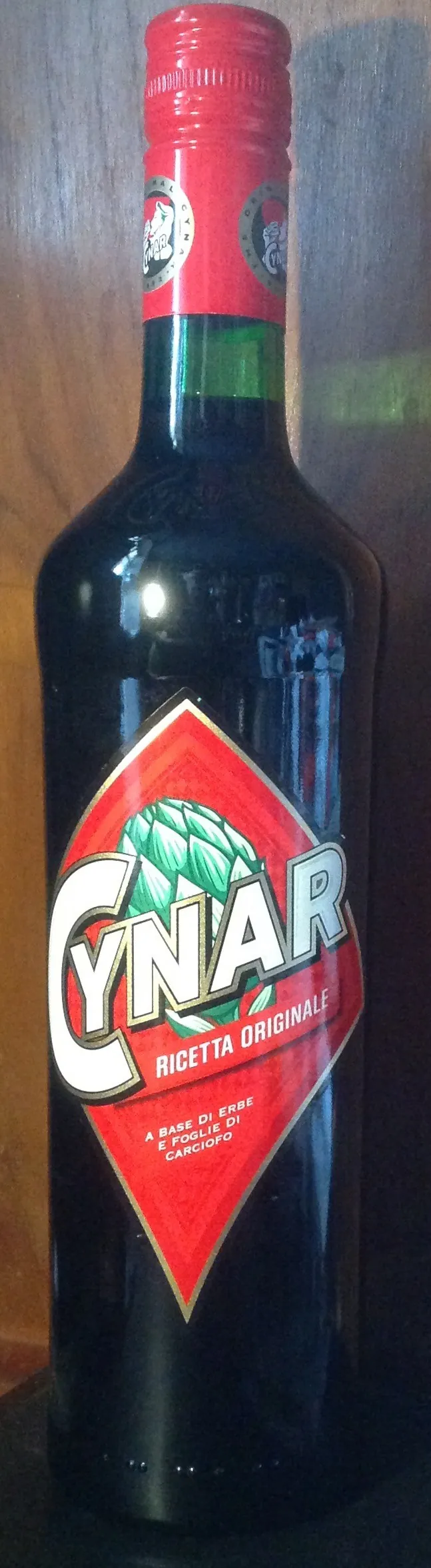
The front of a Cynar bottle. The label has an artichoke illustration and the text "A base di erbe e foglie di carciofo"
Shown: N/A (branded bottle; the label has an artichoke design)Part / state: Front of an unopened bottle. The whole label
Photo: Trekkiedane / CC BY-SA 4.0 / original image / ledger's original image
Scope and provenance of the photo
Identification: Identified as labelled in the source. Own work, stated to be a 0.7-liter bottle. The label text matches the description of artichoke (carciofo) as the raw material in entities.csv. I opened the image and confirmed. The words "CYNAR", "RICETTA ORIGINALE", and "A BASE DI ERBE E FOGLIE DI CARCIOFO" on the label and an artichoke illustration are clearly readable
Image shown: Same size as the original on Wikimedia Commons. No cropping or color changes. For display, a WebP capped at 1200 px wide is served; the ledger's original image can be checked from the link above.
On this page (9 sections)
Reading the bitterness
Cynar is an Italian bitter liqueur featuring artichoke (carciofo), described as having been presented in 1950 at a bar in the Pezziol pavilion of the 28th Milan Fair. The official site attributes the idea to Angelo Dalle Molle, an entrepreneur and philanthropist from Mestre, and records Campari Group’s acquisition in 1995 on its history timeline. The site describes it as 「13種のハーブと植物の浸漬から生まれる天然原料の製品」 (in translation: "a product of natural ingredients made by infusing 13 herbs and plants") and states that artichoke is its most characteristic ingredient and that the drink’s name derives from Cynara in its scientific name, Cynara scolymus.
The official site also presents a myth alongside the scientific name as an origin of Cynar’s name. Explicitly prefaced 「神話によれば」 (in translation: "according to the myth"), the story says Zeus fell in love with the beautiful nymph Cynara without being loved in return and, in anger, transformed her into an artichoke, prickly in character but lovable at heart. The official site itself presents this as a traditional story; classical sources were not checked in this investigation.
According to the official site, Cynar has used the slogan 「現代生活の消耗に抗して」 (in translation: "against the wear and tear of modern life") since advertising in the 1950s–60s. It describes as particularly famous a 1960s television advertisement in which actor Ernesto Calindri relaxes in the middle of a busy road, reads a newspaper, and sips Cynar.
The official site’s main product description never uses the word 「苦い」 (in translation: "bitter"), whereas promotional copy introducing an affiliated bar contains the phrase 「もちろん、しかるべき苦い後味とともに」 (in translation: "of course, with a suitably bitter aftertaste"); this is the only place where it uses 「苦い」 (in translation: "bitter"). A representative Cynar cocktail is a Spritz; the site gives its own recipe with 9 cl Prosecco, 6 cl Cynar, and 3 cl soda. The IBA official page also notes a Spritz variation that uses Cynar instead of Aperol.
Sources for this overview
Cynar Spritz: Contro il Logorio della Vita Moderna
Checked for this overview: Used the official history for the circumstances of the presentation and the acquisition year. / Used the official description of 13 herbs. / Used the explanation deriving the name from artichoke. / Used the myth-based story while preserving its attribution to myth. / Used the description of the slogan and advertising history. / Documented where use of the word “bitter” is concentrated. / Used the proportions in the brand’s own Spritz recipe.
Spritz – IBA Official Cocktail
Checked for this overview: Used the IBA note about substituting Cynar.
Follow the connections
Cynar →is used as an alternative to→ Aperol
Cynar →is used in→ Spritz
Cynar →contains→ globe artichoke
Hypotheses and recipe candidates for this entry are on the Japanese page.
Structured claims — open a section to read each claim's confidence, evidence and limits
Composition and content (2)
Scope: The official Cynar site, presenting the company’s own account in the Italian original.
Show data
ingredient-cynar —has_composition→ (the claim sentence above)Scope: Cynar's official website (the company's own account)
Note: Connected to the existing entity ingredient-artichoke-globe (scientific name Cynara scolymus L.). No quantitative relationship between the existing compound-cynaropicrin (artichoke's bitter sesquiterpene lactone) and the Cynar product appears in the official material we could confirm this time, so this claim does not connect the two.
Show data
ingredient-cynar —contains→ ingredient-artichoke-globeSensory (1)
Scope: Within the Cynar official website, an introductory blurb recommending affiliated bars (a description from a company-affiliated outlet).
Note: Within the same official website, the main product-description text (the "infusione di 13 erbe" section) never uses any word in the "bitter" family, whereas the word "amaro" (bitter) is used explicitly, just once, only in this promotional blurb recommending affiliated bars. We record this as an unevenness in where the word appears within the same brand's site.
Show data
ingredient-cynar —has_sensory_attribute→ (the claim sentence above)How processing and cooking change it (2)
Scope: The note on the official IBA Spritz recipe page.
Note: A connection from the Cynar side based on the same note as the related alternatives record.
Show data
ingredient-cynar —is_alternative_to→ ingredient-aperolScope: The recipe on the official Cynar site itself.
Note: Its 3:2 ratio is almost the same as the official IBA recipe’s 90 ml Prosecco to 60 ml branded aperitif, an independent correspondence between the two sources.
Show data
ingredient-cynar —is_used_in→ dish-spritzCulture (3)
Scope: Italy, Milan and Mestre. The official Cynar site’s own account.
Note: The acquisition by Campari Group in 1995 is also recorded on the same history timeline.
Show data
ingredient-cynar —has_history→ (the claim sentence above)Scope: The official Cynar site’s own account, explicitly introduced as 『神話によれば』 (in translation: "according to the myth").
Note: The official site itself uses 『Secondo il mito』 (in translation: "according to the myth") and treats the story as tradition. This record presents it as a myth introduced by the company, not as a confirmed historical etymology.
Show data
ingredient-cynar —has_name_etymology→ (the claim sentence above)Scope: The official Cynar site’s own account.
Show data
ingredient-cynar —is_presented_as→ (the claim sentence above)