日本語版

cucumber

ingredient / ingredient-cucumber

キュウリ / Cucumis sativus

Cucumber is the edible fruit of cucumber. Wild ancestral lines and immature fruits have strong bitterness, but during domestication only fruit bitterness was selectively lost.

Photographs (captions in Japanese)
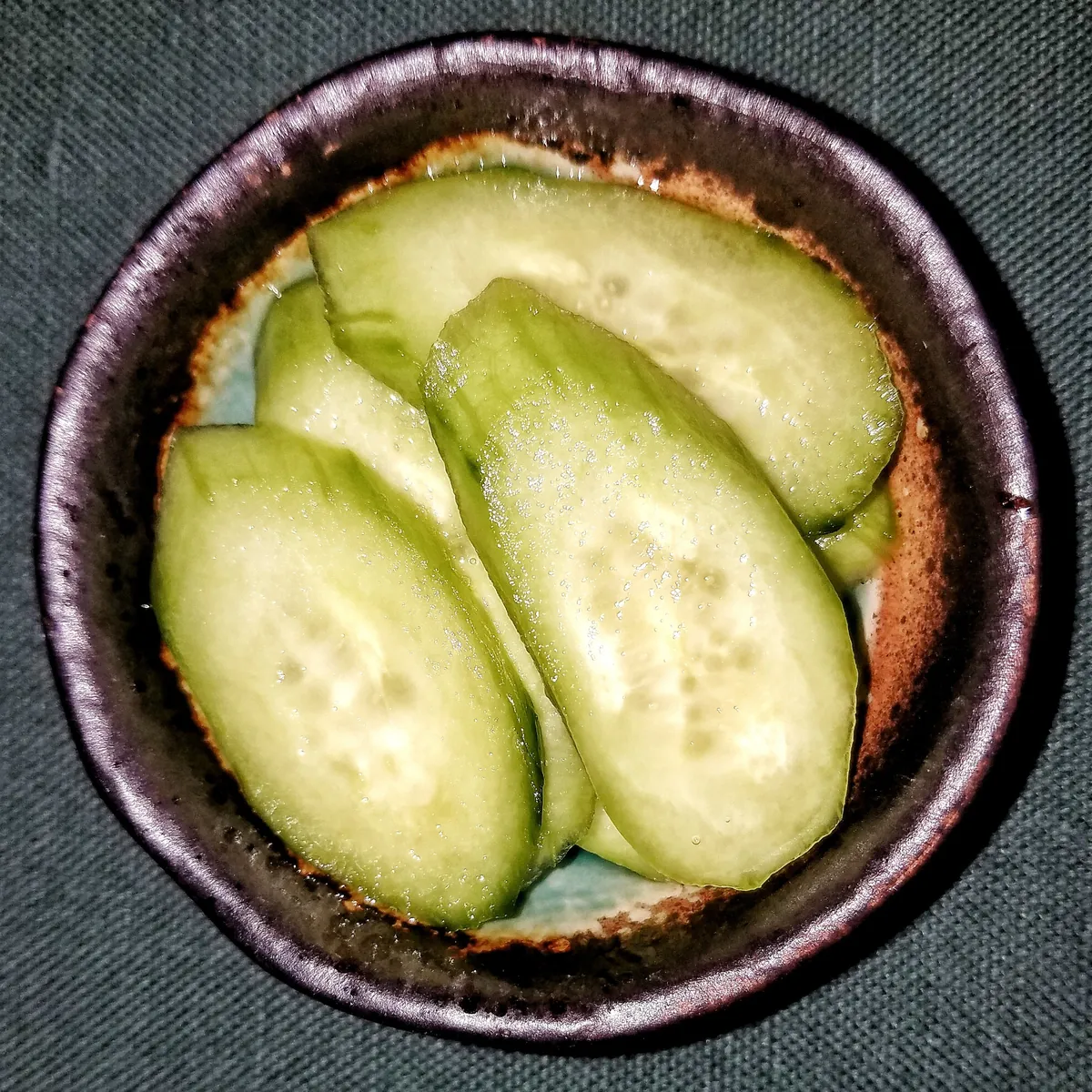
Several diagonally cut slices of cucumber, with green skin and pale green-white flesh, served on a small black dish. The surface is slightly glossy.

A cross-section of a cucumber fruit sliced into rings with the skin on.

Prepared formShown: Cucumis sativusPart / state: Fruit cut into rings (with skin, a cross-section including the seed area)

Photo: Daderot / CC0 1.0 / original image / ledger's original image

Scope and provenance of the photo

Identification: Identified as labelled in the source. The description is only "Cucumbers - Massachusetts, USA". The slices look like a dressed dish and it is not a photograph of blanched cultivation, but the cross-section of the fruit is clear. I opened the image and confirmed that several cucumber slices with green skin and pale green-white flesh overlap on a dish. It has a seasoned, dressed-dish appearance.

Image shown: The original from Wikimedia Commons, reduced to 2400 px on the long side. No cropping or color changes. For display, a WebP capped at 1200 px wide is served; the ledger's original image can be checked from the link above.

On this page (8 sections)
  1. Overview
  2. Sources for this overview (2)
  3. Topic hubs
  4. Other names
  5. Follow the connections
  6. Related entries (10)
  7. Composition and content (1)
  8. Mechanism and receptors (2)
↑

Reading the bitterness

Cucumber has strong bitterness in wild-like lines and immature fruits, but in most domesticated cultivars only the fruit is not bitter. Central to this difference are the Bt (Bitter Fruit) and Bl (Bitter Leaf) genes, which control the biosynthetic pathway for the bitter compound cucurbitacin C. One study identified 9 genes in this pathway and 4 stages of catalytic reactions, and reported that mutations arising in the promoter region of Bt, which governs fruit bitterness, were selected and fixed during domestication. This finding has only been confirmed at the abstract level. An explanatory article states that, because Bl controlling the same pathway retains expression in leaves, domestication selectively removed only fruit bitterness while retaining leaf bitterness as deterrence against herbivory in the plant as a whole. The perspective of domestication (breeding) is involved here.

Even if fruit bitterness was lost through domestication, this does not appear to be constant in all cases. According to an explanatory article, domesticated cultivars in which a particular single-nucleotide polymorphism (SNP) in the Bt promoter remains the G type may develop bitter fruit when exposed to cultivation stress such as low temperature. Conversely, lines in which this SNP has mutated to the A type have been reported not to develop bitterness even at low temperature. This is an example in which the cultivation environment may restore bitterness that had once been suppressed, and it suggests that genetic debittering is not necessarily an irreversible one-way property.

Sources for this overview

  1. Biosynthesis, regulation, and domestication of bitterness in cucumber

    Shang Y; Ma Y; Zhou Y; Zhang H; Duan L; Chen H; Zeng J; Zhou Q; Wang S; Gu W; Liu M; Ren J; Gu X; Zhang S; Wang Y; Yasukawa K; Bouwmeester HJ; Qi X; Zhang Z; Lucas WJ; Huang S / 2014 / journal article / abstract checked

    Checked for this overview: Used while explicitly stating that confirmation is at the abstract level.

  2. Bitter but tasty cucumber

    Chen X-Y / 2015 / journal article / full text checked

    Checked for this overview: Used in full as an explanation of the difference in Bt/Bl expression. / Introduces recurrence of bitterness under low-temperature stress.

Other names: Cucumis sativus (la)

Follow the connections

cucumber →has debittering most likely…→ cucurbitacin C →— sensory attribute→ bitterness

Structured claims — open a section to read each claim's confidence, evidence and limits

Composition and content (1)

cucumber — composition: In fruit of the bitter cultivar 'Shinsyo Hakuhi', juice pressed from the stem end contained cucurbitacin C at 2.0±3.5 mg/L (n=4; only occasionally detected). In 1 fruit selected because its middle part tasted strongly bitter when bitten and measured part by part, concentrations were high near the stem end (7.2 and 7.6 mg/L) and about 0.1 mg/L in the middle and blossom end. In fruit of the non-bitter common cultivars 'Sharp 1', 'Zenkoku Suyo Kyuri', and 'Marianna RZ', cucurbitacin C was not detected (ND).supported

Scope: Layer: food. HPLC analysis of fruit, leaves, and shoot tips from bitter and non-bitter cultivars (2004-2005, in a greenhouse at a research institute in Tsu, Mie Prefecture). The distribution by part is a measurement of 1 selected fruit.

Body text: 'The stem end of Shinsyo Hakuhi fruit contained higher amounts of it than other fruit parts.' Table 2 lists cucurbitacin C content by cultivar (bitter cultivar Shinsyo Hakuhi: 2.0±3.5 mg/L in juice from the stem end of the fruit, n=4; the standard deviation exceeds the mean, and it was only occasionally detected) alongside the bitterness assessment (b=bitter, n=non-bitter). Fruit of the other 3 cultivars were all recorded as ND (not detected) and non-bitter. The distribution by part of the fruit comes from Fig. 2, which measured 1 fruit selected because its middle part tasted strongly bitter when bitten (7.2, 7.6, 2.5, 0.1 and 0.1 mg/L from the stem end).
Limitations: The sensory assessment is a 2-way bitter/non-bitter description with no number of assessors or procedure given. Table 2 is the mean of 4 fruits, while the distribution by part is a measurement of 1 selected fruit. The authors write that bitterness was often faint or very weak in the middle and blossom end. This was not a test of the effect of cutting off the stem end as a preparation step.
Source: Cucurbitacin C—Bitter Principle in Cucumber Plants (Horie H; Ito H; Ippoushi K; Azuma K; Sakata Y; Igarashi I, 2007) · full text checked
Show dataingredient-cucumber —has_composition→ (the claim sentence above)
claim: clm-w68a-cucumber-stem-end-higher-cucurbitacin / type: composition / updated: 2026-10-21

Mechanism and receptors (2)

cucumber has debittering most likely due to cucurbitacin Csupported

Scope: Cucumber, Cucumis sativus

Note: The evidence is Shang et al. 2014, Science (abstract), and its accompanying commentary Chen 2015 (full text). The identification of the 9 genes and 4 catalytic steps of the cucurbitacin C biosynthesis pathway, and tissue-specific control by Bt/Bl, are the central findings of the original paper.

Identified 9 genes and 4 catalytic steps of the cucurbitacin C biosynthesis pathway, and discovered the transcription factors Bl (Bitter Leaf) and Bt (Bitter Fruit), which control this pathway in the leaves and fruit respectively. Reported genomic evidence that selection imposed on Bt during domestication led to non-bitter lines.
Limitations: Because the evidence_type controlled vocabulary has no term corresponding to molecular genetics, cell_or_tissue_experiment was used. The full text was not reached; this is confirmed only at the abstract stage.
Source: Biosynthesis, regulation, and domestication of bitterness in cucumber (Shang Y; Ma Y; Zhou Y; Zhang H; Duan L; Chen H; Zeng J; Zhou Q; Wang S; Gu W; Liu M; Ren J; Gu X; Zhang S; Wang Y; Yasukawa K; Bouwmeester HJ; Qi X; Zhang Z; Lucas WJ; Huang S, 2014) · abstract checked
Explains that a mutation in the Bt promoter region was selected for and fixed during domestication, lowering Bt expression in the fruit, while Bl kept its expression in the leaves — so that, across the plant as a whole, bitterness for deterring herbivory was maintained while only the fruit was made non-bitter.
Limitations: This is a commentary article and does not carry its own original experimental data.
Source: Bitter but tasty cucumber (Chen X-Y, 2015) · full text checked
Show dataingredient-cucumber —has_debittering_most_likely_due_to→ compound-cucurbitacin-c
claim: clm-cucumber-bt-domestication-debitters / type: mechanism / updated: 2026-09-02
cucumber — perceived bitterness is affected by: Cultivation stress such as cold or drought. Non-bitter cultivated varieties in which a specific single-nucleotide polymorphism within the Bt promoter remains the G allele are reported to have fruit that can turn bitter again under cold stress. Lines in which this polymorphism has mutated to the A allele do not turn bitter even under cold.supported

Scope: Cultivated cucumber varieties

Note: From Chen 2015 (a commentary article summarizing the findings of Shang et al. 2014). A summary of primary research showing that the drop in Bt expression from domestication is not an irreversible loss, but a conditional suppression whose expression can shift with environmental conditions.

States that 'some cultivated varieties can turn bitter under stress such as cold,' and that a specific single-nucleotide polymorphism (G/A) within the Bt promoter governs this response. Reports that non-bitter varieties domesticated while retaining the G allele can turn bitter under cold stress, whereas lines mutated to A do not turn bitter even under cold.
Limitations: The original primary data (the body of Shang et al. 2014 itself) was confirmed only via its abstract; the detailed experimental conditions for the SNP rely on this commentary article's description.
Source: Bitter but tasty cucumber (Chen X-Y, 2015) · full text checked
Show dataingredient-cucumber —has_perceived_bitterness_affected_by→ (the claim sentence above)
claim: clm-cucumber-cold-stress-reactivates-bitterness / type: mechanism / updated: 2026-09-02

↑ Top of page · ← Encyclopedia (English entries)