canh khổ qua
dish / dish-canh-kho-qua
カイン・コー・クア
Canh khổ qua is a bitter-gourd soup served at Tết tables and as an offering in southern Vietnam. The VOV article concerns the meat-stuffed version.
Photographs (captions in Japanese)
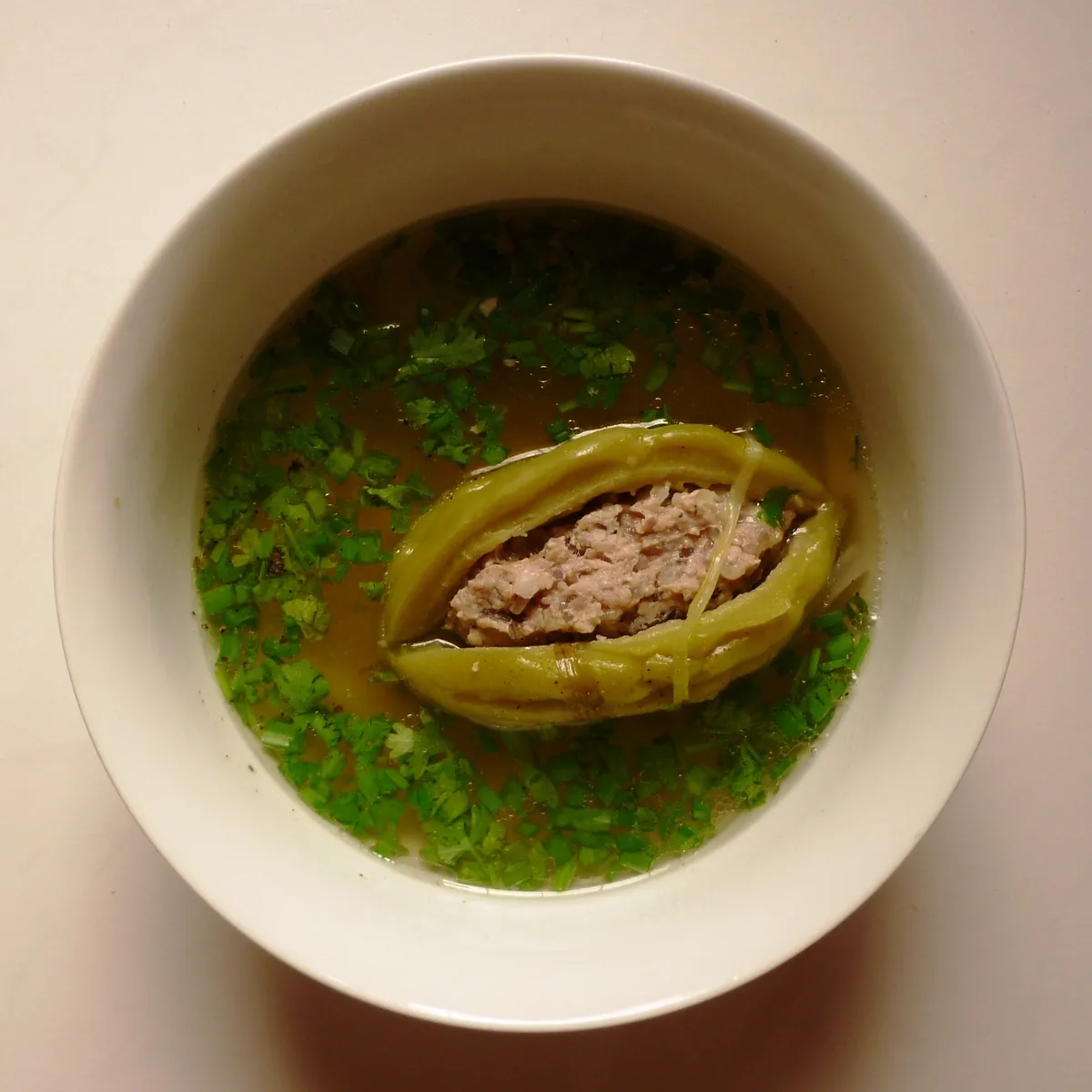
Canh khổ qua (stuffed bitter melon soup). One example in which rings of bitter melon are filled with ground pork, simmered in a clear broth, and sprinkled with chopped herbs. It is a Vietnamese home-style dish and not a standard form for the whole region.
DishShown: Momordica charantia (dish: canh khổ qua)Part / state: Bitter melon (khổ qua) cut into rings, seeded, filled with ground pork, and simmered into a clear soup. Sprinkled with chopped cilantro and green onion
Photo: Ngô Trung / CC BY-SA 3.0 / original image / ledger's original image
Scope and provenance of the photo
Identification: Identified as labelled in the source. The source caption says only "Bitter melon soup (Canh khổ qua)". The scientific name has not been re-identified. It is one example of home cooking and not the standard form in the region.
Image shown: The full-size version from Wikimedia Commons. No cropping or color changes by NIGAMI LAB. For display, a WebP capped at 1200 px wide is served; the ledger's original image can be checked from the link above.
On this page (8 sections)
Reading the bitterness
Canh khổ qua is covered in an article by the public broadcaster VOV as a dish placed on Tết, the Lunar New Year, tables and in offerings to ancestors in the Mekong Delta of southern Vietnam. The article identifies meat-stuffed canh khổ qua nhồi thịt as one of the dishes that appears 「永続的」 (in translation: "perennially") on regional tables, and introduces slowly simmered canh khổ qua hầm as a dish whose name begins with an interpretation that 「苦しみ・困難(khổ)が過ぎ去る(qua)」 (in translation: "suffering and hardship [khổ] pass [qua]"). This is a regional record from one public-broadcast article; it is not presented as a custom uniformly shared throughout Vietnam.
As a dish, the article describes removing the seeds from green bitter gourd (khổ qua), stuffing it with meat, and simmering it. This is a regional record showing that bitter gourd is the main ingredient in this meat-stuffed soup, but the article is only one cooking example and does not represent all household formulations or names.
A 2024 analysis of bitter-gourd extracts concludes, from dose-over-threshold (DoT) calculations, that two bitter compounds isolated by sensory-guided fractionation and HPLC purification, including charantoside B, should be regarded as the bitter principle of bitter gourd. The dry-weight content of charantoside B was 214.8±14.0 mg/kg. This analysis concerns fruit extracts of bitter gourd, not the dish canh khổ qua itself.
Sources for this overview
Checked for this overview: The extent checked for descriptions of its place on Mekong Delta Tết tables and the interpretation of its name. / The extent checked for the description of removing bitter-gourd seeds, stuffing with meat, and simmering.
Checked for this overview: Identification of charantoside B from bitter-gourd extracts and a content of 214.8±14.0 mg/kg.
Follow the connections
canh khổ qua →uses→ bitter melon
canh khổ qua →contains→ charantoside B →elicits→ bitterness
Hypotheses and recipe candidates for this entry are on the Japanese page.
Structured claims — open a section to read each claim's confidence, evidence and limits
Composition and content (1)
Scope: Layer: Food (isolated compound from fruit extract). Isolated from the dichloromethane fraction of 75% methanol extract by sensory-guided fractionation and HPLC purification, quantified by UPLC-MS/MS, sensory threshold test in 3% ethanol solution.
Show data
dish-canh-kho-qua —contains→ compound-charantoside-bHow processing and cooking change it (1)
Scope: Canh khổ qua hầm / nhồi thịt, as recorded by VOV
Note: Based on the cooking description in the same article. Not generalized into a recipe. Confidence calibration (2026-08-31 review): downgraded from supported to contextual, since the grounds are only public and press cultural records.
Show data
dish-canh-kho-qua —uses→ ingredient-bitter-gourdCulture (1)
Scope: Southern Vietnam, the Mekong Delta (the food culture covered by VOV)
Note: A regional record based on a public-broadcast article; it does not claim a uniform custom throughout Vietnam.
Show data
dish-canh-kho-qua —is_documented_as_part_of→ (the claim sentence above)