日本語版

Brassica vegetables

ingredient / ingredient-brassica

アブラナ科野菜

Cruciferous vegetables such as cabbage and broccoli.

Photographs (captions in Japanese)
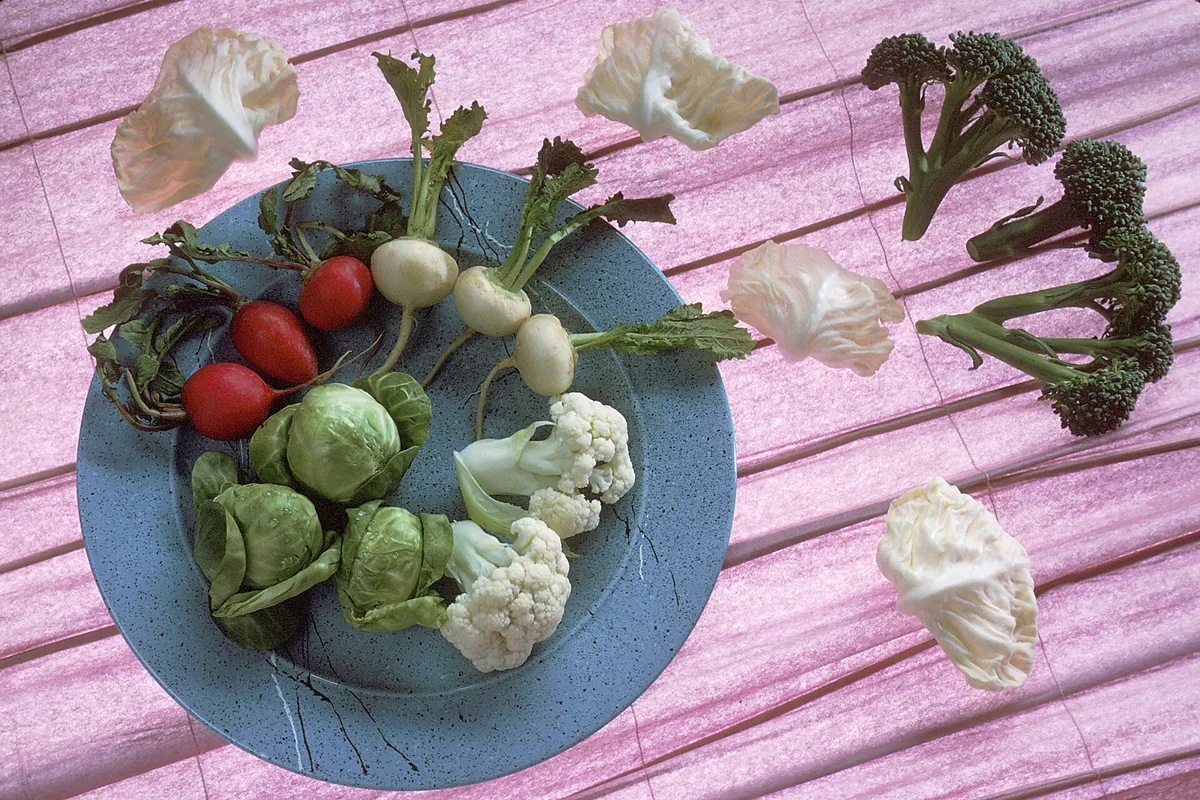
On a blue-gray plate on a pink wood-grain table, red round radishes, small white radishes, green Brussels sprouts, and white cauliflower florets are arranged in a circle, with green broccoli florets and white leaf fragments scattered outside the plate.

One example of Brassicaceae vegetables. Radish, small radishes, Brussels sprouts, and cauliflower with their stems are arranged in a circle on a gray plate, surrounded by broccoli florets and cauliflower and cabbage leaves. The scientific names of the individual items cannot be identified from the photograph.

Shown: Brassicaceae (a mix of several species; radish is the genus Raphanus)Part / state: Radish, small radishes, Brussels sprouts, and cauliflower with their stems arranged in a circle on a plate, with broccoli florets and cauliflower and cabbage leaf fragments scattered around

Photo: Unknown photographer (National Cancer Institute, U.S. government) / Public domain / original image / ledger's original image

Scope and provenance of the photo

Identification: Identified as labelled in the source. The caption of the source (provided by the U.S. National Cancer Institute) reads: "A gray plate with radishes, Brussels sprouts, and cauliflower with their stems arranged in a circle. Cauliflower leaves and broccoli florets on the table". The radish shown (genus Raphanus) belongs to Brassicaceae but not to the genus Brassica, so the photograph is included as a group photograph representing Brassicaceae as a whole and is not regarded as the standard form of the genus Brassica alone.

Image shown: The 1920 px version from Wikimedia Commons. No cropping or color changes by NIGAMI LAB. For display, a WebP capped at 1200 px wide is served; the ledger's original image can be checked from the link above.

On this page (8 sections)
  1. Overview
  2. Sources for this overview (6)
  3. Topic hubs
  4. Follow the connections
  5. Related entries (10)
  6. Composition and content (1)
  7. Sensory (3)
  8. How processing and cooking change it (2)
↑

Reading the bitterness

Cruciferous vegetables include familiar leafy and flower-bud vegetables such as cabbage and broccoli. These vegetables are described as having sulfur-bearing compounds called glucosinolates as a characteristic component. When tissue is damaged, glucosinolates are broken down by enzymatic action, yielding products such as isothiocyanates. Review articles position glucosinolates and isothiocyanates as the causative substances of the characteristic pungent and bitter taste of cruciferous vegetables.

How much glucosinolate remains appears to depend more on the cooking method than on heat treatment itself. In research on broccoli, Brussels sprouts, cauliflower, and green cabbage, steaming, microwaving, and stir-frying showed no significant loss, whereas boiling caused a clear decrease; approximately 90% of the lost amount was detected in the boiling water. When finely chopped and left for 6 hours, as much as 75% loss has been reported. If the amount retained varies this much depending on cooking method, the flavor of raw and cooked forms cannot be described using the same measure.

Two glucosinolates, sinigrin and progoitrin, always correlate with the bitterness of Brussels sprouts themselves, while their relationship with preference is not uniform. Across 4 taste tests conducted between 1989 and 1995, a relationship in which higher combined content was associated with lower preference was observed only when the combined content of these two components exceeded 2.2 g/kg. In tests where content remained below this threshold, no relationship with preference was observed, though the correlation with bitterness continued across the full range of content. High content alone cannot be used as a straightforward measure of preference.

The view that genetic variation in TAS2R38, which influences bitter taste sensitivity, determines preference for cruciferous vegetables has often been discussed in review articles. However, research that has directly tested this view appears to show divided results. In a UK consumer study using rocket, the TAS2R38 genotype was related to bitter perception, but it was reported that it was the pungency of the leaves rather than bitterness that determined acceptance or rejection. In another study using cooked turnip, the TAS2R38 genotype had no significant effect on preference. A systematic review of bitter taste sensitivity and vegetable and legume consumption overall also found the association to be reported as very weak and not statistically significant. The simple scheme that people with stronger bitter perception avoid cruciferous vegetables is not supported, at least by these tests.

Sources for this overview

  1. Bitter taste of Brassica vegetables: The role of genetic factors, receptors, isothiocyanates, glucosinolates, and flavor context

    Wieczorek MN; Walczak M; Skrzypczak-Zielinska M; Jelen HH / 2018 / review / abstract checked

    Checked for this overview: Confirmed the framework in review articles that positions glucosinolates and isothiocyanates as the cause of bitterness.

  2. Effect of storage, processing and cooking on glucosinolate content of Brassica vegetables

    Song L; Thornalley PJ / 2007 / journal article / abstract checked

    Checked for this overview: Confirmed numerical values of glucosinolate retention and loss by cooking method.

  3. The glucosinolates sinigrin and progoitrin are important determinants for taste preference and bitterness of Brussels sprouts

    van Doorn HE; van der Kruk GC; van Holst GJ; Raaijmakers-Ruijs NCME; Postma E; Groeneweg B; Jongen WHF / 1998 / journal article / abstract checked

    Checked for this overview: Confirmed the relationship between content and preference/bitterness at the 2.2 g/kg threshold.

  4. The influence of phytochemical composition and resulting sensory attributes on preference for salad rocket (Eruca sativa) accessions by consumers of varying TAS2R38 diplotype

    Bell L; Methven L; Wagstaff C / 2017 / journal article / full text checked

    Checked for this overview: Confirmed that TAS2R38 genotype was not the primary factor in acceptance or rejection in rocket.

  5. Consumer Liking of Turnip Cooked by Different Methods: The Influence of Sensory Profile and Consumer Bitter Taste Genotype

    Nor NDM; Mullick H; Zhou X; Oloyede O; Houston-Price C; Harvey K; Methven L / 2023 / journal article / full text checked

    Checked for this overview: Confirmed that TAS2R38 genotype did not produce a significant effect on preference in cooked turnip.

  6. Bitter taste sensitivity is minimally associated with adult food preferences and intake, with a negative association to carbohydrate consumption: A systematic review and meta-analysis

    Shareef A; Irwin C; Vincze L; Rigby R; Jani R / 2026 / review / full text checked

    Checked for this overview: Confirmed a meta-analysis result showing weak association between bitter taste sensitivity and vegetable consumption.

Follow the connections

Brassica vegetables →contains→ glucosinolates →are not uniformly→ bitterness

Brassica vegetables →can generate→ isothiocyanates →can elicit→ pungency

sinigrin →reduces taste preference for→ Brassica vegetables

Structured claims — open a section to read each claim's confidence, evidence and limits

Composition and content (1)

Brassica vegetables contains glucosinolatessupported

Scope: Brassicaceae vegetables

Note: Individual glucosinolate profiles vary by crop and processing. / 2026-08-31: Calibrated down from established to supported because the supporting evidence has not been confirmed via full text. Can be re-upgraded once the full text is confirmed.

This review identifies glucosinolates as a characteristic component of Brassicaceae involved in taste and flavor.
Limitations: Profiles vary by crop.
Source: Taste and Flavor Perceptions of Glucosinolates, Isothiocyanates, and Related Compounds (Bell L; Oloyede OO; Lignou S; Wagstaff C; Methven L, 2018) · abstract checked
The content of 7 major glucosinolates was quantified by LC-MS/MS in broccoli, Brussels sprouts, cauliflower, and green cabbage, directly demonstrating that glucosinolates are a constituent of these Brassica vegetables.
Limitations: 4 vegetables. Because content varies with storage and processing, a single value does not characterize a crop. The abstract was reread via efetch on 2026-08-30.
Show dataingredient-brassica —contains→ compound-glucosinolates
claim: clm-brassica-glucosinolates / type: composition / updated: 2026-08-31

Sensory (3)

sinigrin reduces taste preference for Brassica vegetablessupported

Scope: Brussels sprout cultivars across 4 taste tests conducted from 1989 to 1995. 2 consumer panels and 1 analytical panel

Note: Not a monotonic relationship, but a threshold-dependent, conditional one. Below 2.2 g/kg, bitterness and preference diverge, which is a caution against treating glucosinolate content as a proxy for preference in the low-concentration range.

When the combined content of sinigrin and progoitrin exceeded 2.2 g/kg, both correlated negatively with taste preference for Brussels sprouts; under this condition, overall preference across Brussels sprout cultivars was explained by the content of these 2 glucosinolates to the extent of 64% (Novartis Seeds BV) and 86% (TNO) in 2 different trial designs. In 2 additional trials where the combined content across all cultivars was below 2.2 g/kg, no relationship was observed between taste preference and the content of either glucosinolate, but bitterness continued to correlate with both glucosinolates across the whole content range examined.
Limitations: Abstract-level only. The number of consumer panel members is not stated. The 2.2 g/kg threshold is reported as an empirical breakpoint across trials rather than a fitted parameter, and because the trials differ in design and year of execution, the threshold is confounded with trial identity.
Source: The glucosinolates sinigrin and progoitrin are important determinants for taste preference and bitterness of Brussels sprouts (van Doorn HE; van der Kruk GC; van Holst GJ; Raaijmakers-Ruijs NCME; Postma E; Groeneweg B; Jongen WHF, 1998) · abstract checked
15 years before the 1998 study, the source already reports that the bitterness of a specific Brussels sprout cultivar was shown to be linked to the presence of the glucosinolates sinigrin and progoitrin; sinigrin is itself bitter, while progoitrin's bitterness comes from its breakdown product, the goitrogen (-)-5-vinyloxazolidine-2-thione, and a cultivar-screening method for latent bitterness is also described.
Limitations: Supports only the bitterness axis; consumer preference and the 2.2 g/kg breakpoint from van Doorn 1998 are not addressed. The abstract was reconstructed from OpenAlex (a single pathway).
Show datacompound-sinigrin —reduces_taste_preference_for→ ingredient-brassica
claim: clm-sinigrin-progoitrin-sprout-preference / type: sensory / updated: 2026-08-30
TAS2R38 determines the acceptance of Brassica vegetablescontested

Scope: Consumer liking and acceptance of Brassica vegetables as a function of TAS2R38 diplotype

Note: This review-level framing was directly tested in 2 UK consumer studies and was not supported: the genotype effect on perceived bitterness does not carry through to liking. For rocket, the main basis for acceptance was not bitterness but perceived hotness (pungency).

Contradicts: The authors conclude that the hypothesis that all consumers reject bitter cultivars is not fully supported by the data presented, and the same holds even accounting for human TAS2R38 diplotype; the main basis for acceptance/rejection seems in fact to relate more to the leaves' perceived hotness than to bitterness. The effect of consumer genotype on taste preference was significant in sum-of-squares ANOVA (P < 0.004), but the pairwise comparison scores accounting for interaction with sample were not significant. An effect of TAS2R38 diplotype on liking was observed, but this classification alone was not an accurate predictor of whether an individual would like or dislike Brassica-type vegetables. Diplotype frequency did not differ significantly between the discriminating cluster and the indifferent cluster (C1 P = 0.918; C2 P = 0.564; between clusters P = 0.919). The correlation between taste preference and bitterness perception across the whole cohort was significant but weak (r = -0.227, P < 0.0001).
Limitations: Rocket is a Brassica but not Brassica oleracea, so extension to cabbage-type crops is an inference. The genotype's main effect is significant in the omnibus test and fails only in pairwise comparisons, so this is a failure to localize the effect rather than a demonstrated null. The correlation between bitterness and liking is weak but in the expected negative direction.
Contradicts: Although TAS2R38 genotype had a significant effect on bitterness perception, this bitterness genotype had no significant effect on either taste liking (F(2,70) = 0.99, p = 0.38) or overall liking (F(2,70) = 1.05, p = 0.35) of cooked turnip, and the interaction between cooking method and TAS2R38 was not significant for either taste liking (F(6,210) = 0.77, p = 0.59) or overall liking (F(6,210) = 1.38, p = 0.23). The ratio of tasters to non-tasters was similar across all 3 liking clusters (63/37, 67/33, 67/33 percent), and the authors concluded that the separation of these clusters was not driven by bitterness genotype.
Limitations: This is a null result in a sample of 74 with 3 genotype groups, and the authors themselves explicitly note that it is small and UK-limited. The absence of a significant effect is not evidence of the absence of an effect. Even combining bitterness and sweetness perception explains only 15.7% of the variance in taste liking (adjusted R2 = 0.157), and most of the variance in liking is explained by neither taste attribute.
Source: Consumer Liking of Turnip Cooked by Different Methods: The Influence of Sensory Profile and Consumer Bitter Taste Genotype (Nor NDM; Mullick H; Zhou X; Oloyede O; Houston-Price C; Harvey K; Methven L, 2023) · full text checked
Context: This review states that the main sensory attributes involved in these vegetables are a characteristic sharp bitterness and a distinctive aroma, that these characteristics often lead consumers to reject this group of vegetables, and that because some people do not perceive the unpleasant sensation, individual variation in bitterness perception and sensitivity may plausibly be involved.
Limitations: Abstract-level and narrative. Included only to record the framing that the primary consumer studies go on to test; it reports no quantitative association between genotype and acceptance, and is not treated as support for this claim.
Source: Bitter taste of Brassica vegetables: The role of genetic factors, receptors, isothiocyanates, glucosinolates, and flavor context (Wieczorek MN; Walczak M; Skrzypczak-Zielinska M; Jelen HH, 2018) · abstract checked
Limits: In adults (17 years and older), pooled associations of bitter sensitivity (PROP or PTC phenotype, TAS2R38 genotype and others) with liking and intake of vegetables and legumes were small and non-significant (36 of the 72 included studies were meta-analysed; liking 7 studies, dz=−0.02; intake 17 studies, dz=−0.10). The authors conclude that bitter sensitivity explains little of the variation in adults' diets.
Limitations: Vegetables and legumes are broader than brassicas, so this does not directly test the claim that bitter-sensitive people eat fewer brassicas (it limits the claim rather than refuting it). Studies of people aged 17 and over were included.
Show datareceptor-tas2r38 —determines_acceptance_of→ ingredient-brassica
claim: clm-tas2r38-drives-brassica-rejection / type: sensory / updated: 2026-08-30
bitterness determines the acceptance of Brassica vegetablessupported

Scope: A narrative review of consumer research (bitterness acceptance in EVOO and Brassicaceae)

Note: The review states that “although bitter taste is a general driver of dislike,” and for Brassica vegetables specifically, that “consumers generally prefer such vegetables cooked as they are less bitter and pungent.” As an industry response, it cites “the elimination of bitter substances from vegetables ... and the use of sweet masking substances.” This is a minimal addition to the 『産業は苦味を抜く』 (in translation: "industry removes bitterness") side, connecting to existing assets on Brassica breeding and acquired liking.

Bitterness is a general driver of food dislike, and for Brassica vegetables, consumers prefer a cooked state with less bitterness and pungency. As an industry response, both the removal of bitter substances from vegetables and the use of sweetness-based masking substances have been employed.
Limitations: The review itself carries no original experimental data. The methodological quality of the individual cited studies was not traced back individually in this survey.
Show datasensation-bitter —determines_acceptance_of→ ingredient-brassica
claim: clm-h10-cavallo-bitterness-drives-vegetable-dislike / type: sensory / updated: 2026-09-02

How processing and cooking change it (2)

Brassica vegetables has its flavor affected by Cooking conditions, enzyme stability, and glucosinolate hydrolysis productssupported

Scope: Brassicaceae foods

Note: Raw and cooked forms must not be merged into a single sensory record.

Cooking alters glucosinolate hydrolysis and the formation and release of sulfides. The review recommends interpretation by compound and by process step.
Limitations: A single processing direction does not apply to every food.
Source: Taste and Flavor Perceptions of Glucosinolates, Isothiocyanates, and Related Compounds (Bell L; Oloyede OO; Lignou S; Wagstaff C; Methven L, 2018) · abstract checked
Cooking method strongly determined the fate of glucosinolates: steaming, microwaving, and stir-frying produced no significant loss, whereas boiling showed significant loss through leaching, with about 90% of the lost glucosinolates detected in the boiling water; when finely chopped, content fell by up to 75% after 6 hours of standing.
Limitations: Compositional evidence only; the sensory consequences of hydrolysis products were not measured in this study. The abstract was reread via efetch on 2026-08-30.
Show dataingredient-brassica —has_flavor_affected_by→ (the claim sentence above)
claim: clm-brassica-processing / type: processing / updated: 2026-08-30
Brassica vegetables can generate isothiocyanatessupported

Scope: Glucosinolate hydrolysis in raw or processed Brassicaceae

Note: Enzyme stability and cooking change the product profile. / 2026-08-31: Calibrated down from established to supported because the supporting evidence has not been confirmed via full text. Can be re-upgraded once the full text is confirmed.

This review describes isothiocyanates as a hydrolysis product of glucosinolates, whose formation is affected by cooking and enzyme stability.
Limitations: Not all glucosinolates yield the same sensorially active products.
Source: Taste and Flavor Perceptions of Glucosinolates, Isothiocyanates, and Related Compounds (Bell L; Oloyede OO; Lignou S; Wagstaff C; Methven L, 2018) · abstract checked
After fine shredding, the source states verbatim that 'Glucosinolate losses were detected partly as isothiocyanates' (quantified by LC-MS/MS as thiourea derivatives), directly demonstrating isothiocyanate formation from glucosinolate hydrolysis following tissue disruption.
Limitations: The abstract does not give the proportion of the loss that appeared as isothiocyanates. The abstract was reread via efetch on 2026-08-30.
The review frames isothiocyanates as hydrolysis products of glucosinolates in Brassica vegetables, discusses their role alongside glucosinolates as compounds responsible for the characteristic pungent, bitter taste, and situates isothiocyanates within the broader flavor context of these vegetables.
Limitations: Abstract level. Compound-specific hydrolysis conditions and sensory attribution are in the full text, which was inaccessible.
Source: Bitter taste of Brassica vegetables: The role of genetic factors, receptors, isothiocyanates, glucosinolates, and flavor context (Wieczorek MN; Walczak M; Skrzypczak-Zielinska M; Jelen HH, 2018) · abstract checked
Show dataingredient-brassica —can_generate→ compound-isothiocyanates
claim: clm-brassica-isothiocyanates / type: processing / updated: 2026-08-31

↑ Top of page · ← Encyclopedia (English entries)