niga-uruka (bitter uruka, ayu entrails)
dish / dish-niga-uruka
にがうるか
Niga-uruka (bitter uruka, ayu entrails) is a type of ayu uruka made only from ayu viscera. In places including Minamiamabe District, Oita, it is called (niga-uruka) and is described as having the bitterness and astringency characteristic of viscera. Related names, such as (shibu-uruka) and (doro-uruka), reflect differences in how the viscera are prepared and when they are collected.
Photographs (captions in Japanese)
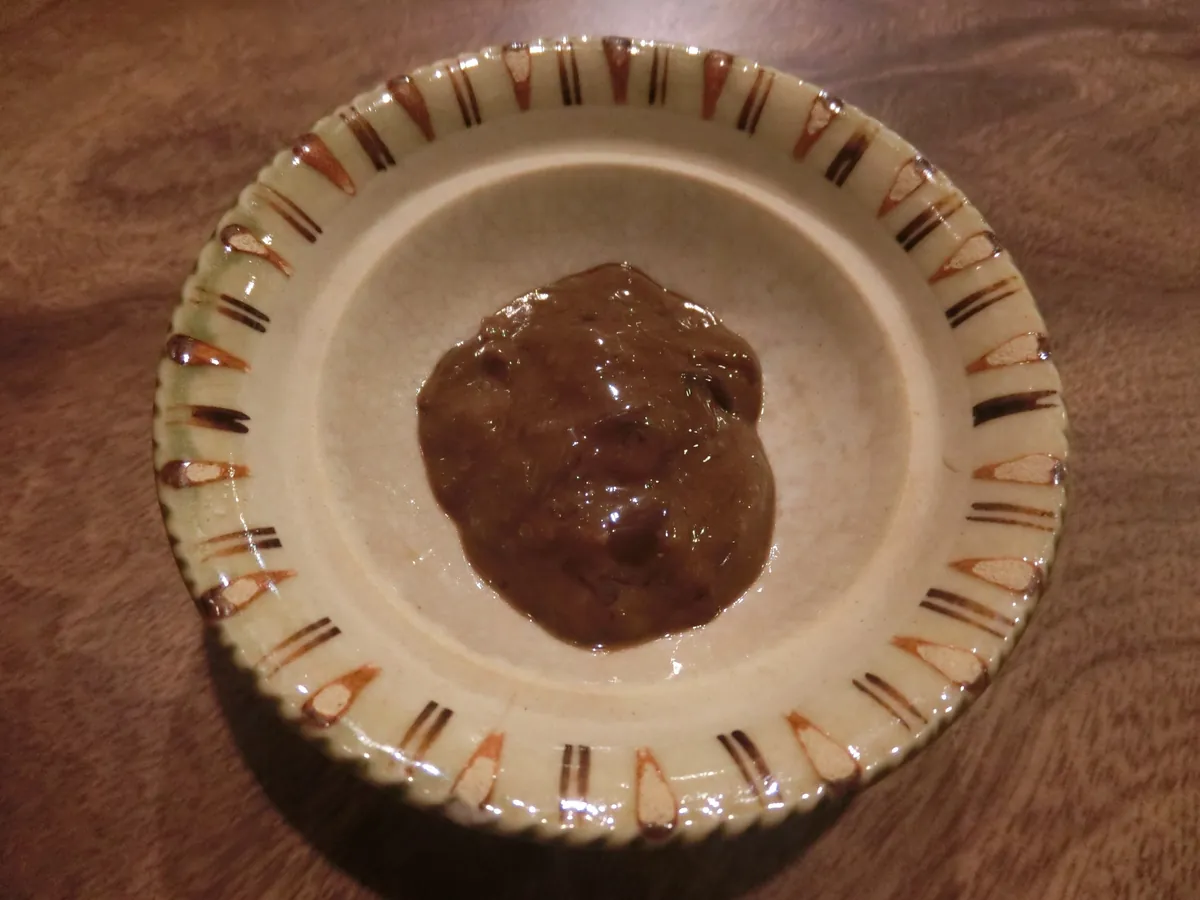
"Shibu-uruka" (a type made only from ayu innards) made in Gujo City, Gifu Prefecture. Recorded as written in the file description, "渋うるか".
DishShown: Not applicable (dish)Part / state: Serving (small dish)
Photo: 大野一将 / CC BY-SA 4.0 / original image / ledger's original image
Scope and provenance of the photo
Identification: Identified as labelled in the source.
Image shown: Resized by NIGAMI LAB to 2400 px on the long side with sips (the original is 4608x3456 px). No trimming or color changes. For display, a WebP capped at 1200 px wide is served; the ledger's original image can be checked from the link above.
On this page (9 sections)
Reading the bitterness
Niga-uruka names a type of ayu uruka made solely from ayu viscera. A product description from Minamiamabe District, Oita, defines it as 『にがうるか…鮎の内臓のみをうるかにしたもの』 (in translation: "niga-uruka... uruka made only from ayu viscera"). It is distinguished by the part used from other types of uruka that also include flesh, eggs, or milt.
Official material on Oita regional cuisine says that in Oita, 「うるか」 (uruka) often refers to 「にがうるか」 (niga-uruka), and explicitly states that only ayu viscera are used. However, this account comes from one prefectural-level source and does not cover details of similarly named niga-uruka varieties in other regions.
The dish is described as having a distinctive bitterness and astringency arising from its use of viscera. Oita regional-cuisine material says 『内臓を使っていることもあり、「にがうるか」の独特な苦味、渋味を好む人も多い』 (in translation: "Because it uses viscera, many people also enjoy the distinctive bitterness and astringency of niga-uruka"). This is a statement of preference in an introductory text, not an assessment of intensity by sensory testing.
Another study homogenized the viscera taken from 20 frozen ayu and divided the material into 1 storage control group at −80 °C and 4 groups held at 30 °C for 7 days. The 4 groups included a condition combining 12% salt with 100 MPa pressurization, among others. From changes in microbial counts and composition, the authors interpreted the fermentation of the laboratory uruka as due to endogenous enzymes rather than microorganisms. This was not an experiment that measured the bitterness of commercial niga-uruka.
Sources for this overview
Checked for this overview: Checked the viscera-only definition in the Minamiamabe District product description.
Checked for this overview: Checked the naming practice for niga-uruka in Oita regional-cuisine material. / Checked the statement that many people like its bitterness and astringency.
Enzymatic fermentation of Uruka under hydrostatic pressure conditions
Checked for this overview: Viscera from 20 fish, 1 storage control group at −80 °C, the 4 groups held at 30 °C for 7 days, the 12% salt and 100 MPa combination, and the authors' mechanistic interpretation and the limitation of unmeasured bitterness
Other names: 渋うるか (ja, identification medium), しぶうるか (ja, identification medium), どろうるか (ja, identification medium)
Follow the connections
niga-uruka (bitter uruka, ayu entrails) →is a form of→ uruka (salted, fermented ayu entrails)
Structured claims — open a section to read each claim's confidence, evidence and limits
Composition and content (1)
Scope: Uruka of Oita Prefecture (a local-dish source from Oita) and a nationwide product survey (a 1996 paper)
Show data
dish-niga-uruka —is_a_form_of→ dish-urukaSensory (1)
Scope: Oita Prefecture's ayu uruka ("Uchi no Kyodo Ryori," Ministry of Agriculture, Forestry and Fisheries)
Note: Not an intensity rating from a sensory test, but a statement of preference within an introductory text.
Show data
dish-niga-uruka —has_perceived_bitterness_associated_with→ (the claim sentence above)How processing and cooking change it (1)
Scope: Laboratory viscera uruka from Jang and Iwahashi 2024. 1 storage control group at −80 °C and 4 groups held at 30 °C for 7 days.
Note: This is the authors' conclusion under their experimental conditions. The samples were not made as commercial 「にがうるか」 (niga-uruka), and this is not generalized to all traditional production methods. Bitterness was not measured.
Show data
dish-niga-uruka —was_observed_with→ (the claim sentence above)