Tom Khom
dish / dish-tom-khom
トムコム
Tom Khom is a group of northern Thai and highland dishes that share a name associated with bitterness. Their ingredients and cultural contexts may differ.
Photographs (captions in Japanese)
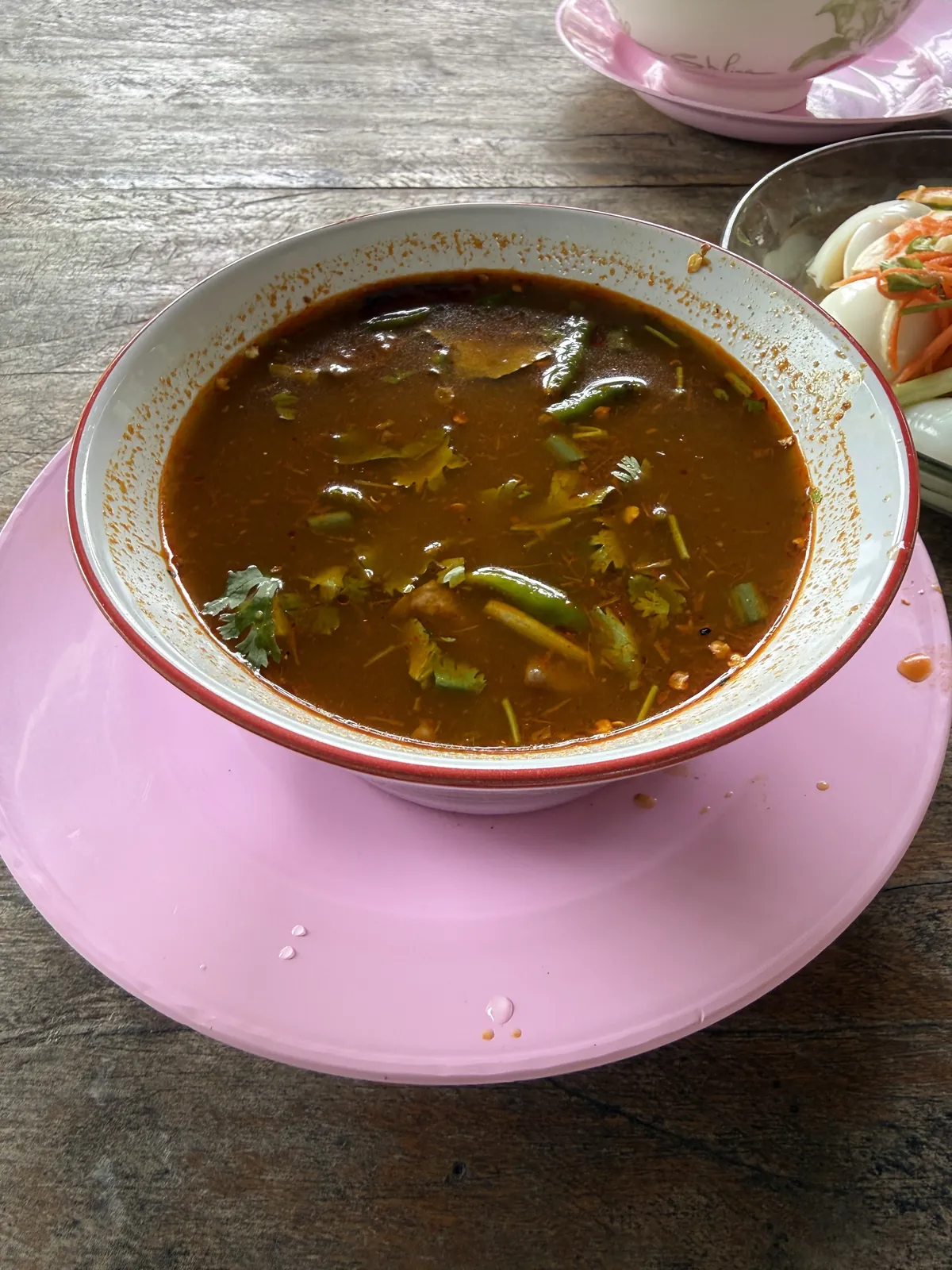
A bowl served as "ต้มขม (tom khom)" at a restaurant in Thailand that specializes in larb. Green chili peppers, cilantro, lemongrass fibers, and pieces of meat float in a dark brown soup. It is one example of a standard dish printed in the recommended section of the menu and does not show the standard form of tom khom as a whole.
DishShown: No applicable taxon (a served bowl of tom khom)Part / state: A bowl as served (from above)
Photo: 苦味研究所(NIGAMI LAB) / CC BY 4.0 / original image / ledger's original image
Scope and provenance of the photo
Identification: Provisional identification in the field. Photographed by the site operator, a record of a single meal. In the restaurant's menu, ต้มขม was printed in the recommended section of a larb specialty restaurant. By the operator's recollection, it was a bowl made with beef bile, at a restaurant in a hot-spring town in the mountains of Chiang Mai (confirmed by the person on 2026-09-16, consistent with the description on the about page).
Image shown: Rotated 90 degrees clockwise from the photographer's original, and nothing else. No cropping or color changes. The EXIF data contains no camera equipment or location information. Because the EXIF orientation tag (6) remained after rotation, the tag was corrected to 1 on 2026-09-04 (pixels unchanged; the image had been rotated twice on the display side). For display, a WebP capped at 1200 px wide is served; the ledger's original image can be checked from the link above.
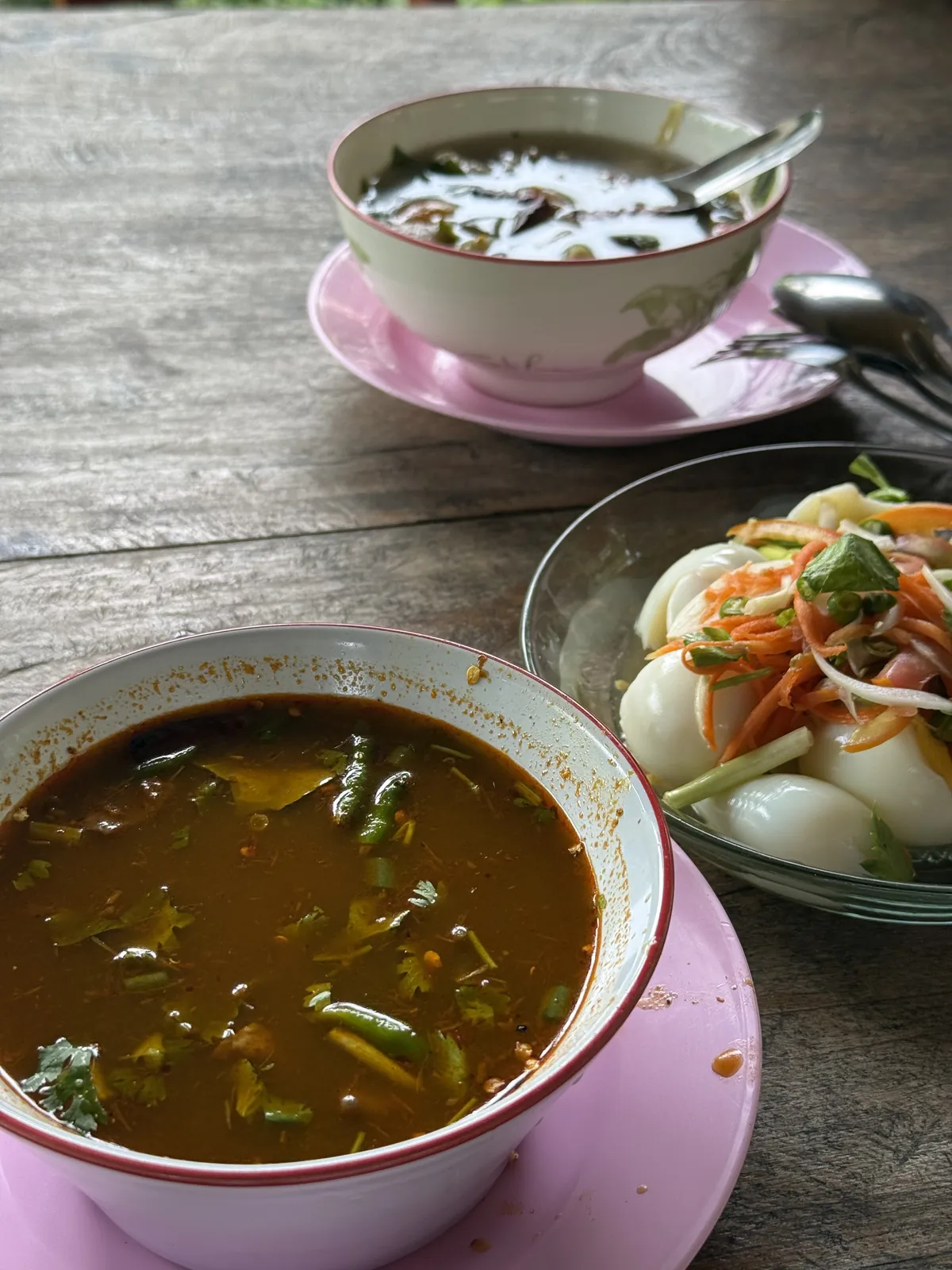
The table where tom khom was served. In front is the tom khom, behind it a white bowl of a coconut-milk-based dish, and on the right a yam of eggs boiled in mineral water (menu name: ยำไข่ต้มน้ำแร่). It is a record of the arrangement of one meal and does not show a fixed combination.
Field observationShown: No applicable taxon (a served bowl of tom khom)Part / state: Context of serving at the table
Photo: 苦味研究所(NIGAMI LAB) / CC BY 4.0 / original image / ledger's original image
Scope and provenance of the photo
Identification: Provisional identification in the field. Photographed by the site operator, a record of a single meal. In the restaurant's menu, ต้มขม was printed in the recommended section of a larb specialty restaurant. By the operator's recollection, it was a bowl made with beef bile, at a restaurant in a hot-spring town in the mountains of Chiang Mai (confirmed by the person on 2026-09-16, consistent with the description on the about page).
Image shown: Rotated 90 degrees clockwise from the photographer's original, and nothing else. No cropping or color changes. The EXIF data contains no camera equipment or location information. Because the EXIF orientation tag (6) remained after rotation, the tag was corrected to 1 on 2026-09-04 (pixels unchanged; the image had been rotated twice on the display side). For display, a WebP capped at 1200 px wide is served; the ledger's original image can be checked from the link above.
On this page (8 sections)
Reading the bitterness
Tom Khom (ต้มขม) is a group of dishes whose Thai name means 「苦いスープ」 (in translation: "bitter soup"). A record from a Thai cultural program dated 1 October 2015 (2015/10/1; Buddhist Era 2558) features the Tom Khom of the Lisu people. It presents the dish as a soup centered on bitterness, with the locally gathered forest plant di-ngu-wa (ดีงูหว้า, whose scientific species identification has not been confirmed) as its main ingredient. However, this is an account from a single cultural media source. It does not locate the dish at the village or province level, nor does it establish a composition shared by every dish with the same name.
The same record places this Tom Khom in celebratory rituals, including a ceremony to call back the soul, as a symbol of health and strength. It also explicitly presents the dish as Lisu food. However, this remains an account from a single cultural media source, without independent support from an ethnographic study. This source alone cannot determine how far dishes called Tom Khom share ingredients or intensity of bitterness across regions and cooks.
Sources for this overview
Checked for this overview: Checked that the dish was introduced as a soup with bitterness as its theme. / Checked the description that the plant di-ngu-wa is treated as the main ingredient. / Checked the dish's place in auspicious rituals, including soul-calling. / Checked that it was presented as Lisu food.
Other names: ต้มขม (th), tom khom (th-Latn)
Follow the connections
Tom Khom →includes→ dee ngu wa
Tom Khom →is documented in→ Lisu
Tom Khom →is documented in→ Northern Thailand
Tom Khom →has a defining sensory theme→ bitterness →can be measured separately …→ astringency
Hypotheses and recipe candidates for this entry are on the Japanese page.
Structured claims — open a section to read each claim's confidence, evidence and limits
How processing and cooking change it (2)
Scope: The Isan dish 「ต้มขมไส้อ่อน」 (in translation: "bitter soup with pig small intestine"). One entry from a user-submitted recipe site (Wongnai)
Show data
dish-tom-khom —includes→ seasoning-khi-phiaScope: One individually submitted recipe on the Thai recipe-sharing site Cookpad.
Note: This recipe is another example of the Tom Khom offal-and-khi-phia type, differing in its use of beef from ต้มขมไส้อ่อน, in the existing wave24-larb-khom track, which uses pork small intestine and น้ำเพี้ย. It is only one user-submitted recipe and does not specify a region (northern Thailand or Isan). It adds one more example with a different animal species in support of the hypothesis of an 「内臓・เพี้ย型ต้มขม」 (in translation: "offal-and-phia type of Tom Khom") left open in docs/tomkhom-research-dossier.md §3.3.
Show data
dish-tom-khom —includes→ (the claim sentence above)Culture (5)
Scope: A Lisu variant of Tom Khom recorded in a Thai Health media report
Note: The herb's scientific identification remains unresolved, and this recipe should not be generalized to all Tom Khom.
Show data
dish-tom-khom —includes→ organism-dee-ngu-waScope: A single cultural media record.
Note: Independent ethnographic corroboration is needed before broad publication.
Show data
dish-tom-khom —is_consumed_in→ (the claim sentence above)Scope: A recipe variant presented in one Thai cultural-media record
Note: Do not infer that every Tom Khom belongs to the Lisu.
Show data
dish-tom-khom —is_documented_in→ culture-lisuScope: A media record of a highland community in northern Thailand.
Note: This record does not establish a detailed location at the village or province level. External audit N3 (2026-10-20): the program's description does not mention the northern highlands (the video was not watched), and no location for this evidence can be given, so the evidence was reclassified as contextual and the statement was removed from the description.
Show data
dish-tom-khom —is_documented_in→ region-northern-thailandScope: The recorded Lisu dish name and preparation are presented explicitly as Tom Khom, that is, a bitter soup
Note: Even recipes sharing the same name can differ in bittering ingredient and intensity.
Show data
dish-tom-khom —has_defining_sensory_theme→ sensation-bitter