bitter-leaf soup
dish / dish-bitterleaf-soup
ビターリーフスープ
Bitter-leaf soup is a soup widely eaten in Nigeria. It uses leaves of Vernonia amygdalina, whose bitterness has been reduced to a preferred level by kneading and washing or by boiling and discarding the water, as a vegetable and flavoring.
Photographs (captions in Japanese)
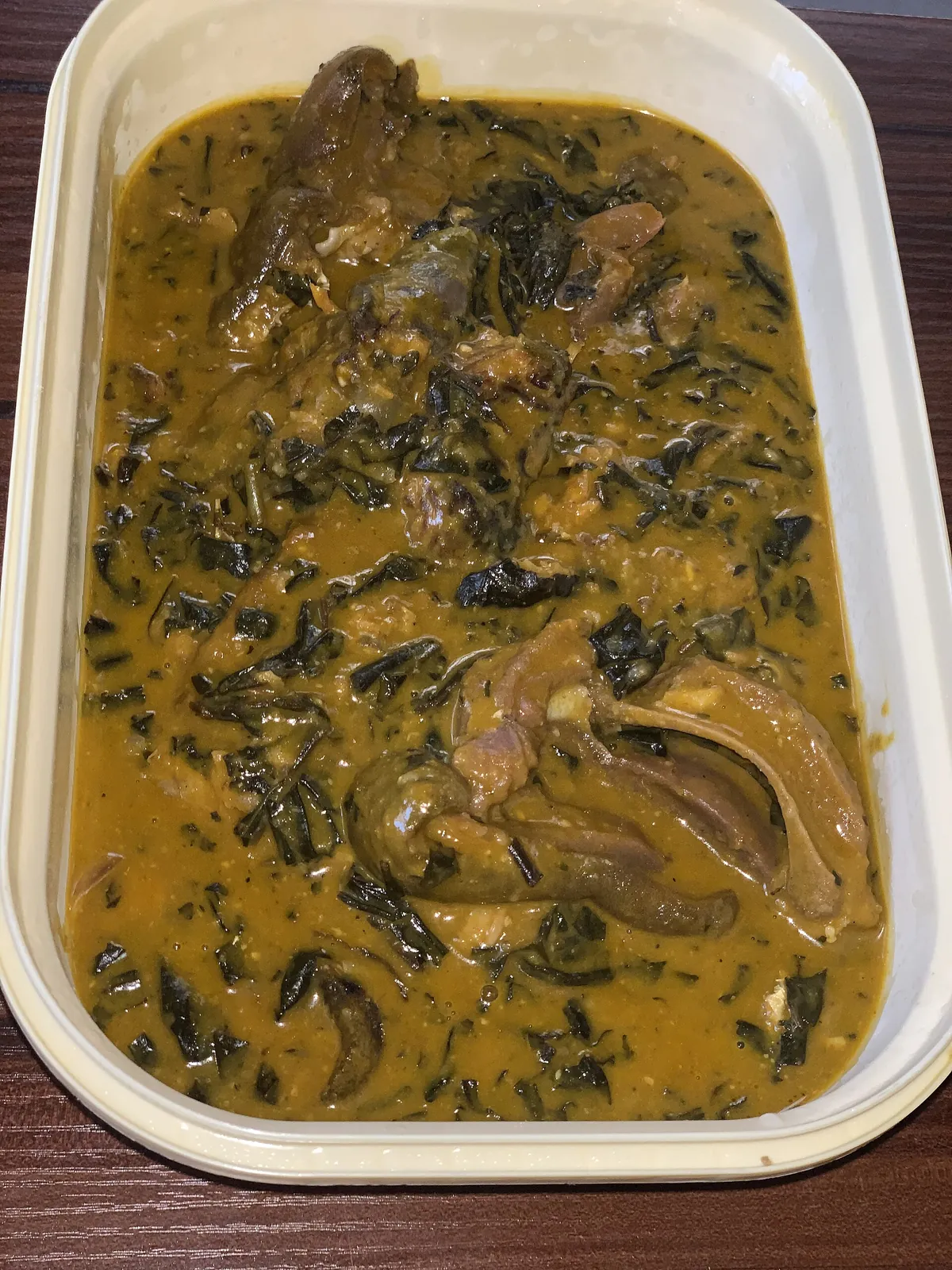
Bitterleaf soup (Ofe Onugbu). One Nigerian example in which chopped bitter leafy greens are made into a thick palm-oil-based soup with meat. The serving style and ingredients differ by household and region.
DishShown: Vernonia amygdalina (the source describes it as Ofe Onugbu = bitterleaf soup)Part / state: A thick, palm-oil-based soup of chopped bitterleaf (such as Vernonia amygdalina) simmered with meat. Served in a container
Photo: Edriiic / CC BY-SA 4.0 / original image / ledger's original image
Scope and provenance of the photo
Identification: Identified as labelled in the source. The source caption says only "Bitter leaf soup". The leaf species used (such as Vernonia amygdalina) has not been re-identified. It is one example of home cooking and not the standard form in the region.
Image shown: The 1920 px version from Wikimedia Commons. No cropping or color changes by NIGAMI LAB. For display, a WebP capped at 1200 px wide is served; the ledger's original image can be checked from the link above.
On this page (7 sections)
Reading the bitterness
Bitter-leaf soup uses the leaves of bitter leaf (Vernonia amygdalina), a shrub in the daisy family, as a green vegetable or a flavoring in Nigeria. A 2011 review explicitly states that the leaves are used in Nigerian soups as a green vegetable or spice, particularly as an ingredient in the popular bitter-leaf soup. Because fresh leaves are strongly bitter, they undergo preparation such as kneading and washing before being used in cooking.
In Igbo communities in southeastern Nigeria, soup made with these leaves is also called Onugbu soup and is documented as part of the regional food system. The introductory background of a 2023 food chemistry paper says that this indigenous vegetable soup is eaten not only as an everyday meal but also on special occasions such as weddings, funerals, child dedications, and title-taking ceremonies. However, this account is not an ethnographic study of the culture itself, and it gives no counts of observations for each occasion. It needs to be read as an outline of regional cuisine given as background to a food chemistry paper.
Sources for this overview
Antioxidative and Chemopreventive Properties of Vernonia amygdalina and Garcinia biflavonoid
Checked for this overview: Checked the review's explicit statement that the leaves are used in Nigeria as a green vegetable or spice and as an ingredient in bitter-leaf soup.
Checked for this overview: Checked the background account identifying Onugbu soup as part of the Igbo regional food system. / Checked the background account stating that the soup is eaten at everyday meals and at weddings, funerals, child dedications, and title-taking ceremonies.
Follow the connections
bitter-leaf soup →contains→ bitter leaf →— sensory attribute→ bitterness
bitter-leaf soup →is documented as part of→ Igbo traditional food system
Structured claims — open a section to read each claim's confidence, evidence and limits
How processing and cooking change it (1)
Scope: Nigeria
Show data
dish-bitterleaf-soup —contains→ organism-vernonia-amygdalinaCulture (2)
Scope: The culinary system of southeastern Nigeria
Note: Recorded as onugbu soup.
Show data
dish-bitterleaf-soup —is_documented_as_part_of→ culture-igboScope: Regional food background in the introduction to a 2023 food chemistry paper.
Note: This cultural account was not based on an ethnographic study undertaken specifically to investigate it.
Show data
dish-bitterleaf-soup —is_consumed_in→ (the claim sentence above)