Hydrophobic oligopeptides liberated by proteolysis of food proteins (casein, soy protein, etc.) during fermentation, cheese maturation, or enzymatic protein hydrolysis. Many exhibit bitterness.
Photographs (captions in Japanese)
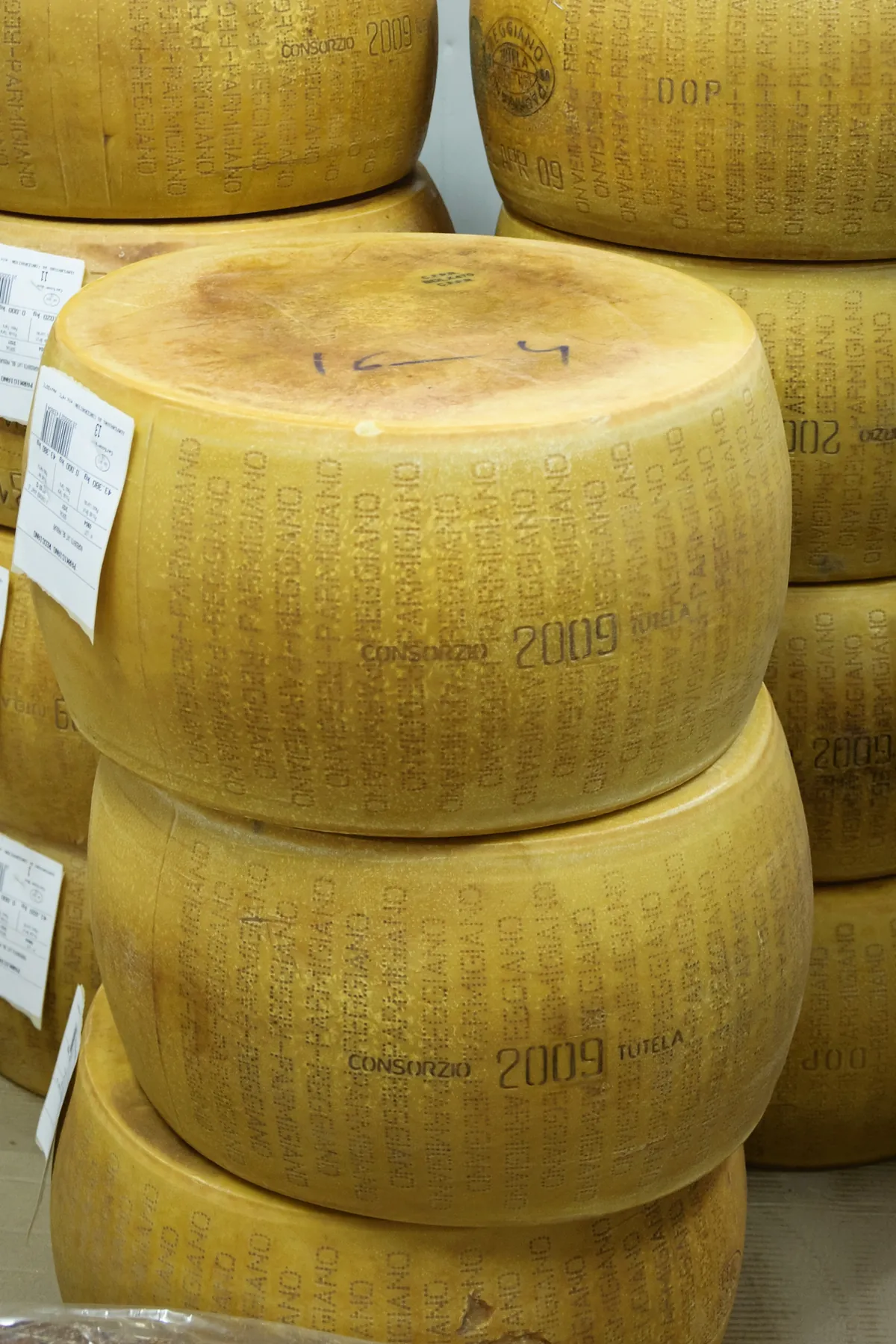
An aged wheel of Parmigiano-Reggiano cheese. Bitter peptides are known to arise in aged cheese through the breakdown of proteins such as casein, and this photograph was adopted as a representative example of the formation process and the food, not of the compounds themselves.
Raw materialShown: Not applicable (fermented and aged cheese)Part / state: Wheel of aged cheese
Identification: Identified as labelled in the source. A different file from the photograph used for ingredient-cheese (to avoid duplication).
Image shown: The full-size file from Wikimedia Commons. No cropping or color changes by NIGAMI LAB. For display, a WebP capped at 1200 px wide is served; the ledger's original image can be checked from the link above.
Bitter peptides are small peptides rich in hydrophobic (water-repellent) amino acids generated when food proteins such as casein and soy protein are proteolyzed during cheese maturation or enzymatic protein hydrolysis. From the water-soluble fraction of aged Gouda cheese, 16 bitter peptides have been identified as casein hydrolysates; from aged sharp Cheddar cheese, 5 peptides with strong bitterness have each been identified as casein products. In protein hydrolysis processing, the generation of such low-molecular-weight hydrophobic peptides tends to be the main driver of bitterness, as reviews summarize.
However, the relationship between individual peptide concentration and bitterness intensity is not straightforward. In a study using reduced-fat Cheddar cheese, the correlation between the concentration of a single peptide and the bitterness score from trained panelists was weak; a strong correlation was achieved only when using an index combining 2 peptides. Soy protein hydrolysates also show a bell-shaped change in bitterness relative to molecular weight—when molecular weight falls below a certain point, bitterness actually weakens—constituting an example where the summary 「低分子量ペプチドほど苦い」 (in translation: "lower-molecular-weight peptides are more bitter") does not apply directly. In an experiment reproducing aged Cheddar bitterness by adding multiple β-casein-derived peptides to young cheese, a flavor was created with no significant difference in bitterness intensity from authentic aged cheese; one of these peptides increased substantially during maturation.
As an entry point to the mechanism of bitter perception, experiments using cultured cells showed that bitter dipeptides and tripeptides activated the receptor TAS2R1, whereas flavorless dipeptides elicited no response even at high concentrations. In experiments using the bitter fraction from casein digested with trypsin, multiple TAS2R receptors, particularly TAS2R1 and TAS2R4, responded. However, this fraction is a mixture of structurally diverse peptides, and the authors themselves note that this experiment alone cannot specify which peptide corresponds to which receptor.
Checked for this overview: Confirmed the top 5 peptides by bitterness intensity in Cheddar cheese. / Confirmed experiment reproducing authentic bitterness by adding 5 peptides.
Maehashi K; Matano M; Wang H; Vo LA; Yamamoto Y; Huang L / 2008 / journal article / full text checked
Checked for this overview: Confirmed TAS2R1 activation by bitter dipeptides. / Confirmed TAS2R1 and TAS2R4 responses to casein digest. / Confirmed that peptide-to-receptor correspondence cannot be identified owing to the mixed nature of the fraction.
Entries connected to this one by a claim, by a shared topic hub, or by a short path through the claim data.
Structured claims — open a section to read each claim's confidence, evidence and limits
Composition and content (4)
bitter peptides includes a chymosin-derived member: β-CN f193-209: a chymosin-derived peptide that has been associated with bitterness in cheese. Its concentration was 0.3-1.0 mg/g; the effect of ripening time was significant, but no difference among starters was detected (P>0.5). A combined index with αs1-CN f1-9 has been proposed for predicting the tendency toward bitterness (r=0.84).supported
Scope: Reduced-fat Cheddar cheese (Broadbent 2002). The association with bitterness is cited by that paper from earlier literature.
Note: The association with bitterness itself is cited by Broadbent 2002 from earlier literature (that paper's refs 4 and 28); there is no threshold measurement within this paper itself.
The authors build on earlier literature (refs 4 and 28) associating αS1-CN (f 1-9) and the chymosin-derived peptide β-CN (f 193-209) with bitterness in cheese. The concentration of β-CN f193-209 was 0.3-1.0 mg/g (Table 4, all sampling times); the effect of ripening time was significant (P<0.0001), and no effect of starter was detected (ANOVA P>0.5). An index combining both peptides is proposed as useful for predicting the tendency toward bitterness (r=0.84).
Limitations: This paper itself contains no threshold measurement of β-CN f193-209's bitterness; the association depends on cited references (refs 4 and 28).
The concentration of β-CN f193-209 measured by MALDI-TOF in aged Cheddar correlates with sensory bitterness intensity (r = 0.803 at 180 days, 0.554 at 270 days), supporting the use of this peptide as a quantifiable marker linked to cheese bitterness.
Limitations: Because the correlation weakens the longer ripening continues (0.554 at 270 days), this peptide is a partial marker rather than the sole driver. Extraction at the abstract level.
miso — bitterness is attributed to: bitter peptidespreliminary
Scope: Hatcho miso (soybean miso made using soybean alone)
Note: Ishii (1966) confirmed, through solvent fractionation and sensory testing, that the ether and butanol extracts of Hatcho miso show a strong bitterness (accompanied by an astringent taste), and states 「八丁味噌の苦味は従来からペプチド,アミンのような窒素化合物によるといわれているが,まだ確証はない」 (in translation: "the source states that Hatcho miso's bitterness has traditionally been attributed to nitrogen compounds such as peptides and amines, but there is not yet definitive confirmation"). The chemical isolation and identification of the bitter substance itself had not been completed as of this paper.
Verbatim: 「八丁味噌の苦味は従来からペプチド,アミンのような窒素化合物によるといわれているが,まだ確証はない」 (in translation: "the source states that Hatcho miso's bitterness has traditionally been attributed to nitrogen compounds such as peptides and amines, but there is not yet definitive confirmation"). For the residues and extracts from repeated ether and butanol extraction of Hatcho miso, the strength of bitterness was compared by a two-point preference test with 2 groups of 9 students each, and a significant difference was confirmed (sample A, extracted first, was more bitter).
Limitations: The bitter substance itself was not chemically identified, and the author himself points out the possibility of secondary bitterness enhancement from contact with the extraction solvent. Mackey's report that bitterness is harder to detect when oil is present is also cited, and it is stated that the influence of lipids should be taken into account.
Source: 八丁味噌の苦味について (石井謙二, 1966) · full text checked
Show dataingredient-miso —has_bitterness_attributed_to→ compound-class-bitter-peptides
soy sauce (shoyu) — bitterness is attributed to: bitter peptidescontextual
Scope: Commercial soy sauce (background description in Imamura & Katayama 2017's examination of the validity of sensory-evaluation terms)
Note: In the process of selecting a quantitative indicator for sensory evaluation, Imamura & Katayama (2017) state 「しょうゆの苦味は,isoleucineなどの苦味を呈するアミノ酸やペプチド類に起因すると考えられている」 (in translation: "the source states that soy sauce's bitterness is attributed to bitter-tasting amino acids such as isoleucine, and to peptides"), and analyse, as indicators of bitterness, 9 bitter amino acids (phenylalanine, arginine, isoleucine, valine, leucine, methionine, histidine, tyrosine and lysine) and melanoidins indexed by the colour number. This description is a background explanation based on a prior source cited by the same paper (reference 23, a secondary citation whose original was not checked), and the same paper itself does not newly isolate or identify a bitter peptide.
Context: Verbatim: 「しょうゆの苦味は,isoleucineなどの苦味を呈するアミノ酸やペプチド類に起因すると考えられている」 (in translation: "the source states that soy sauce's bitterness is attributed to bitter-tasting amino acids such as isoleucine, and to peptides"). Following this statement, the same paper analysed, as indicators of bitterness, 9 bitter amino acids (phenylalanine, arginine, isoleucine, valine, leucine, methionine, histidine, tyrosine and lysine) and melanoidins, some of which taste bitter (using the colour number as the indicator).
Limitations: The cited source (reference 23) is a secondary citation; the original was not checked.
bitter peptides is produced through: During maturation of reduced-fat Cheddar cheese with an exopolysaccharide (EPS)-producing Lactococcus lactis subsp. cremoris strain (JFR1), HPLC analysis showed that hydrophobic peptides (described as involved in bitterness) accumulated significantly during storage. In cheese made with a non-mucoid Streptococcus thermophilus adjunct lacking capsule formation (lower moisture content and residual rennet activity), accumulation of these hydrophobic peptides was less.supported
Scope: Reduced-fat Cheddar cheese, HPLC-based peptide profile over time.
Note: The paper's conclusion suggests that 『EPS産生培養は脱苦味株と併用すべき』 (in translation: "EPS-producing cultures should be used together with debitterizing strains"), rather than the paper itself experimentally verifying this combination.
In reduced-fat Cheddar cheese made with EPS-producing strain JFR1, hydrophobic (bitterness-related) peptides accumulated significantly during storage as shown by HPLC analysis. In cheese made with a capsule-forming, non-ropy S. thermophilus adjunct, accumulation was less.
Limitations: No sensory panel rated bitterness intensity; the measure is the amount of hydrophobic peptides by HPLC. JFR1 had the highest share of hydrophobic peptides from day 30 to 180; on day 1 it was 45.8%, lower than the other strains (46.5%, 48.9%), and it fell from 72.7% to 67.3% between days 120 and 180.
cheese — bitterness derives in part from: bitter peptidessupported
Scope: Aged Gouda and aged sharp Cheddar (water-soluble extracts).
Note: The explanatory power of any single peptide alone is limited: in Broadbent 2002, the correlation coefficients between a single peptide's concentration and the bitterness score stayed at 0.56 and 0.58, versus r=0.84 for a combined 2-peptide index (the sum of each concentration divided by its highest value in the data set) (see limits).
A total of 16 bitter peptides were identified from the water-soluble fraction of aged Gouda. All derive from casein proteolysis: 11 are previously unreported β-casein-derived peptides (including 6 derived from β-CN(57-69) and 2 from β-CN(198-206), among others), and 6 are derived from αs1-casein.
Limitations: The abstract does not give sample details such as the cheese's ripening period or origin.
As the compounds responsible for the bitterness of aged sharp Cheddar, the 5 peptides with the highest bitterness intensity (all derived from β-casein) were identified by de novo sequencing.
Limitations: A corrigendum was issued in 2019 (contents not checked). The abstract gives no absolute values for concentration or threshold.
Limits: The correlation coefficients between individual peptide concentration and bitterness score stayed at 0.56 for αs1-CN f1-9 and 0.58 for β-CN f193-209. An index that adds together, for each cheese, the 2 ratios of each peptide's concentration to its highest value in the data set gave r=0.84 (Fig. 3). The authors state that other peptides certainly also contribute to bitterness.
Limitations: A limit on claims that attribute cheese bitterness to a single peptide. The regression is from a reduced-fat model system.
bitter peptides — recognition thresholds: 0.05-6.0 mmol/L (12 synthesized and purified peptides showed clear bitterness). The lowest threshold was 0.05 mmol/L, for the decapeptide YPFPGPIHNS, with a caffeine-like bitterness quality.supported
Scope: Peptides purified from aged Gouda cheese and then synthesized.
Note: The abstract gives neither the threshold-measurement method nor the panel size.
In sensory evaluation of the purified and synthesized peptides, 12 showed clear bitterness, with recognition thresholds of 0.05-6.0 mmol/L. The decapeptide YPFPGPIHNS had a caffeine-like bitterness quality and the lowest threshold, 0.05 mmol/L.
Limitations: The abstract gives neither the panel size nor the threshold-measurement procedure.
Context: Verbatim: 'the synthetic peptides exhibited a bitter taste with threshold values 0.25 and 0.16mM'. The 2 synthesized hydrophobic peptides correspond to bovine β-casein f61-67 (H-Pro-Phe-Pro-Gly-Pro-Ile-Pro-OH) and f60-66, chosen as a common portion of bitter peptides isolated from cheese. In this way, an independent group also places the threshold of casein-derived cheese bitter peptides in the same sub-mM-to-mM range as the Gouda set (0.05-6.0 mmol/L).
Limitations: Because this is a different peptide from the Gouda set (a middle portion of β-casein rather than the C-terminal Gouda-derived decapeptide), what it corroborates is the order of magnitude, not the individual value. The abstract does not give the panel size or the threshold procedure.
Limits: The taste of the synthetic peptides was judged by a panel of 4 people, and the threshold was reported as a ratio relative to caffeine as the reference substance (Rcaf). As the peptide was shortened from the full-length form, the threshold concentration rose monotonically (bitterness weakened).
Limitations: The panel size is small, and this is not an absolute threshold.
bitter peptides reconstitute the bitterness of cheesesupported
Scope: Aged sharp Cheddar versus young mild Cheddar. A taste-reconstitution experiment.
Note: The sequences are as given in the abstract (residue numbers are not written because they are not given in the abstract).
During ripening, GPVRGPFPIIV, YQEPVLGPVRGPFPI, and MPFPKYPVEP increased 28.7-fold, 3.1-fold, and 1.8-fold respectively; APHGKEMPFPKYPVEPF was detected only in sharp Cheddar; and MAPKHKEMPFPKYPVEPF was unchanged. A mild Cheddar model with the 5 peptides added at matched concentrations showed no significant difference in bitterness intensity from real sharp Cheddar. The main contributor was GPVRGPFPIIV.
Limitations: The abstract does not give absolute concentration values or panel details.
In aged Cheddar, the concentration of the β-casein C-terminal bitter peptide β-CN f193-209, quantified by MALDI-TOF, correlated with the bitterness intensity rated by a trained panel: the correlation coefficient was 0.803 at 180 days and 0.554 at 270 days. That is, an independent group has quantitatively linked the β-casein C-terminal peptide to Cheddar bitterness, which is consistent with the results of the reconstitution experiment in which β-casein-derived peptides (including the f193-209 fragment) reconstituted the bitterness of sharp Cheddar.
Limitations: This is only a correlation, and only a single peptide was tracked; the authors attribute the drop in correlation at 270 days to other bitter peptides or masking compounds, which itself constrains attribution to a single peptide. The abstract gives no panel details.
bitter peptides cause the bitterness of protein hydrolysates: The bitterness that frequently occurs with enzymatic hydrolysis of protein is due to the formation of low-molecular-weight peptides mainly composed of hydrophobic amino acids (a review's summary).supported
Scope: Enzymatic food protein hydrolysates.
Note: Not "the lower the molecular weight, the more bitter": the fraction below 1000 Da has the weakest bitterness (Cho 2004, see limits).
The source states that enzymatic hydrolysis of proteins often produces a bitter taste, attributed to the formation of low-molecular-weight peptides composed mainly of hydrophobic amino acids.
Limitations: This is a review abstract; it does not give quantitative boundaries for molecular weight range or hydrophobicity.
Limits: Bitterness is nonmonotonic with respect to molecular weight, peaking at about 3000-4000 Da (hydrolysate 1) and 2000 Da (hydrolysate 2); bitterness falls as molecular weight drops below 1000 Da, and the <1000 Da fraction is the weakest in bitterness for both.
Limitations: This limits the generalization "low-molecular-weight peptide = bitter" to the soy system. It is not fractionation data from a casein system.
Most bitter peptides are peptides rich in hydrophobic amino acids, and the mean hydrophobicity value (Q-value), calculated from the constituent amino acids, is used to estimate whether a peptide is bitter. A peptide with a Q-value of 1,400 or higher is estimated to be bitter (limited, however, to peptides with a molecular weight of 6,000 Da or less). The presence of a hydrophobic amino acid at the peptide's C-terminus is considered important for the expression of bitterness. Bitter peptides have so far been isolated and identified from pepsin hydrolysates of soy protein, and from tryptic and bacterial protease hydrolysates of casein.
Limitations: The Q-value rule (Ney's rule) is an approximation limited to peptides with a molecular weight of 6,000 Da or less.
Scope: Sake's peptides are reported to make a favorable sensory contribution to flavor (introducing a citation to an earlier study).
Context: Sake's peptides are reported to make a favorable sensory contribution,15) and recently, ones that also carry physiological functions have been drawing attention as well.16)
Limitations: The cited source (reference 15) has not been checked directly. The peptide referred to here may differ from the bitter peptide that Hashizume (2008) itself isolated and evaluated (strong bitterness, unpleasant aftertaste).
Note: 2 independent lines of cell assay point to the same receptor. The contribution in vivo is not established.
The bitter dipeptides Gly-Phe and Gly-Leu (25 mM) activate hTAS2R1 most strongly, with no or weak response at other receptors. The tasteless dipeptide Gly-Gly did not activate any hTAS2R (tested up to 100 mM). hTAS2R1 was more sensitive to bitter peptides than to other bitter compounds such as denatonium, picrotin, salicin, and caffeine.
Limitations: The authors state explicitly that background signal also rises at higher concentrations. This is a cell-assay result; the receptor's contribution in human sensory perception is not directly shown.
Bitter tripeptides activate T2R1 more strongly than dipeptides, with the strongest, Phe-Phe-Phe (FFF), having an EC50 in the micromolar range. Homology modeling places the bitter peptides binding to the same pocket on the receptor's extracellular face (a cap structure formed by TM1/2/3/7 and ECL1/2).
Limitations: The actual EC50 value is not given in the abstract. The modeling is not an experimental structure.
Statements: "TAS2R1 exhibited strong responses to the two bitter peptides GL and GF but not to the nonbitter GG" and "The receptor that was found to be activated by the highest number of peptides is the receptor TAS2R1." In Table 1 (List of Amino Acids/Peptides Activating Human Bitter Taste Receptors), the TAS2R1 row lists "F, GF, GL, IF, LW, FI, FL, WW, GLL, IQW, LKP, FFF, WWW, YPFPGPIHNS, LVYPFPGPIHN".
Limitations: Includes data integrated from prior literature (including Maehashi 2008 and Upadhyaya 2010); within the scope of extraction in this review, it has not been possible to fully separate out which data are this paper's own new experimental results.
Note: The fraction is a mixture of numerous peptides; the correspondence between individual peptides and receptors cannot be identified from this experiment alone (see limits).
Cells expressing hTAS2R1, hTAS2R4, hTAS2R14, and hTAS2R16 respond to bitter fraction M (2.5 mg/mL; moderately bitter, equivalent to the bitterness of 0.125 mM quinine), obtained by gel filtration of a 12-hour trypsin digest of casein (1%), with hTAS2R1 and hTAS2R4 responding especially strongly.
Limitations: The fraction is a mixture; the response is attributable only at the level of the fraction.
Limits: The authors state explicitly that the bitter fraction contains numerous structurally different peptides and is likely to include non-bitter peptides as well. In addition, background signal rises at high peptide concentrations, and hTAS2R16 showed no significant response to the synthetic dipeptides (though it did respond to its specific ligand, salicin).
Limitations: The correspondence between individual peptides and individual hTAS2Rs cannot be established with this experimental system.
bitter peptides is produced through: Casein breakdown by PrtP-positive Lactococcus lactis strains. When LTH 7122 was grown in reconstituted casein medium, PrtP peptidase activity rose in the growth phase (5 hours) under higher protein and calcium (8.5% protein, 70 mM calcium), and casein-derived bitter peptide concentrations were also higher. Transcription of the prtP gene did not clearly rise in the high-protein medium. In tests in milk citrate broth (MCB), according to the abstract, adding 50 mM CaCl2 lowered transcription by more than 50% in both strains, while activity fell 15% in LTH 7123 and rose slightly in LTH 7122. The change in activity and the change in transcription level did not necessarily agree.supported
Scope: Culture experiments in milk citrate broth (LTH 7122 and 7123, 3 and 5 hours) and in reconstituted casein medium (protein 3.4% and 8.5% w/v, LTH 7122 only, 5 and 24 hours). An experiment separate from the cheese sensory test.
Note: At low calcium concentration (+5 mM in MCB), both prtP transcription and activity rose, but at high concentration (+50 mM) the responses of transcription and activity diverge — reported as a nonlinear relationship.
In tests in milk citrate broth (MCB) (LTH 7122 and 7123, 3 and 5 hours), adding 5 mM CaCl2 raised both prtP transcription and PrtP activity, while adding 50 mM lowered transcription. The abstract states that at 50 mM transcription fell by more than 50% and that activity fell 15% in LTH 7123 and rose slightly in LTH 7122 (the body text describes the LTH 7123 activity as comparable to the basic medium). In tests in reconstituted casein medium (LTH 7122 only, 5 and 24 hours), PrtP activity rose at 5 hours at 8.5% protein and 70 mM calcium (at 24 hours it was similar to 3.4% protein), and bitter peptide concentrations were also higher under high-protein, high-calcium conditions. Transcription did not clearly rise in the high-protein medium.
Limitations: The relationship between transcription level and peptidase activity is not consistent across strains, media and time points. The percentage changes at 50 mM are the abstract's figures, and the figure values were not checked. Bitter peptide concentrations were measured in the culture medium, in an experiment separate from the cheese sensory test.
Scope: Layer: cell (description in primary research summarized by the review).
Note: Secondhand citation of a summary by a review (Jalševac et al. 2022) of primary research (reference 42). The primary source has not been read. The relevant section of the review describes only receptor activation and does not state that the peptide itself is 「苦い」 (in translation: "bitter").
"Finally, larger peptides found in the cheese-maturation process also activated TAS2R39 as well as TAS2R1."
Limitations: The primary source (reference 42) is a secondhand citation; the original has not been read. The specific sequences and concentrations of the peptides are not given in the review.
Scope: Layer: cell (description in primary research summarized by the review).
Note: A review (Jalševac et al. 2022) summarizes primary research on amino acids and peptides (references 40-42); this is a second-hand citation. Primary sources have not been read. The relevant section of the review describes only the activation of these receptors by the peptides and does not characterize the peptides themselves as 「苦い」 (in translation: "bitter").
"TAS2R39 was activated by Trp-Trp and Leu-Trp dipeptides but not by other Trp-containing combinations (like Trp-Leu)...Of the tested tripeptides, Trp-Trp-Trp and Leu-Leu-Leu both activated TAS2R39...larger peptides found in the cheese-maturation process also activated TAS2R39 as well as TAS2R1."
Limitations: Primary sources (references 40-42) have not been read in the original. Intensity and concentration of activation are not stated in the review.
bitter peptides can be debittered by: For milk protein hydrolysate (a cheese-flavoring raw material), extensive hydrolysis (degree of hydrolysis raised from 7.5% to 28.0%) by a protease that specifically cleaves Pro, Leu, Phe, and Val residues (with FU the most effective among several enzymes tested) lowered the bitterness sensory score from 5.0 to 0.3-2.7 (varying by the protease used). The bitterness of the whole mixture could not be predicted by a simple sum of individual peptides' bitterness; the analysis found that the abundance of peptides with a molecular weight of 0.5-3 kDa and 5-23 residues contributed most, followed by N-terminal basic amino acids and C-terminal hydrophobic amino acids.supported
Scope: Cheese flavoring (an enzymatic hydrolysate) made from a milk protein (casein-based) hydrolysate. Sensory evaluation was combined with peptidomics (structural analysis).
Note: Note that the subject is not aged cheese itself but a "cheese flavoring" raw material produced by enzymatic hydrolysis.
As the degree of hydrolysis increased from 7.5% to 28.0%, the bitterness sensory score fell from 5.0 to 0.3-2.7 (depending on the protease used, with FU the most effective). The analysis found that a protease cleaving Pro, Leu, Phe, and Val is desirable for effective debittering.
Limitations: The source reports that the bitterness of the whole cannot be predicted by a simple sum of individual peptides' bitterness.
bitter peptides is reduced by Microbial aminopeptidases. They are described as reducing bitterness by selectively cleaving, from the N-terminal side, hydrophobic amino acids exposed at peptide termini after endopeptidase hydrolysis of protein. The review states that commercial aminopeptidases are mainly used for debittering protein hydrolysates, deep hydrolysis of protein, and the production of seasonings, cheese, and bioactive peptides.supported
Scope: A review on the properties and applications of microbial aminopeptidases.
The review states that microbial aminopeptidases selectively cleave hydrophobic amino acids from the N-terminus and are applied to reduce the bitterness of protein hydrolysates, cheese, and the like.
Limitations: This abstract contains no quantitative comparison of effect by individual strain or enzyme.
bitter peptides is produced through: Cheese bitterness is described as an inevitable consequence of the proteolysis that proceeds during ripening, and the relationship between proteolytic activity and the accumulation of bitter peptides is organized in a review.supported
Scope: A review on cheese bitterness (1996). It covers isolation and detection methods for bitter peptides, their physicochemical properties, and control methods.
The review states that bitterness is an inevitable consequence of proteolysis, and reviews the relationship between proteolytic activity and bitter-peptide accumulation, along with isolation and detection methods and physicochemical properties.
Limitations: This is a 1996 review and does not reflect later molecular-biology findings (for example, PrtP specificity).