Topic hub — 2026-10-20
Does boiling or soaking cut citrus peel bitterness?
When making marmalade, people boil the peel and change the water, soak it, and cut away the white pith, all to take out bitterness. How far have studies confirmed that these steps lower bitterness? We keep naringin, which tastes bitter at once, apart from limonoids, which are said to turn bitter later with heating or time. This page lines up the included studies together with their conditions: the fruit and part of the peel, the number and length of treatments, and how it was evaluated. It then separates what was established within one experiment, what differences between studies might explain, and what this comparison alone cannot separate.
On this page (10 sections)
- What this page establishes
- What the included studies allow us to say
- Bitterness ratings at a glance
- Conditions and results, study by study
- What was established within an experiment
- Candidate explanations for the differences
- What is not known — what this comparison alone cannot separate
- How studies and rows were counted
- What we looked at
- Read in the encyclopedia
What this page establishes
- That boiling and soaking sharply cut naringin in the peel, levelling off after a certain time or number of boils.
- That total limonoids were found hard to remove by soaking in water.
- That, in the sources searched, the only study in which people compared bitterness against untreated peel used jam, and water-only treatment left it about as bitter.
- That the pith is high in naringin, but limonoids are higher in the outer peel and seeds; no study was found comparing marmalade with and without the pith by taste.
What the included studies allow us to say
- Boiling and soaking sharply cut naringin, a compound behind peel bitterness: soaking natsumikan outer peel for 2–3 hours removed 80–85%, and boiling banpeiyu outer peel 5 minutes with a water change, 3 times (then 1 hour of water cooling), cut it by 66.2%. But in the sources searched, only 1 study compared human-rated bitterness against untreated peel (bitter-orange jam), and it reports jam treated with water only as about as bitter as untreated jam. [rows: Morohoshi 1971 soaking, naringin; Morishita 1986 boiling, outer peel naringin; Lagha-Benamrouche 2018 water-debittered jam]
- A drop in compounds and a drop in perceived bitterness need to be checked separately. One measurement found that limonoids (total) hardly left with water soaking, and in one study bitterness rankings did not follow residual naringin. [rows: Morohoshi 1973 limonoid removal; Morishita 1986 peel bitterness ranking]
Bitterness ratings at a glance
Only the results in which people rated bitterness. Values for "Treated peel" and "Comparison" are as reported. "Direction" shows which sample was more bitter; gaps the paper does not treat as a difference are shown as "about the same". Select a study name to jump to its detailed table.
Results in which people rated bitterness only. Where each value comes from (a table or a reading from a figure) is shown in its row; scales and methods differ between studies, so compare within a row, not across rows.
| Study | Comparison and condition | Measured as | Treated peel | Comparison | Direction / test |
|---|---|---|---|---|---|
| Morishita 1986 | peel bitterness ranking Outer peel: hot-water method vs enzyme treatment (untreated peel not included) | rank sum (smaller = more bitter; 10 people) | rank sum 22 (less bitter than enzyme) | rank sum 13 (enzyme; most bitter) | Comparison more bitter Tested, only some pairs significant |
| Morohoshi 1971 | marmalade bitterness 7 marmalades differing in boiling and soaking times (none made from untreated peel) | 5-point scale (20 people); direction not stated | 2.70–3.65 | not given | Direction not given No test reported |
| Lagha-Benamrouche 2018 | water-debittered jam Jam debittered with water only vs bitter jam not debittered | bitterness ranking (30 people) | about as bitter | — (reference) | About the same No test reported |
| Lagha-Benamrouche 2018 | salt-debittered jam Jam debittered with salt water vs bitter jam not debittered | bitterness ranking (30 people) | less bitter | — (reference) | Comparison more bitter Tested, significant |
Conditions and results, study by study
For each study, the conditions for the fruit, the part of the peel, the treatment and the evaluation, and the results. Each row is one study × one measured result, so naringin, limonoids and human ratings are separate rows. Under each row we give where it is in the paper and whether it can be used to judge whether pretreatment lowers peel bitterness, with the reason. Nothing is left blank: "not given", "not read" and "not applicable" are kept apart.
Morishita 1986 sensory + composition
マーマレード加工における果皮の脱苦味の検討. 調理科学 19(4):330-334 — doi:10.11402/cookeryscience1968.19.4_330
- How deeply checked
- Checked in full text — Read in the full text of the J-STAGE PDF (Tables 1, 3 and 6; Figure 2) Checked by: LLM (one extracted, another checked against the source; no human check), 2026-10-20.
- Samples
- Banpeiyu pomelo (Kumamoto, November 1984); outer peel (2 × 10 mm) and inner peel (pith, 5 mm cubes) separated, 2 g each
- Processing and cooking
- Hot-water method: boil 5 min in 9 volumes of water and change the water, 3 times, then cool in water 1 h. Enzyme: 0.1% naringinase (3 volumes) at 40 °C for 2 h. Acid: 1% hydrochloric acid (9 volumes) at room temperature for 2 h, then rinsing, the hot-water method and cooling
- How it was served or eaten
- The treated peel itself was tasted (not made into marmalade)
- Who rated, on what scale
- 10 cookery-lab staff ranked bitterness (smaller rank sum = stronger); Kramer's test; untreated peel was not included in the tasting
| Measured | Comparison and condition | Treated peel | Comparison | Unit | Direction / test |
|---|---|---|---|---|---|
| Naringin (immediately bitter) | boiling, outer peel naringin Hot-water method (5 min × 3, then 1 h water cooling) vs untreated; outer peel | 46.7 | 138.0 | mg% | Comparison higher No test reported |
| A 66.2% reduction; for the outer peel, the 2nd boil gave about the same as the 1st and the 3rd reduced it further Where: Table 1, Figure 2 For whether pretreatment lowers peel bitterness: Not usable — Compound amount, not perceived bitterness | |||||
| Naringin (immediately bitter) | boiling, pith naringin Hot-water method (5 min × 3, then 1 h water cooling) vs untreated; inner peel (pith) | 163.0 | 388.3 | mg% | Comparison higher No test reported |
| A 58.0% reduction; the pith levelled off after 2 boils (residual proportions in Figure 2 do not match the table exactly) Where: Table 1, Figure 2 For whether pretreatment lowers peel bitterness: Not usable — As above | |||||
| Limonoids (delayed bitterness) | boiling, outer peel limonin Hot-water method (5 min × 3, then 1 h water cooling) vs untreated; outer peel | 3.1 | 14.1 | ppm | Comparison higher No test reported |
| A 78.0% reduction, the largest of the 3 treatments (pith: 14.8 to 3.5) Where: Table 3 For whether pretreatment lowers peel bitterness: Not usable — As above | |||||
| Bitterness intensity (sensory) | peel bitterness ranking Outer peel: hot-water method vs enzyme treatment (untreated peel not included) | rank sum 22 (less bitter than enzyme) | rank sum 13 (enzyme; most bitter) | rank sum (smaller = more bitter; 10 people) | Comparison more bitter Tested, only some pairs significant |
| The text reports only the enzyme–acid difference as significant; whether the hot-water method differed significantly is not stated. The authors inferred that bitterness rankings did not follow residual naringin and that residual limonin and peel firmness mattered Where: Table 6 For whether pretreatment lowers peel bitterness: Limited — People compared peel bitterness, but untreated peel was not included and whether the hot-water method differed significantly is not stated | |||||
Morohoshi 1971 sensory + composition
マーマレード作製中のナリンギン量の変化について. 調理科学 4(2):116-118 — doi:10.11402/cookeryscience1968.4.2_116
- How deeply checked
- Checked in full text — Read in the full text of the J-STAGE PDF (Table 2 and text) Checked by: LLM (one extracted, another checked against the source; no human check), 2026-10-20.
- Samples
- Natsumikan (Yugawara); outer peel (outer third of the peel), and the inner white part (pith) and segment membranes (minced)
- Processing and cooking
- Soaked in 2% salt water, running water or standing water for 30 min to 24 h (outer peel in 10 g packs, 2 per condition; water volume and temperature not given); outer peel boiled 15–90 min; 7 trial marmalades with different boiling and soaking times
- How it was served or eaten
- 7 trial and 2 commercial marmalades were tasted (the text says 10 products, the tables show 9)
- Who rated, on what scale
- 20 people in their 20s; 5-point scale for bitterness, firmness, overall and others; no test, and the direction of the bitterness scale is not stated; naringin by paper chromatography with fluorescence
| Measured | Comparison and condition | Treated peel | Comparison | Unit | Direction / test |
|---|---|---|---|---|---|
| Naringin (immediately bitter) | soaking, naringin Soaked 2–3 h vs before soaking; outer peel, and inner white part with segment membranes | 80–85% removed from the outer peel, 60–70% from the inner white part and membranes | before soaking | proportion removed | Comparison higher No test reported |
| Little change after 3 h; small differences among 2% salt water, running water and standing water (no test); boiling cut it sharply within 15–30 min, then levelled off Where: Table 2 and text For whether pretreatment lowers peel bitterness: Not usable — Compound amount | |||||
| Bitterness intensity (sensory) | marmalade bitterness 7 marmalades differing in boiling and soaking times (none made from untreated peel) | 2.70–3.65 | not given | 5-point scale (20 people); direction not stated | Direction not given No test reported |
| No test. The authors concluded that boiling 30 min in 2% salt water and soaking 1 h, or boiling 45–60 min without soaking, matched the traditional long process in bitterness, firmness and overall; the trial products had 60–75 mg% naringin, similar to commercial ones Where: Text and table For whether pretreatment lowers peel bitterness: Limited — People rated marmalade bitterness, but there is no untreated-peel sample, no test and no stated scale direction | |||||
| Naringin (immediately bitter) | naringin by part Inner white part (pith) vs outer peel (untreated) | 1105 | 436 | mg% | Treated peel higher No test reported |
| The pith had about 2.5 times the outer peel Where: Table 2 For whether pretreatment lowers peel bitterness: Not usable — Compound amount by part, not a pretreatment comparison | |||||
Morohoshi 1973 composition only
マーマレード作製中のリモノイド量の変化について. 調理科学 6(1):46-48 — doi:10.11402/cookeryscience1968.6.1_46
- How deeply checked
- Checked in full text — Per the lab ledger's full-text record (the figures were not re-read for this question) Checked by: LLM (one extracted, another checked against the source; no human check), 2026-10-20.
- Samples
- Natsumikan (Ehime); outer peel, inner white part (pith), segment membranes and seeds
- Processing and cooking
- Soaked in 2% salt water or standing water for 1–24 h; boiled 15–90 min
- How it was served or eaten
- Not applicable (compound analysis)
- Who rated, on what scale
- Not applicable (no human tasting); total limonoids measured colorimetrically against a limonin standard (not limonin alone)
| Measured | Comparison and condition | Treated peel | Comparison | Unit | Direction / test |
|---|---|---|---|---|---|
| Limonoids (delayed bitterness) | limonoid removal Outer-peel limonoids (total): 3 h in 2% salt water vs 3 h in standing water | about 25% removed | hardly removed (comparable after 12 h) | proportion removed | Treated peel higher No test reported |
| After 12 h both removed about 25%. Boiling removed about 30% (the boiling time is 30–45 min in the text, 30–40 min in the summary). Limonoids were higher in the outer peel (3.38 mg%) and seeds (8.88 mg%) than in the pith (1.00 mg%) Where: Table 1, Figures 3–5 (per the ledger) For whether pretreatment lowers peel bitterness: Not usable — Compound amount | |||||
Lagha-Benamrouche 2018 sensory only
Desamerization of Bitter Jam: Biochemical and Sensory Quality. Journal of Food Quality — doi:10.1155/2018/8178059
- How deeply checked
- Checked in full text — Per the lab ledger's full-text record and the abstract read for this question (the full text was blocked by a verification page and not re-read) Checked by: LLM (one extracted, another checked against the source; no human check), 2026-10-20.
- Samples
- Jam made from the mesocarp (pith) of bitter orange (Citrus aurantium)
- Processing and cooking
- Debittering with water only and with salt water (a process including soaking and heating; counts, times and salt concentrations not re-read for this question)
- How it was served or eaten
- Tasted as finished jam
- Who rated, on what scale
- 30 trained panelists ranked bitterness (per the lab ledger; the abstract read for this question gives no panel size or method)
| Measured | Comparison and condition | Treated peel | Comparison | Unit | Direction / test |
|---|---|---|---|---|---|
| Bitterness intensity (sensory) | water-debittered jam Jam debittered with water only vs bitter jam not debittered | about as bitter | — (reference) | bitterness ranking (30 people) | About the same No test reported |
| The abstract says they were equally bitter (no significance wording in the abstract) Where: Abstract For whether pretreatment lowers peel bitterness: Limited — The only study found in which people compared with untreated jam; but the full text could not be re-read for this question, so this rests on the abstract and the ledger | |||||
| Bitterness intensity (sensory) | salt-debittered jam Jam debittered with salt water vs bitter jam not debittered | less bitter | — (reference) | bitterness ranking (30 people) | Comparison more bitter Tested, significant |
| The abstract says salt significantly reduced bitterness; debittering also reduced acids, sugars, vitamin C and others Where: Abstract (per the ledger) For whether pretreatment lowers peel bitterness: Limited — As above | |||||
Morishita 1994 composition only
Effect on the Taste and Flavor of Marmalade by Combining Citrus Fruits. Journal of Home Economics of Japan 45(8):709-712 — doi:10.11428/jhej1987.45.709
- How deeply checked
- Checked in full text — Read in the full text of the J-STAGE PDF (Table 1, Figure 1) Checked by: LLM (one extracted, another checked against the source; no human check), 2026-10-20.
- Samples
- Yuzu peel (from a processor in Kochi)
- Processing and cooking
- Soaked 2 h in 9 volumes of water, then boiled (the boiling time is 5 min in the Methods but 15 min in the notes to Table 1 and Figure 1)
- How it was served or eaten
- Not applicable (compound analysis; the marmalade tasting compares fruits, not pretreatments)
- Who rated, on what scale
- Not applicable (no human tasting of pretreatments); naringin by HPLC
| Measured | Comparison and condition | Treated peel | Comparison | Unit | Direction / test |
|---|---|---|---|---|---|
| Naringin (immediately bitter) | soaking, yuzu naringin Yuzu peel: 2 h in water vs raw | 14.02 | 18.22 | mg% | Comparison higher No test reported |
| About 23% lower Where: Table 1 For whether pretreatment lowers peel bitterness: Not usable — Compound amount | |||||
| Naringin (immediately bitter) | boiled, yuzu naringin Yuzu peel: 2 h in water then boiled vs raw | 4.38 | 18.22 | mg% | Comparison higher No test reported |
| About 76% lower; the boiling time is given as both 5 and 15 min in the paper. The authors judged naringin to be below its bitterness threshold (8 mg%) and inferred that the marmalade's bitterness came from nomilin; with the same treatment limonin fell to 70% of the pre-treatment level Where: Table 1 For whether pretreatment lowers peel bitterness: Not usable — Compound amount | |||||
| Limonoids (delayed bitterness) | boiled, yuzu nomilin Yuzu peel: 2 h in water then boiled vs the comparison value (as stated in the text) | 15.8 | 5.4 | ppm | Treated peel higher No test reported |
| The text says nomilin rose with heating, but Figure 1 has no value for untreated peel, and 5.4 is close to the juice bar, so what it was compared with is uncertain Where: Text p. 710, Figure 1 For whether pretreatment lowers peel bitterness: Not usable — A compound amount, and the comparison value is uncertain | |||||
What was established within an experiment
Only results where the same panel compared changed conditions within one study.
- Boiling banpeiyu peel 5 minutes with a water change, 3 times, then cooling in water for 1 hour, cut naringin from 138.0 to 46.7 mg% in the outer peel and from 388.3 to 163.0 mg% in the pith, and limonin from 14.1 to 3.1 ppm in the outer peel. Pith naringin levelled off after 2 boils. [rows: Morishita 1986 boiling, outer peel naringin; Morishita 1986 boiling, pith naringin; Morishita 1986 boiling, outer peel limonin]
- In the same study, when 10 people ranked the treated peels, the enzyme-treated peel was the most bitter (rank sum 13; hot-water method 22). The authors noted that the order did not follow residual naringin. Untreated peel was not compared. [rows: Morishita 1986 peel bitterness ranking]
- Soaking natsumikan peel removed 80–85% of the naringin from the outer peel and 60–70% from the inner white part and membranes within 2–3 hours, after which it changed little. Salt water, running water and standing water differed little (no test). [rows: Morohoshi 1971 soaking, naringin]
- Total limonoids in natsumikan outer peel hardly left in 3 hours of standing water, while about 25% left in 2% salt water and about 30% with boiling (no human tasting). [rows: Morohoshi 1973 limonoid removal]
- For bitter-orange pith jams, jam debittered with water only was about as bitter as jam not debittered, while jam debittered with salt water was significantly less bitter (per the abstract and the lab ledger). [rows: Lagha-Benamrouche 2018 water-debittered jam; Lagha-Benamrouche 2018 salt-debittered jam]
- Yuzu peel naringin fell from 18.22 to 14.02 mg% after 2 hours in water and to 4.38 mg% after boiling. [rows: Morishita 1994 soaking, yuzu naringin; Morishita 1994 boiled, yuzu naringin]
Candidate explanations for the differences
Conditions that differ between studies, or between treatments, and could explain differences in bitterness. Several conditions differ at once, so which one mattered is unknown. These are candidates, not causes.
- Limonoids. Even when naringin drops, bitterness may remain if limonoids are left. One measurement found them hard to remove by soaking, another found boiling removed them well, and one report says nomilin rose in boiled yuzu peel (the comparison value is uncertain). [rows: Morohoshi 1973 limonoid removal; Morishita 1986 boiling, outer peel limonin; Morishita 1994 boiled, yuzu nomilin]
- Salt. The abstract says salt-debittered jam was less bitter while water-debittered jam was not. Whether salt drew out more bitterness or leftover saltiness masked it cannot be told from the abstract. [rows: Lagha-Benamrouche 2018 salt-debittered jam; Lagha-Benamrouche 2018 water-debittered jam]
- Removing the pith. Naringin was about 2.5 times higher in the pith than in the outer peel, so removing the pith should cut naringin (an inference from concentrations by part, not an experiment measuring before and after). But limonoids were higher in the outer peel and seeds than in the pith, and in the sources searched no study compared marmalade made with and without the pith by taste. [rows: Morohoshi 1971 naringin by part; Morohoshi 1973 limonoid removal]
- Peel firmness. In the study where bitterness rankings did not follow residual naringin, the authors inferred that firmness also mattered. Firmness itself was measured, but whether it caused the bitterness difference was not tested separately. [rows: Morishita 1986 peel bitterness ranking]
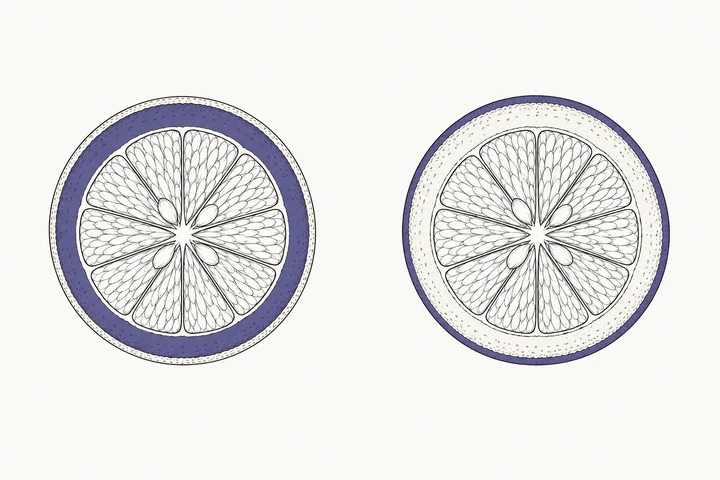
Naringin
More in the pith
Limonoids
More in the outer peel
In studies comparing the outer peel and the pith of natsumikan, naringin was higher in the pith and limonoids were higher in the outer peel. Shading shows only the order between the outer peel and the pith within each compound. The amounts of the two compounds cannot be compared across left and right. The membranes, flesh and seeds drawn in outline carry no amount information here; they do not mean little or none. The purple is not the real colour of the peel.
Source: naringin from Morohoshi 1971, limonoids from Morohoshi 1973 (in the table of conditions and results by study)
Illustration: illustration desk (PurpleHeron)
What is not known — what this comparison alone cannot separate
- How much perceived bitterness drops compared with untreated peel: most human ratings in this table compare treatments with one another, and only 1 (of jam) compared with untreated. [rows: Morishita 1986 peel bitterness ranking; Morohoshi 1971 marmalade bitterness; Lagha-Benamrouche 2018 water-debittered jam]
- The effect of the number of boils: in compounds, the pith levelled off after 2 boils and the outer peel fell further at the 3rd, but in the sources searched no study compared bitterness across numbers of boils by taste. [rows: Morishita 1986 boiling, outer peel naringin; Morishita 1986 boiling, pith naringin]
- Differences between fruits: the studies with human ratings used different fruits (banpeiyu, natsumikan, bitter orange), so whether the effect of pretreatment on perceived bitterness differs by fruit cannot be separated (one study compared compound changes for yuzu, konatsu, kumquat and navel orange in the same table). [rows: Morishita 1986 peel bitterness ranking; Morohoshi 1971 marmalade bitterness; Lagha-Benamrouche 2018 water-debittered jam; Morishita 1994 boiled, yuzu naringin]
How studies and rows were counted
The number of evidence rows is not the number of studies. Table rows, ledger evidence rows, papers and research groups are counted separately.
- Sources in the table: 5, of which 3 have results on people's bitterness ratings in this table; for the others, only results on something else (compounds, smell) are shown, or they are used only for context.
- Rows in the table (study × measured result): 13. Rows on perceived bitterness: 4.
- Evidence rows in the lab's ledger these rows rest on: 6. One paper can supply several rows. Rows without a ledger evidence row come from other tables of the same papers, or from sources newly read for this question.
- Research groups among the studies with bitterness results in this table, as grouped in the ledger: 3 (reports from the same lab count as 1; co-authors and affiliations can overlap, so this is not a count of independent replications).
What we looked at
The sources examined for this question, why each was included or excluded, and which full texts could not be reached. We searched PubMed, J-STAGE and CiNii for studies on pretreating citrus peel for marmalade (boiling, soaking, salt water, removing the pith) in relation to bitterness, naringin and limonin, and added the sources already in the lab's ledger.
| Source | Decision | Why |
|---|---|---|
| マーマレード加工における果皮の脱苦味の検討 (1986) doi | Included in the table | Measured naringin, limonin and human bitterness rankings for 3 peel treatments; read in full |
| マーマレード作製中のナリンギン量の変化について (1971) doi | Included in the table | Soaking and boiling times versus naringin, and marmalade tasting; read in full |
| マーマレード作製中のリモノイド量の変化について (1973) doi | Included in the table | Soaking, salt water and boiling versus limonoids; per the ledger's full-text record |
| Desamerization of Bitter Jam: Biochemical and Sensory Quality (2018) doi | Included in the table | The only study comparing human-rated bitterness against untreated jam; the full text was blocked this time, so this rests on the abstract and the ledger |
| Effect on the Taste and Flavor of Marmalade by Combining Citrus Fruits (1994) doi | Included in the table | Soaking and boiling yuzu peel versus naringin; read in full |
| 不溶性ナリンギナーゼによるバンペイユ果皮中のナリンギン濃度の変化 (1986) doi | Excluded | Compares enzyme treatments, not household pretreatments |
| カンサン・オレンジの皮の苦味除去(ベトナム語の論文) (2023) doi | Excluded | Uses sodium hydroxide or alum; human ratings compare treatments only (untreated and water-only peel were not tasted) |
| 高圧力を利用した柑橘マーマレードに関する研究 (2014) | Excluded | No debittering pretreatment; compares high pressure with heating |
| 高圧力を利用したレモンマーマレードの製造 (2015) doi | Excluded | Compares high pressure with heating, not pretreatments |
| ブンタン果皮煮沸液中の苦味成分の回収 (1995) doi | Excluded | Shows naringin and limonoids in the boiling water but not what remained in the peel |
| Assessment of different debittering techniques to valorize orange peel (2023) doi | Full text not reachable | Compared salt water, sodium carbonate, fermentation and sugar coating; full text subscription-only, and the abstract gives no comparison values against untreated peel |
| ナツミカン果実の凍結による苦味の増大について (1976) doi | Excluded | About the segment membrane, not the peel or pith |
Read in the encyclopedia
- Naringin — immediately bitter, abundant in peel and pith
- Limonin — turns bitter later with heating or time
- Yuzu peel / Natsumikan / Banpeiyu — fruits studied for this question
- Citrus bitterness — the topic hub on citrus bitter compounds and processing
Source ledger
Each study's source can be reached from its section above. All of the lab's sources are listed in the source ledger.
How to cite this page
Aoki, M. (NIGAMI LAB) (2026). Does boiling or soaking cut citrus peel bitterness?. https://nigamilab.com/en/topics/citrus-peel-prep/
Each claim card has a stable anchor (#clm-…). The dataset is CC BY 4.0; see the data page. Dataset DOI: 10.5281/zenodo.22739101