aromatic cocktail bitters
ingredient / ingredient-aromatic-bitters
芳香ビターズ(カクテルビターズ) / aromatic cocktail bitters (type)
Aromatic cocktail bitters: a category of highly concentrated flavoring liquids made by extracting plant materials with alcohol and added in small amounts to cocktails to impart aroma and flavor (including Angostura-type aromatic bitters and orange bitters). Individual trademarked brands are not made into entities.
Photographs (captions in Japanese)
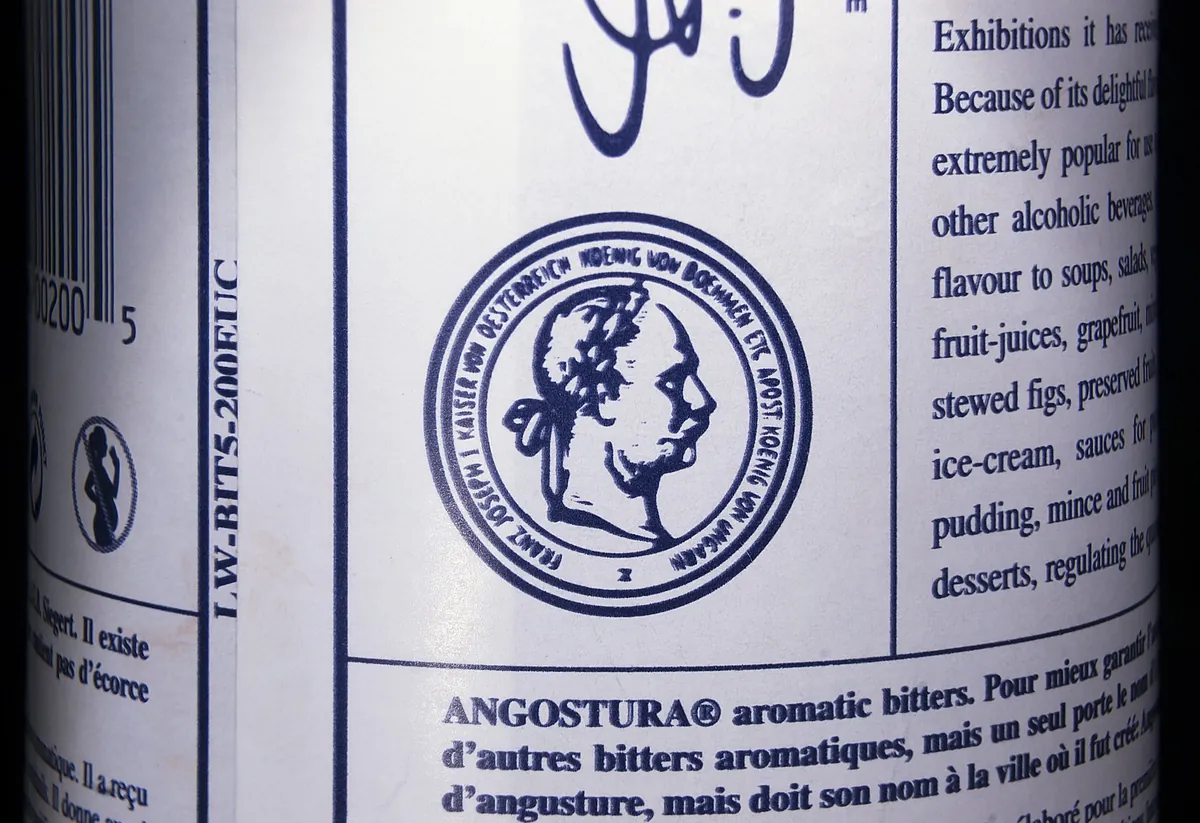
A bottle of Angostura aromatic bitters. Photographed as a real, representative commercial example of the high-concentration aromatic bitters type made by alcohol extraction of plant materials.
Shown: Not applicable (product bottle of a seasoning liquid)Part / state: Product bottle
Photo: Didier Descouens / CC BY-SA 3.0 / original image / ledger's original image
Scope and provenance of the photo
Identification: Identified as labelled in the source. Under NIGAMI LAB's naming policy the brand itself has not been made an entity, but the photograph was adopted as a representative actual example of the type.
Image shown: The full-size file from Wikimedia Commons, reduced to 2400 px on the long side with sips. No cropping or color changes by NIGAMI LAB (resizing only). For display, a WebP capped at 1200 px wide is served; the ledger's original image can be checked from the link above.
On this page (9 sections)
Reading the bitterness
Aromatic bitters (cocktail bitters) are a category of highly concentrated flavoring liquids made by extracting plant materials with alcohol and added in very small amounts to cocktails to impart aroma and flavor. They include Angostura-type aromatic bitters and orange bitters; individual trademarked brands themselves are outside this entry's scope. The reference work 『The Oxford Companion to Spirits & Cocktails』 (2021) lists gentian root, cinchona bark, and wormwood as representative bittering ingredients. A 2015 study subjected 16 commercial bitters brands to gas chromatography–mass spectrometry (GC-MS), tentatively identified 148 volatile compounds, and reported significant differences among brands in citrus, celery, and spice aroma attributes in descriptive sensory evaluation. The study did not measure bitterness intensity itself.
In its May 13, 1806 issue, The Balance, and Columbian Repository, a newspaper in Hudson, New York, answered a reader's question 『cock tailとは何か』 (in translation: "What is a cock tail?") by defining a cocktail as 『あらゆる種類の蒸留酒・砂糖・水・ビターズから成る刺激性の飲み物』 (in translation: "a stimulating drink consisting of spirits of any kind, sugar, water, and bitters") and adding that it was also colloquially called 『bittered sling』 (in translation: "bittered sling"). The source treats this 1806 account as one of the earliest definitions of cocktail, whereas the earlier examples from 1798 and 1803 only show the word in use without defining it. This finding was checked through an article reproducing a facsimile of the newspaper page; the original paper itself was not viewed directly.
Angostura's official website presents the company's account that its founder, Dr. Johann Gottlieb Benjamin Siegert, moved to Angostura (now Ciudad Bolívar), Venezuela, as surgeon general of Simón Bolívar's army, completed the formula 『アマルゴ・アロマティコ』 (in translation: "Amargo Aromatico") in the course of his military medical practice, and that production subsequently moved to Trinidad in his sons' generation. This is the company's own history, not independent verification of the historical events by a third party. In a statement for the company's 200th anniversary (2024), Trinidad and Tobago's Ministry of Trade and Industry stated that its products circulated in more than 170 countries and territories, accounted for 8% of the country's food and beverage export value during 2019–2023, and remained among its top 10 exported products.
A historical article records that when Britain tightened taxation and licensing of gin sales in the 18th century, sellers began adding herbs and selling gin as a 『医療用リキュール』 (in translation: "medicinal liqueur") to evade those rules, and that the method recurred in various countries whenever liquor was regulated. In the United States, Hostetter's Stomach Bitters, launched in Pittsburgh around 1852–1853, is treated as a representative example. Its advertisements at the time claimed medical effects for a range of ailments; this reports a historical advertising claim, not evidence that holds today. The U.S. Pure Food and Drug Act of 1906 required disclosure of alcohol and other ingredients' content, and records of subsequent government analyses judged Hamburg Stomach Bitters 『砂糖水に香味料を加えた酒に過ぎない』 (in translation: "nothing more than liquor made from sugar water with flavoring added") and Kaufmann's Sulfur Bitters' claims of medical effect 『虚偽かつ不正』 (in translation: "false and fraudulent"). By contrast, in 1997 the California State Board of Equalization found that Angostura bitters, a concentrate used in small amounts for flavoring, did not qualify as 『飲用に供しうる』 (in translation: "fit for beverage purposes") and was therefore outside the state's alcoholic beverage tax.
Sources for this overview
The Oxford Companion to Spirits and Cocktails — “bitters” entry
Checked for this overview: Confirmed the reference work identifies gentian root as a core bittering ingredient. / Confirmed the reference work identifies cinchona bark as a core bittering ingredient. / Confirmed the reference work identifies wormwood as a core bittering ingredient.
Volatile and sensory profiling of cocktail bitters
Checked for this overview: Checked the overview of GC-MS and descriptive sensory evaluation of 16 brands.
Checked for this overview: Checked the facsimile showing the 1806 newspaper's definition of cocktail.
Checked for this overview: Checked the founder's history as presented on the company's official website.
Minister Gopee-Scoon Congratulates Angostura on its bicentennial anniversary
Checked for this overview: Checked the 8% export share cited in the Trinidad and Tobago government statement.
Checked for this overview: Checked the historical account of evading taxation by selling medicinal liqueurs. / Checked the post-enactment government analysis and its finding of false labeling.
Checked for this overview: Checked the provisions of the 1906 Act requiring disclosure of ingredient content.
Re: Angostura bitters (opinion letter on Alcoholic Beverage Tax applicability)
Checked for this overview: Checked California's 1997 finding that the product was outside the scope of its alcoholic beverage tax.
Follow the connections
cocktail →is defined in that context …→ aromatic cocktail bitters
aromatic cocktail bitters →is flavoured with→ gentian root →— sensory attribute→ bitterness
aromatic cocktail bitters →is flavoured with→ Cinchona succirubra (bark extract) →— sensory attribute→ bitterness
Hypotheses and recipe candidates for this entry are on the Japanese page.
Structured claims — open a section to read each claim's confidence, evidence and limits
Composition and content (3)
Scope: Aromatic bitters for cocktails, in general.
Note: A general statement from a reference-book entry, not an analytical value showing any individual brand's formulation.
Show data
ingredient-aromatic-bitters —is_flavoured_with→ ingredient-gentian-rootScope: Aromatic bitters for cocktails, in general.
Note: A general statement from a reference-book entry, not an analytical value showing any individual brand's formulation. Because this differs in character from the existing ingredient-cinchona-extract entity (defined under Japan's existing food-additive list), it is linked via object_entity_id while keeping the two descriptions distinct.
Show data
ingredient-aromatic-bitters —is_flavoured_with→ ingredient-cinchona-extractScope: Aromatic bitters for cocktails, in general.
Note: This is a general description in a reference entry, not an analytical measurement of the composition of an individual brand.
Show data
ingredient-aromatic-bitters —is_flavoured_with→ ingredient-wormwoodSensory (1)
Scope: 16 commercially available cocktail bitters on the US market (types that are added in small amounts to cocktails as alcoholic extracts of plant materials)
Note: This study centres on aroma profiles and does not quantify bitter (taste) intensity. A primary analysis of the bittering plants in bitters (gentian and others) has not yet been checked.
Show data
ingredient-aromatic-bitters —has_characterized_volatile_and_sensory_profile_of→ (the claim sentence above)Safety and regulation (3)
Scope: California, 1997
Note: This classification is based on administrative opinions from a single state and at a single point in time, and does not generalize to other states or years.
Show data
ingredient-aromatic-bitters —is_classified_by→ (the claim sentence above)Scope: United States; enacted June 30, 1906.
Show data
ingredient-aromatic-bitters —is_subject_to_labeling_requirement_of→ (the claim sentence above)Scope: United States, from 1906 onward.
Note: [Discourse note] This is a record of the historical fact that a specific brand's labeling was ruled false; this project does not evaluate the medical effects of that brand or of any current product.
Show data
ingredient-aromatic-bitters —has_history→ (the claim sentence above)Culture (4)
Scope: Hudson, New York, United States, 5/13/1806.
Show data
concept-cocktail —is_defined_in_context_as→ ingredient-aromatic-bittersScope: Venezuela → Trinidad and Tobago
Note: [Note on attribution] This company history comes from its official website and is included as the company's own account. It has not been independently verified against third-party historical sources.
Show data
ingredient-aromatic-bitters —has_history→ (the claim sentence above)Scope: Trinidad and Tobago, 2019–2023 (statement issued in 2024).
Note: This is a reference to statistics in a government press release, not the original tabulation of trade statistics.
Show data
ingredient-aromatic-bitters —has_cultural_role_of→ (the claim sentence above)Scope: England to the United States, 18th-19th centuries.
Note: [Discourse note] The advertised claims are a record of period advertising language, and we do not assert that any such effect holds today.
Show data
ingredient-aromatic-bitters —has_history→ (the claim sentence above)