Nurungji
dish / dish-nurungji
ヌルンジ
Nurungji is the scorched rice layer formed at the pot bottom when cooking rice. In Korea it is eaten as a snack and also simmered with water and drunk as sungnyung (숭늉).
Photographs (captions in Japanese)
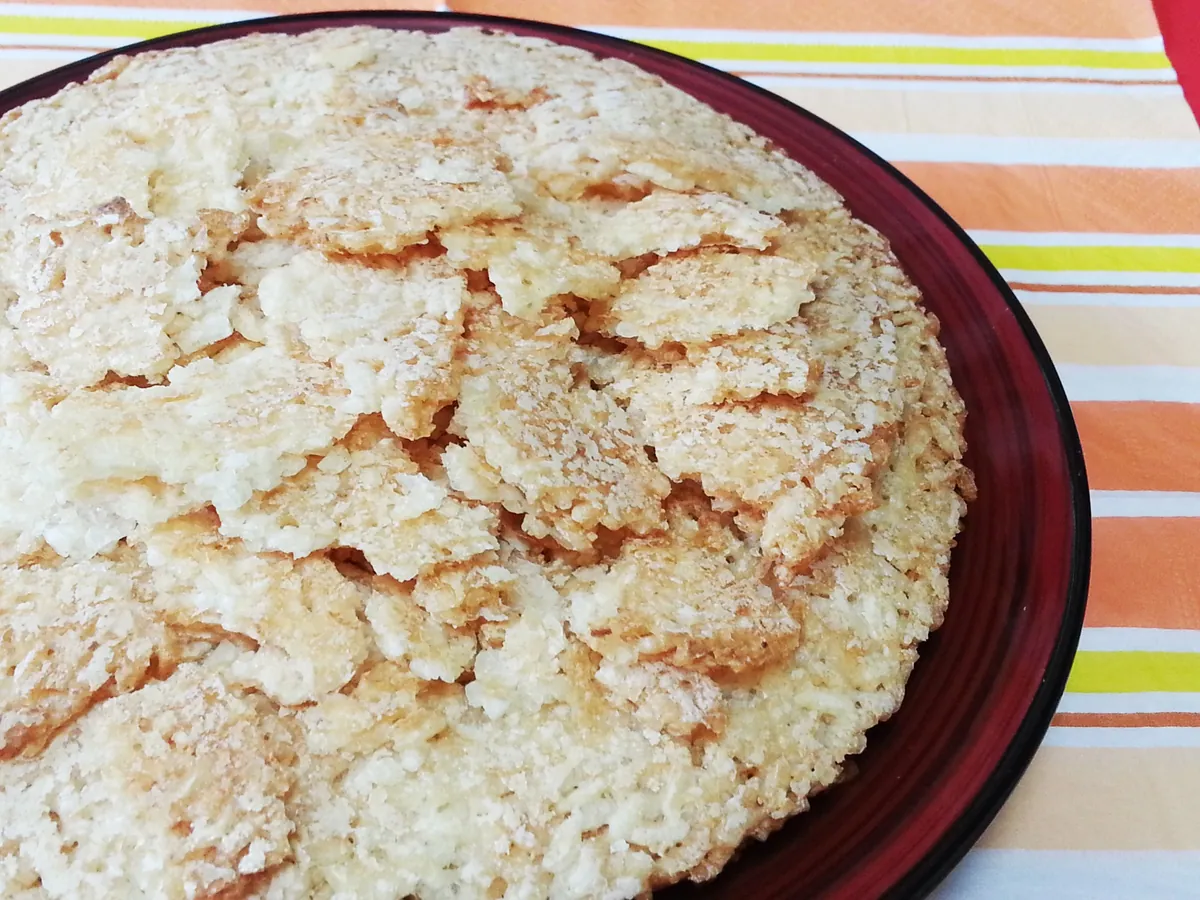
Cracked, golden disc-shaped nurungji (scorched rice) on a plate.
DishShown: No applicable taxon (dish: 누룽지 nurungji, scorched rice from the bottom of the pot)Part / state: Disc-shaped layer of scorched rice taken from the bottom of the pot (whole)
Photo: Hyeon-Jeong Suk / CC BY 2.0 / original image / ledger's original image
Scope and provenance of the photo
Identification: Identified as labelled in the source. The description is "nurungji (scorched rice)". I opened the image and confirmed that a mass of golden to dark brown rice, cracked into a disc, covers the whole plate.
Image shown: The original from Wikimedia Commons, reduced to 2400 px on the long side. No cropping or color changes. For display, a WebP capped at 1200 px wide is served; the ledger's original image can be checked from the link above.
On this page (7 sections)
Reading the bitterness
The Encyclopedia of Korean Culture (Academy of Korean Studies) describes the taste of nurungji (the scorched rice layer that forms on the pot bottom when cooking rice) as 「고소하다(香ばしい)」 (in translation: "savory") and explains that when pot-bottom temperature exceeds 200°C, amino-carbonyl (Maillard) reaction causes browning and produces volatile carbonyl compounds, which penetrate the rice to create its characteristic savory flavor. A peer-reviewed paper likewise reports that browning forms appetizing color and savory flavor in nurungji made under heating conditions of 2–14 minutes. Neither source mentions bitterness.
A consumer-acceptance test in an international peer-reviewed journal (n=104) evaluated 5 kinds of nurungji containing 0–100% barley on 9 axes: overall acceptance, appearance, aroma, taste, sweetness intensity, texture, savory-intensity, aftertaste, and purchase intention. Bitterness was not included as an evaluation axis. This is not data positively denying bitterness, but only that it was not measured; it suggests that the research team treated savory flavor rather than bitterness as a core sensory attribute of nurungji.
Sources for this overview
Checked for this overview: Used the description explaining savory flavor through the Maillard reaction as evidence.
누룽지 가열시간에 따른 품질 특성, 아크릴아마이드 함량 및 항산화 활성
Checked for this overview: Used the report on browning and flavor by heating condition as evidence for this paragraph.
Checked for this overview: Confirmed that bitterness was excluded from the evaluation axes.
Other names: 누룽지 (ko), nurungji (ko)
Structured claims — open a section to read each claim's confidence, evidence and limits
Sensory (2)
Scope: A general description of pot-bottom temperature exceeding 200°C in pot-cooked rice, not individual measurement data.
Show data
dish-nurungji —has_sensory_attribute→ (the claim sentence above)Scope: Wonkwang University (원광대학교), Korea; barley-blended 누룽지 (0/25/50/75/100%); consumer panel n=104.
Show data
dish-nurungji —has_sensory_response→ (the claim sentence above)How processing and cooking change it (1)
Scope: Laboratory-scale production and physicochemical analysis using Korean polished rice (5 heating conditions of 2–14 minutes).
Show data
dish-nurungji —is_produced_through→ (the claim sentence above)